
ABA practices get clients by running a consistent inbound lead system — intent-clustered SEO and Google Ads feeding cluster-specific landing pages — and pairing it with direct referral outreach to the pediatricians, neuropsychologists, and therapists who diagnose the kids they serve. The metric that matters isn’t leads. It’s qualified intakes: children with a diagnosis, verified benefits, and services that actually start. Below is how that system works, with the real cost ranges we see across markets.
Most ABA marketing guides will hand you the same generic best-practices checklist. This one is built on what ABA actually costs to market and the things that make it different from every other local service — payer dependency, diagnosis gatekeeping, and the staffing problem that quietly runs the whole business. It’s the same thinking behind our SEO strategies built specifically for ABA.
Why ABA marketing doesn’t work like other local marketing
If you market an ABA practice the way you’d market a plumber, you’ll waste money and frustrate families. Three things make ABA its own animal:
A lead isn’t a customer — it’s the start of a gauntlet. Before a child starts services, there’s usually a diagnosis, an insurance authorization, a benefits verification, and a service-area match. A form fill is nowhere near a booked client. That’s why the entire industry’s habit of reporting “leads” is close to meaningless — plenty of leads never become anything.
Insurance acceptance decides who converts. Whether you’re in-network with a family’s plan often matters more than your website, your reviews, or your ad copy. It’s the single biggest driver of whether a lead turns into a started client.
Staffing runs the business, not the other way around. ABA’s deepest pain point isn’t finding clients — it’s keeping clinicians utilized. Caseloads ebb and flow, and an idle BCBA or RBT is a retention risk. This one fact, as you’ll see, inverts the usual advice about “marketing to your capacity.”
Everything below is built around those three realities.
Cluster your keywords by intent, then build a page for each
ABA is a local healthcare service, so the foundation is intent-driven keyword clustering, not a scattershot list of terms. We build around a few core clusters:
- Medical / acute-intent — the diagnosis-and-urgency searches that happen before a family shops for a provider: autism evaluation near me, autism testing, how to get an ABA referral, waitlist and “accepting new patients” queries. These people are at the front of the journey and they’re gold, because you can capture them before your competitors do.
- General ABA — the broad, high-intent provider searches: ABA therapy near me, ABA therapy [city], applied behavior analysis [city].
- Types of ABA — a cluster per delivery model, because families search by the setting they need: in-home ABA, school-based ABA, and center-based ABA.
Then we build a dedicated landing page around each cluster. This does double duty, and it’s the part almost no one spells out: the same page ranks organically and serves as the high-relevance landing page for your Google Ads. When your ad about in-home ABA points to a page about in-home ABA, your Quality Score climbs, your cost-per-click drops, and your click-through rate rises. One well-built page earns on both the organic and the paid side.
What ABA marketing actually costs (real ranges across markets)
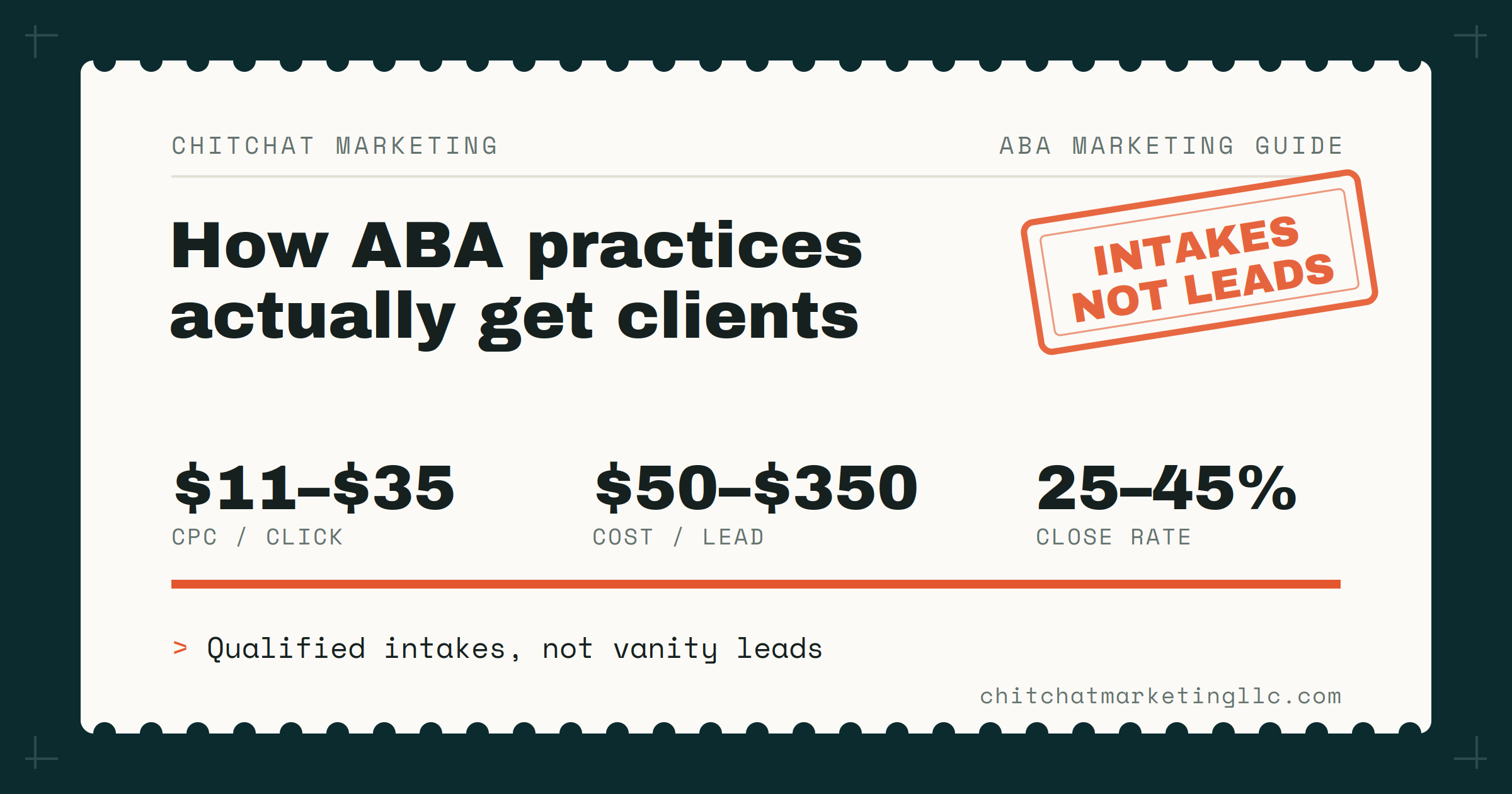
Here’s what almost no competing page will give you: actual numbers. One caveat first — ABA varies enormously by region. Coverage, competition, and Medicaid rules differ so much market-to-market that a single practice’s figures would mislead you. So these are the ranges we see across the metros we run campaigns in, not one cherry-picked account.
| Metric | Range we see | What moves it |
|---|---|---|
| Cost per click (Google Ads) | $11 – $35 | Market size and competitiveness |
| Cost per conversion (lead) | $50 – $350 | Market |
| Lead-to-client close rate | 25% – 45% | Insurance acceptance |
Now the number that matters, which we’ve never seen another agency publish: the true cost to start a client, not the cost of a lead. If your cost per conversion is $150 and you close 35% of those leads, your real cost per started client is roughly:
$150 ÷ 0.35 ≈ $430 to start one ABA client.
That’s illustrative, not a quote — plug in your own market’s numbers and the figure moves. But the discipline is the point: a practice bragging about a $50 cost per lead at a 25% close rate is actually paying $200 to start a client, and a practice at $150 per lead and a 45% close is paying $333. The cheap-looking lead isn’t always the cheaper client. If you’re only tracking cost per lead, you’re flying blind.
How to tell a qualified lead from a wasted one
Because so many ABA leads wash out, the whole system has to be built to separate the real ones from the noise — and to feed that signal back into the ads.
We run a shared spreadsheet with every client. Leads come in, the practice marks which ones were qualified (right diagnosis stage, in-network or workable coverage, inside the service area) versus unqualified, and we push that qualified-lead data back into Google Ads as offline conversions. That’s the closed loop: the algorithm stops optimizing toward form fills and starts optimizing toward the leads that actually become clients. Over time the campaign gets smarter about who it brings you.
This is the difference between an agency reporting “we got you 40 leads” and an agency reporting “we got you 14 started clients at $430 each.” Only one of those is a business metric.
The ABA rule nobody tells you: never throttle your lead flow
Here’s where standard marketing advice gets ABA exactly wrong. Most guides tell you to match your marketing to your capacity — slow down the leads when you’re full. In ABA, that’s a mistake, and understanding why is the most important thing in this entire guide.
ABA caseloads ebb and flow. Clients cancel. Authorizations lapse. Families move or age out. When that happens and you have no inbound pipeline, you don’t just have an empty slot — you have an idle clinician. And an idle BCBA or RBT is the fastest way to lose them. Staff retention is ABA’s hardest problem, and nothing erodes it like underutilization.
So we don’t throttle lead flow to match a caseload number. We keep a consistent inbound system running at all times, specifically so that the moment a client drops, there’s a new case ready to backfill the hours and keep the clinician working. The pipeline isn’t there to build a waitlist — it’s there to protect utilization and, by extension, retention.
And when leads come in faster than the current team can serve them? That’s not a problem to solve by slowing marketing down. That’s the signal to staff up. In a healthy ABA practice, sustained lead flow is what tells the owner it’s time to hire the next clinician — you grow the team toward proven demand, not on a guess.
Fill the pipeline with referrals, not just clicks
Digital brings families who are already searching. But a huge share of ABA clients arrive by referral from the providers who diagnose and treat these kids first — and that channel is almost entirely absent from every ABA marketing guide online.
The referral targets worth building relationships with:
- Pediatricians
- Neuropsychologists and diagnosticians
- Speech-language pathologists (SLPs)
- Occupational therapists (OTs)
- Behavior technicians and other ABA-adjacent providers
- Preschools and daycare centers
When it’s applicable, we run email outreach to these targets on the practice’s behalf. But the relationships that actually drive referrals are built by the practice’s own team — a phone call, a check-in, a face at the office. Marketing opens the door; the clinician relationship closes it.
The outreach that works — pre-qualify the referral before it arrives. The reason a diagnostician refers to this provider over the other three in town comes down to making the decision easy for them and easy for the family. So the outreach leads with:
- A short waitlist / “we’re accepting new patients now.” Referring providers won’t send a family to a six-month wait.
- The exact insurances you’re in-network with, listed plainly. This removes the biggest source of failed referrals.
- A quick overview of your service offerings (in-home, center-based, school-based, early intervention) so the referrer can hand the family the right information up front.
Do that, and the referral arrives pre-qualified. By the time it reaches the practice, most of the work is done — it’s just insurance verification, scheduling, and the intake session. That’s a dramatically higher-converting lead than anything a cold click produces.
Here’s a starting template for the outreach email:
Subject: Now accepting new ABA patients — [Practice Name] ([City])
Hi Dr. [Name],
I wanted to reach out on behalf of [Practice Name], an ABA therapy provider serving [City/area]. We currently have openings for new patients (short waitlist), and I thought it might be helpful for your referrals.
A few quick details to make referrals easy:
- In-network with: [Plan A, Plan B, Medicaid, etc.]
- Services: in-home, center-based, and school-based ABA; early intervention
- Ages served: [range]
If a family you’re working with needs ABA, we handle insurance verification and intake from there — you just send them our way. Happy to drop off information for your front desk or set up a quick call.
Thank you, [Name / Practice]
Keep it truthful and current — an out-of-date waitlist claim burns the relationship faster than no outreach at all.
The website and local SEO fundamentals for ABA
The clusters above need a site built to convert anxious, researching parents. The essentials:
- A clear services page detailing each program and, critically, the insurances you accept — the first thing most families check.
- Location pages for multi-site practices, each with genuinely unique content (therapists, programs, photos, directions) — never copy-paste, which Google treats as duplicate content.
- Google Business Profile optimized for every location: accurate name/address/phone, hours, real office photos, and consistent information everywhere it appears.
- Local citations in behavioral-health and healthcare directories, with NAP details identical across all of them.
- Fast, mobile-first pages with obvious click-to-call and short intake forms. Every extra step costs you a lead.
- A resource/blog section that answers the questions parents actually ask, positioning the practice as a calm, helpful authority on a sensitive topic.
This is table stakes — the part of ABA marketing that is well-covered elsewhere — so do it well and don’t over-invest your attention here. The advantage is in the clusters, the numbers, and the referral engine above.
Stay compliant: BACB ethics code and HIPAA
ABA marketing operates under rules most local businesses never think about. Two to keep front of mind (and confirm with your own compliance resource — this is guidance, not legal advice):
- BACB ethics code. Public statements and advertising must be truthful and non-misleading. Be careful with outcome claims and with soliciting testimonials from current clients, which the code restricts. Run your ad creative and landing-page claims against current BACB advertising guidance before they go live.
- HIPAA. Be deliberate about anything that could expose protected health information: retargeting pixels on sensitive pages, review-solicitation flows, and any use of a client’s information in marketing. Review requests should never reveal that someone is a patient, and testimonials require proper authorization.
Nearly every competing guide skips this entirely. Getting it right protects the practice and signals that you understand the field.
Frequently asked questions
How do ABA therapy practices get new clients?
Through a consistent inbound system — intent-clustered SEO and Google Ads pointing to cluster-specific landing pages — combined with direct referral relationships with pediatricians, neuropsychologists, SLPs, OTs, and preschools. The goal is qualified intakes (kids who actually start services), not raw leads.
How much does ABA therapy marketing cost per lead?
Across markets, cost per click runs about $11–$35 and cost per conversion about $50–$350, depending on market size and competition. But the number that matters is cost per started client — cost per lead divided by your close rate — which is often several times the lead cost.
What’s a good close rate for ABA leads?
We see 25%–45%, driven mostly by insurance acceptance. Being in-network with the plans in your area moves this number more than almost anything else.
Should I use Google Ads or SEO for my ABA practice?
Both, and they reinforce each other. The landing pages you build to rank organically double as high-relevance ad landing pages, which lifts your Quality Score and lowers your cost per click. Ads capture urgent, ready-to-book families now; SEO compounds over time.
Should I slow down marketing when my practice is full?
No — this is the ABA-specific mistake. Keep consistent lead flow running so you can immediately backfill when a client cancels, which protects clinician utilization and retention. When demand outpaces capacity, that’s your signal to hire, not to throttle marketing.
How do I market an ABA practice without violating HIPAA or the BACB code?
Keep all claims truthful and non-misleading, be cautious with current-client testimonials, secure proper authorization before using any client information, and make sure review requests and retargeting never expose protected health information. Review creative against current BACB advertising guidance.
Is marketing worth it for a small, single-BCBA practice?
Yes — arguably it matters more, because a single idle clinician is a bigger share of your capacity. A steady, modest lead flow keeps that clinician utilized and gives you the demand signal you need before hiring your second.
Ready to fill your caseload — and keep it full?
We build and run ABA marketing systems designed around what actually matters in this field: qualified intakes, insurance-aware targeting, referral pipelines, and consistent lead flow that protects your staffing. If you’re an ABA practice that wants a pipeline built around your real economics — not vanity leads — let’s talk.
See our ABA therapy SEO services → or book a call.
How this article was made: written by Thomas Guardado, founder of ChitChat Marketing LLC, based on ChitChat’s experience running SEO and Google Ads campaigns for ABA therapy practices across multiple U.S. metros. Cost ranges reflect observed cross-market performance, not a single account, and vary by region. Compliance notes are general guidance, not legal advice — confirm specifics with your own compliance resource.

Thomas Guardado is a seasoned digital marketing and SEO expert with over a decade of hands-on experience helping brands grow their online presence and dominate search results. Based in Connecticut, he specializes in organic search strategy, technical SEO, content optimization, and data-driven campaigns that turn clicks into customers.

Leave a comment