
Local SEO explained: boost visibility and drive customers
TL;DR:
- Nearly half of all Google searches have local intent, with most visitors acting within 24 hours.
- Google ranks local businesses based on relevance, distance, and prominence, with reviews and GBP optimization being vital.
- Implementing targeted local SEO strategies can yield high ROI, especially for healthcare and home service sectors.
Nearly half of all Google searches carry local intent, and 76% of nearby searchers visit a business within 24 hours. Yet most small healthcare and home service businesses treat local search as an afterthought. If you run a dental practice, HVAC company, or home cleaning service, you are sitting on one of the most cost-effective growth channels available. This article walks you through what local SEO is, how Google ranks local businesses, which strategies work best for your sector, and what kind of return you can realistically expect.
Table of Contents
- What is local SEO and why does it matter?
- How Google ranks local businesses: The three core factors
- Essential local SEO strategies for healthcare and home services
- Local SEO ROI: Evidence and benchmarks for small businesses
- Why most small businesses miss the mark with local SEO
- Elevate your local presence with proven strategies
- Frequently asked questions
Key Takeaways
| Point | Details |
|---|---|
| Local search drives customers | Most local searches result in visits and purchases within 24 hours, making local SEO essential for small businesses. |
| Google relies on relevance, distance, and prominence | Optimizing for these three factors will boost your visibility in local search results. |
| Citations and directories are vital | Getting listed accurately on industry-specific sites and maintaining consistent business info earns higher rankings. |
| ROI proves local SEO’s value | Healthcare and home service businesses benefit from measurable results, including more leads and cost savings. |
| Holistic presence beats isolated tactics | Integrating website, profile, and reviews maximizes your impact in local and AI-driven search environments. |
What is local SEO and why does it matter?
Local SEO is a branch of search engine optimization focused on local search results. In plain terms, it is the practice of making your business easy to find when someone nearby searches for what you offer. Think “urgent care clinic near me” or “plumber in Austin.” These are not generic searches. The person typing them is ready to act.
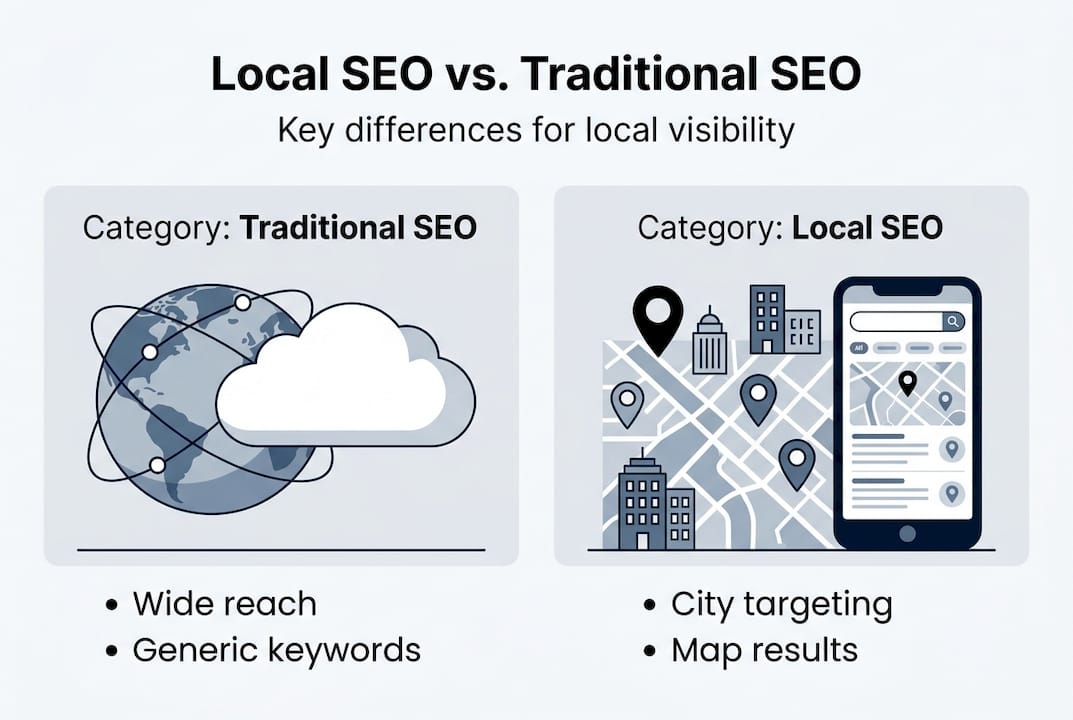
Traditional SEO targets broad, often national keywords. Local SEO narrows the focus to a city, neighborhood, or region. That shift changes everything. A national keyword like “home cleaning services” faces enormous competition. A local keyword like “home cleaning services in Tampa” is far more winnable for a small business.
Here is a snapshot of how local search behavior translates into business outcomes:
| Local search behavior | Statistic |
|---|---|
| Searches with local intent | 46% of all Google searches |
| Nearby searchers who visit within 24 hours | 76% |
| Local searches that result in a purchase | 28% |
| Mobile searches leading to store visits | Over 50% |
These numbers matter because they show that local searchers are not browsers. They are buyers. A person searching for a pediatrician or a licensed electrician in their zip code has already made a mental decision to hire someone. Your job is to be the business they find first.
For healthcare providers, this means showing up when patients search for specific conditions or services nearby. For home service businesses, it means appearing at the top when a homeowner has a leaking pipe or needs a roof inspection. The advantages of local SEO go beyond visibility. They translate directly into calls, appointments, and booked jobs.
Key insight: Local search is not about traffic volume. It is about reaching the right person at the exact moment they need your service.
Understanding the benefits of local SEO helps you prioritize where to invest your marketing dollars, especially when budgets are tight.
How Google ranks local businesses: The three core factors
Now that you understand how local SEO targets a specific intent, let’s look at how Google actually decides which businesses show up first. Google’s local algorithm uses three core factors: relevance, distance, and prominence. Each one plays a different role in determining your position in the Map Pack, which is the group of three local businesses Google highlights at the top of search results.
| Ranking factor | What it means | Estimated Map Pack weight |
|---|---|---|
| Relevance | How well your business matches the search query | ~35% |
| Distance | How close your business is to the searcher | ~33% |
| Prominence | How well-known and trusted your business appears online | ~32% |
Relevance is about your Google Business Profile (GBP), your website content, and your categories. Distance is largely outside your control, though your service area settings matter. Prominence is where you have the most leverage. It includes reviews, citations, backlinks, and overall online presence.
Here is how to address each factor practically:
- Relevance: Complete every field in your GBP. Choose the most accurate primary category and add secondary categories. Match your website content to the services you list.
- Distance: Set your service area accurately in GBP. If you serve multiple cities, create location-specific pages on your website.
- Prominence: Actively request reviews from satisfied customers. Respond to every review, positive or negative. Build citations on reputable directories.
Optimizing your Google Business Profile is the single highest-impact action most small businesses can take right now. GBP optimization accounts for roughly 32% of Map Pack ranking weight. That is significant.

Reviews are not just social proof. They are a ranking signal. Businesses with more frequent, high-quality reviews consistently outrank competitors with fewer or older reviews. Pair strong reviews with solid Google My Business SEO tips and you create a compounding advantage over time.
Essential local SEO strategies for healthcare and home services
Now, let’s translate these ranking factors into practical methods you can implement for your niche. The strategies that work for a general retail store are not always the right fit for a physical therapist or an HVAC technician. Your sector has specific directories, compliance requirements, and customer expectations.
Start with industry-specific directories. Directory recommendations for healthcare include Healthgrades and Zocdoc. For home services, Angi and HomeAdvisor are the go-to platforms. Being listed on these sites does two things: it builds trust with potential customers and it creates citations that strengthen your local rankings.
Citations are mentions of your business name, address, and phone number across the web. This combination is called NAP, which stands for Name, Address, and Phone number. Consistency is critical. If your address appears differently on Yelp than it does on your website, Google gets confused and your rankings can suffer. Understanding NAP in digital marketing is foundational to any local SEO effort.
Here are the core strategies to prioritize:
- Audit your existing citations using a tool like BrightLocal or Moz Local to find inconsistencies
- Create service-specific landing pages for each major offering, such as “teeth whitening in Phoenix” or “furnace repair in Denver”
- Develop hyper-local content that references your city, neighborhood landmarks, or community events
- Use HIPAA-compliant photos on your healthcare website and GBP to build trust without violating patient privacy
- List your business on local business directories relevant to your industry and region
Pro Tip: Fixing NAP inconsistencies across 20 or more directories can produce noticeable ranking improvements within 60 to 90 days. Start with the top five directories in your industry and work outward. Use a local SEO checklist to track your progress and avoid missing key platforms.
For home service businesses, seasonal content works especially well. A blog post about “what to check before winter HVAC maintenance in Chicago” targets a local audience at exactly the right time of year.
Local SEO ROI: Evidence and benchmarks for small businesses
It’s vital to see how these strategies deliver results for businesses similar to yours. The numbers are encouraging, and they hold up across sectors.
For home service businesses, HVAC SEO median ROI reaches 27x. That means for every dollar invested in local SEO, the typical return is $27. Paid advertising rarely comes close to that over the long term. For healthcare providers, the contrast between organic and paid is equally striking. Organic cost per lead (CPL) in healthcare averages $285, compared to $401 for paid search. That is a 29% savings per lead, and organic leads tend to convert at higher rates.
Real-world results back this up. A Miami dental practice saw 40 to 300% traffic and lead growth through targeted local SEO within 90 days. Those are not outlier numbers. They reflect what happens when a business properly aligns its GBP, website, and citations.
| Business type | Metric | Result |
|---|---|---|
| HVAC/home services | Median SEO ROI | 27x |
| Healthcare (organic) | Average cost per lead | $285 |
| Healthcare (paid search) | Average cost per lead | $401 |
| Dental practice (case study) | Traffic/lead growth | 40 to 300% |
Actionable takeaways for your business:
- Track rankings for your top 10 local keywords monthly
- Monitor GBP insights: calls, direction requests, and website clicks
- Compare your organic lead volume to paid lead volume quarterly
- Set a 90-day benchmark to measure early progress
Pro Tip: Use Google Search Console alongside your GBP insights to see which queries are driving impressions and clicks. This tells you exactly where to focus your content efforts next. The importance of local SEO becomes undeniable once you start measuring these numbers consistently.
Why most small businesses miss the mark with local SEO
Beyond the stats and strategies, there is a deeper reason why local SEO works and why many businesses never see its full benefit. Most small business owners treat local SEO as a checklist. They claim their GBP, add a few photos, and consider the job done. That approach leaves significant results on the table.
Local SEO prioritizes entity-based signals over individual page tactics. Google does not just look at your website in isolation. It looks at your GBP, your reviews, your citations, your social presence, and how all of these signals align to form a coherent picture of your business. When these elements work together, your visibility in Maps, organic results, and AI-generated answers improves dramatically.
The businesses that win at local SEO are the ones that treat it as an ongoing presence, not a one-time setup. They respond to reviews every week. These businesses update their GBP with new photos and posts. They publish local content consistently. They build citations gradually over time.
This integrated approach is what separates a business that ranks on page one from one that never breaks into the Map Pack. Use a local SEO checklist to build this habit into your monthly routine. Think of it less as optimization and more as reputation management at scale.
Elevate your local presence with proven strategies
If you are ready to move from understanding local SEO to actually implementing it, the right foundation makes all the difference. A well-built website designed with search in mind is where everything starts.
At Chitchat Marketing, we help healthcare and home service businesses build that foundation through SEO web design that is built to rank and convert. From technical structure to local content strategy, we handle the details so you can focus on running your business. Explore our SEO optimization tips to get a head start, or reach out to learn how we can build a local SEO strategy tailored to your market and your goals.
Frequently asked questions
What is local SEO and how is it different from traditional SEO?
Local SEO optimizes your online presence to appear for city- or region-specific searches, while traditional SEO targets broader, non-location-based keywords. It is focused on local results that drive nearby customers to take immediate action.
How do I improve my Google Business Profile for local SEO?
Complete your profile with accurate categories, photos, and business hours, then encourage customers to leave reviews and post regular updates. GBP optimization accounts for roughly 32% of your Map Pack ranking weight, so it is worth consistent attention.
Can local SEO actually bring more customers to my business?
Yes. 76% of nearby searchers visit a business within 24 hours of searching, and 28% of those searches result in a purchase, making local SEO one of the highest-converting channels available.
What are the best local SEO strategies for healthcare and home service businesses?
Use industry-specific directories like Healthgrades and Angi, ensure NAP consistency across all platforms, create service-specific landing pages, and use compliant photos to build trust and improve local rankings.
How can I measure the ROI from local SEO investments?
Track organic traffic, leads, and conversions monthly. Home services businesses typically see a median SEO ROI of 27x, and healthcare businesses save an average of $116 per lead compared to paid search.
Recommended
- Key Advantages of Local SEO Services That Help Your Business Grow – ChitChat Marketing LLC
- Local SEO Packages That Drive Leads for Small Businesses – ChitChat Marketing LLC
- SEO Optimization Tips That Drive Real Business Growth – ChitChat Marketing LLC
- Local SEO: What It Is, How It Works & How to Do It – ChitChat Marketing LLC