
TL;DR:
- Conducting regular SEO audits significantly increases website traffic and lead generation.
- A comprehensive SEO audit covers technical, on-page, content, off-page, and user experience factors.
- Acting promptly on audit findings can deliver measurable improvements in traffic, conversions, and ROI.
An SEO audit can feel like an optional task you keep pushing to next quarter. But businesses that treat audits as a priority are seeing 500-700% traffic increases after acting on the findings. So what exactly is an SEO audit, and why should it be on your radar right now? Simply put, it is a structured review of your website’s ability to rank in search engines and convert visitors into leads. This guide breaks down what an audit covers, what results you can realistically expect, and how to build audits into your ongoing growth strategy.
Table of Contents
- What is an SEO audit and why does it matter?
- Essential components of a comprehensive SEO audit
- How SEO audits deliver measurable results
- When and how often should you perform an SEO audit?
- Why most businesses undervalue SEO audits (and what to do differently)
- Supercharge your growth with expert SEO audits
- Frequently asked questions
Key Takeaways
| Point | Details |
|---|---|
| SEO audits reveal growth blockers | An SEO audit uncovers technical and content issues that limit your website’s performance and lead generation. |
| Results are proven and dramatic | Businesses see massive gains in traffic, leads, and ROI after implementing audit findings backed by real-world data. |
| Audits should be routine | Scheduling regular SEO audits keeps your site competitive, proactive, and ready to capitalize on changing search trends. |
| Small businesses especially benefit | Even small or local websites can unlock fast improvements and cost-effective growth with consistent SEO audits. |
What is an SEO audit and why does it matter?
An SEO audit is a systematic evaluation of your website’s performance in search engines. It looks at everything from technical infrastructure and page content to backlink profiles and user experience. The goal is to identify what is holding your site back and what opportunities you are missing. Think of it as a health check for your online presence.
Many business owners assume audits are only relevant for large enterprises with massive websites. That is a costly misconception. Whether you run a local service business or a growing e-commerce store, your website has gaps that are quietly costing you traffic and leads. A detailed SEO audit guide can help you understand exactly where those gaps are and how to close them.
Here is why businesses benefit immediately from an audit:
- Uncover hidden technical errors that prevent search engines from indexing your pages correctly
- Identify content gaps where competitors are ranking and you are not
- Benchmark your current performance so you have a clear baseline to measure future growth
- Spot missed keyword opportunities that align with how your customers actually search
- Improve user engagement by finding pages with high bounce rates and low conversion rates
The results speak for themselves. Businesses that act on audit findings have reported 165% increases in organic leads, along with 127% traffic growth and 68% conversion improvements in the same period.
“Post-audit case studies consistently show 347% ROI, reinforcing that SEO audits are one of the highest-return investments a business can make in its digital presence.”
And this is not just for companies with big budgets. SEO for small business works precisely because audits level the playing field. You do not need to outspend competitors. You need to out-optimize them.
Essential components of a comprehensive SEO audit
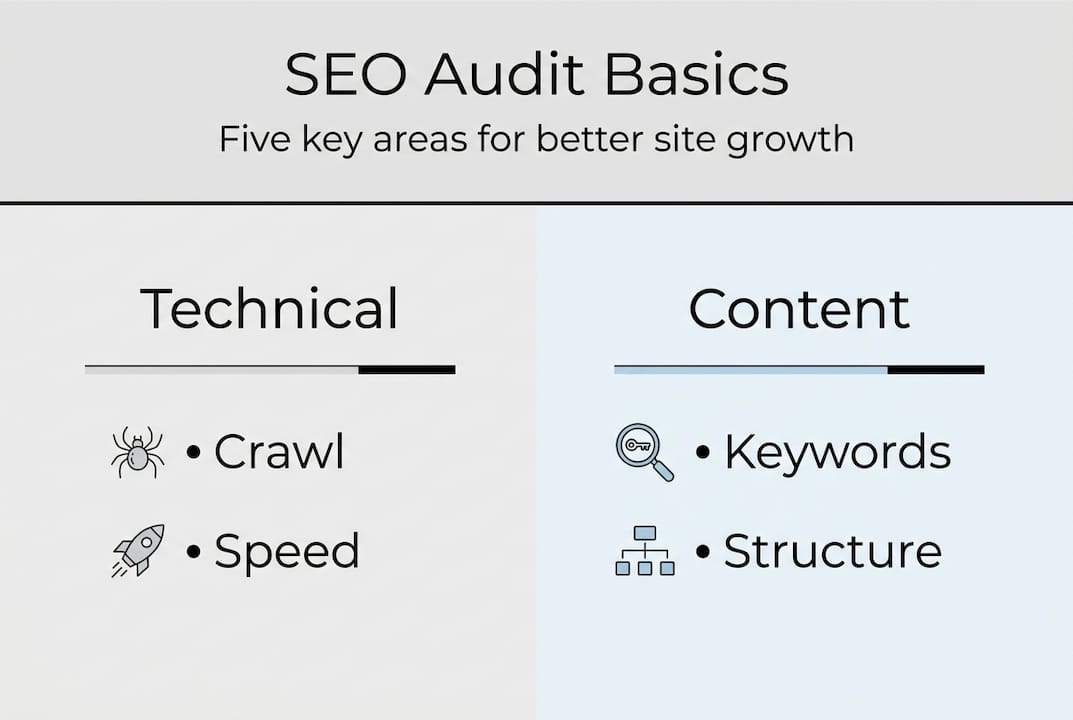
Not all audits are created equal. A surface-level review might catch a few broken links, but a thorough audit goes much deeper. Here are the five core categories every strong audit should cover, in the order they are typically analyzed:
- Technical SEO — Site speed, crawlability, indexation, mobile responsiveness, and HTTPS security
- On-page SEO — Title tags, meta descriptions, header structure, keyword placement, and internal linking
- Content quality — Thin content, duplicate content, outdated pages, and topical authority gaps
- Off-page SEO — Backlink profile, domain authority, toxic links, and citation consistency
- User experience (UX) — Navigation structure, Core Web Vitals, landing page performance, and conversion paths
Here is a quick comparison of what each component checks for and who benefits most:
| Audit component | What it checks | Who benefits most | Common missed issues |
|---|---|---|---|
| Technical SEO | Crawl errors, site speed, indexation | All businesses | Duplicate URLs, broken redirects |
| On-page SEO | Title tags, headers, keyword use | Content-heavy sites | Missing meta descriptions, keyword stuffing |
| Content quality | Thin pages, duplicate content | Blogs, service pages | Outdated content, cannibalization |
| Off-page SEO | Backlinks, domain authority | Competitive industries | Toxic links, unlinked brand mentions |
| User experience | Bounce rate, Core Web Vitals | E-commerce, lead gen | Poor mobile UX, slow load times |
Using the right best SEO tools for each category makes a significant difference in what you find. Free tools like Google Search Console cover the basics, while paid platforms like SEMrush and Ahrefs give you competitive data and deeper technical insights.
Pro Tip: Always start with technical SEO before touching content or keywords. If search engines cannot properly crawl and index your site, no amount of great content will move the needle. Fix the foundation first, then build on it.
Once you have identified issues across all five areas, you can prioritize fixes based on impact. Resources on improving website SEO can help you sequence your action plan effectively so you tackle high-value changes first.
How SEO audits deliver measurable results
The real question every business owner asks is simple: will this actually move the needle? The data says yes, consistently. Businesses that complete a thorough audit and implement the recommendations see measurable improvements across traffic, leads, and revenue.

Here is what typical before-and-after outcomes look like based on reported case study data:
| Metric | Before audit | After audit | Typical improvement |
|---|---|---|---|
| Organic traffic | Flat or declining | Steady growth | 127% to 700% increase |
| Organic leads | Inconsistent | Predictable pipeline | Up to 165% increase |
| Conversion rate | Below industry average | Improved UX and CTAs | Up to 68% increase |
| Return on investment | Unclear | Measurable and tracked | Up to 347% ROI |
These numbers come from real-world post-audit results, not projections. The pattern is consistent: identify the root cause of underperformance, fix it systematically, and the metrics follow.
Here are the most common measurable improvements businesses see after an audit:
- Faster page load times that reduce bounce rate and improve user engagement
- Better keyword rankings that bring in more qualified, high-intent traffic
- Cleaner site architecture that makes it easier for both users and search engines to navigate
- Stronger backlink profiles that signal authority and push rankings higher
- More optimized landing pages that turn visitors into leads at a higher rate
One critical insight from recent SEO case studies is that audits are not a one-time event. Businesses that run recurring audits compound their gains over time. Each round of fixes raises the baseline, and the next audit finds even more refined opportunities. You can also track your progress by learning how to improve SEO score consistently between audits.
The bottom line is that an audit without action is just a report. The value is in the implementation, and the businesses seeing 347% ROI are the ones that treat audit findings as a priority action list, not a suggestion.
When and how often should you perform an SEO audit?
Frequency matters as much as thoroughness. Running one audit and calling it done is like checking your finances once and never looking again. Here is how often you should audit based on your business size and website scale:
- Small businesses with under 50 pages: Full audit every 6 months, basic technical check quarterly
- Mid-size businesses with 50 to 200 pages: Full audit every quarter, monthly monitoring of key metrics
- Large businesses or e-commerce with 200+ pages: Full audit every 1 to 2 months, continuous automated monitoring
Beyond regular scheduling, certain events should trigger an immediate audit:
- Website redesign or migration — New site structures often break existing SEO signals
- Significant ranking drop — A sudden loss in traffic signals a technical issue or algorithm impact
- New competitor entering your market — Understand where they are outranking you and why
- Content strategy overhaul — Ensure new content aligns with technical and keyword foundations
- Google algorithm update — Major updates can shift rankings and require a fresh assessment
Here is a practical checklist for what to review on a regular basis between full audits:
- Check Google Search Console for crawl errors and manual actions
- Review top-performing pages for traffic drops or ranking changes
- Confirm that new pages are being indexed correctly
- Monitor Core Web Vitals scores for any performance regressions
- Review backlink profile for new toxic links
Pro Tip: Put your next audit on the calendar right now, before you finish reading this article. Businesses that schedule audits in advance are far more likely to act on findings consistently. If you are weighing whether to invest in ongoing SEO or paid search, understanding SEO or Google Ads can help you decide the right mix. For businesses that need expert support without a large budget, affordable SEO services make recurring audits accessible at any stage of growth.
Why most businesses undervalue SEO audits (and what to do differently)
Here is an uncomfortable truth: most businesses only run an SEO audit after something goes wrong. Rankings drop, leads dry up, or a site redesign creates chaos. Then the audit becomes a fire drill instead of a growth tool.
The companies pulling ahead in competitive markets treat audits the way smart businesses treat financial reviews. You do not wait for a cash flow crisis to look at your books. You check regularly, spot trends early, and make adjustments before problems compound. The same logic applies to your website.
We have seen this pattern repeatedly. Businesses that schedule quarterly audits do not just recover faster from algorithm changes. They rarely get hit as hard in the first place because they are already addressing vulnerabilities. The local SEO benefits of this proactive approach are especially strong for service-area businesses competing in tight geographic markets.
The shift is simple but powerful. Stop thinking of audits as a reaction to problems. Start treating them as a competitive intelligence tool that keeps you one step ahead.
Supercharge your growth with expert SEO audits
Understanding what an SEO audit covers is the first step. Turning those insights into real traffic and lead growth is where expert guidance makes the difference. At ChitChat Marketing LLC, we specialize in ROI-focused SEO audits that go beyond surface-level fixes and identify the changes that actually move your business forward.
Whether you need a full technical review, a content gap analysis, or a complete SEO web design overhaul, our team delivers clear, actionable findings you can implement right away. Explore our SEO optimization tips to get started, or reach out to book a professional audit and see exactly where your biggest growth opportunities are hiding.
Frequently asked questions
How long does a typical SEO audit take?
A thorough SEO audit usually takes one to two weeks, depending on your website’s size and complexity. Larger sites with hundreds of pages or complex technical setups may require additional time for a complete review.
Can I do an SEO audit myself or should I hire a professional?
Basic audits can be done with online tools, but expert-led audits offer deeper insights and a higher return on investment. Professionals identify issues that automated tools often miss, particularly around content strategy and competitive positioning. Businesses acting on professional audit findings consistently report stronger results than those relying solely on DIY tools.
What tools are best for running an SEO audit?
Common tools include Google Search Console, SEMrush, Ahrefs, and Screaming Frog for technical and content audits. Each tool has strengths, so using a combination gives you the most complete picture of your site’s health.
Will an SEO audit guarantee more leads and sales?
An audit identifies improvement opportunities, and measurable increases in leads and sales depend on acting on the findings. Businesses that implement audit recommendations have reported up to 347% ROI, but results require consistent execution, not just a completed report.
Recommended
- What is an SEO Audit? Complete Guide to Improving Website Performance – ChitChat Marketing LLC
- Technical SEO Checklist for Small Business Websites – ChitChat Marketing LLC
- 10 Proven Steps on How to Improve SEO for Website – ChitChat Marketing LLC
- How to Improve SEO Score: Practical Steps That Work – ChitChat Marketing LLC