
TL;DR:
- A strong online presence with a website, Google profile, and reviews is essential before marketing.
- Local SEO and Google Ads are key strategies to increase new patient visibility and appointments.
- Tracking and optimizing call and form leads help improve marketing ROI and practice growth.
Getting new patients through the door is one of the toughest challenges dental practices face today. The market is crowded, patient expectations are high, and most people start their search for a dentist online. If your practice isn’t showing up in those searches, you’re losing appointments to competitors down the street. This guide gives you a clear, actionable plan built around two proven digital tools: SEO (search engine optimization) and Google Ads. Whether you’re starting from scratch or looking to sharpen what you already have, each step here is designed to build real visibility and bring in more qualified new patients.
Table of Contents
- What you need to start: Dental marketing essentials
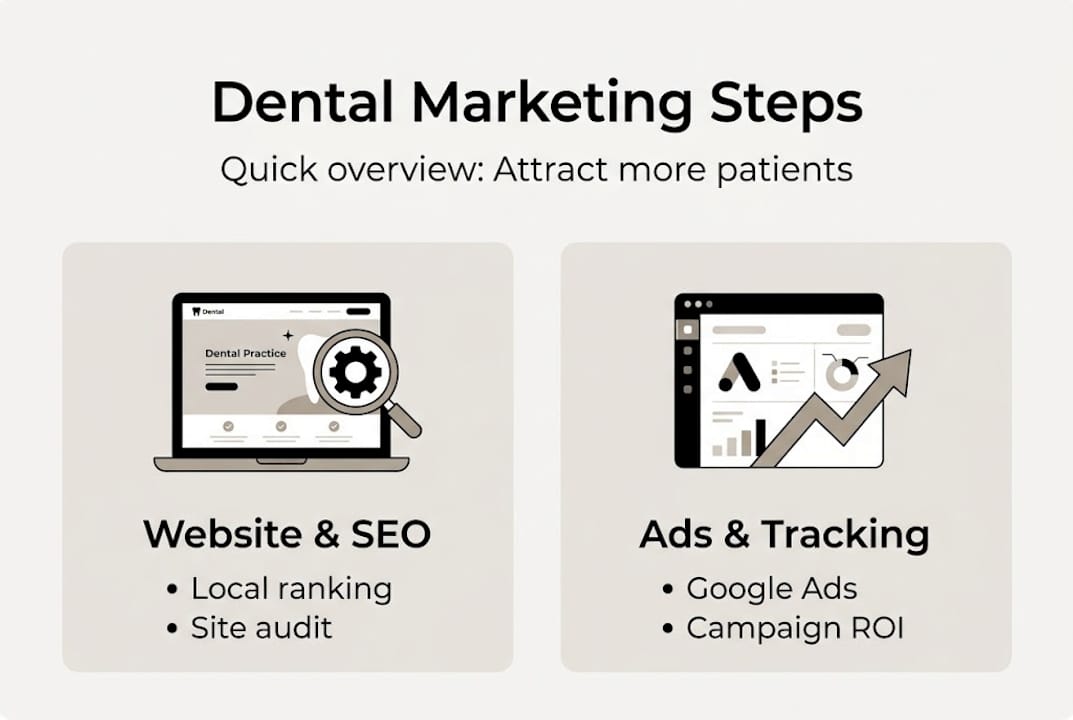
- Step 1: Optimize your dental website for local SEO
- Step 2: Set up and run effective Google Ads campaigns
- Step 3: Track, analyze, and optimize your dental marketing efforts
- Our perspective: Where most dental marketing guides go wrong
- Ready to grow? Get expert help with your dental marketing
- Frequently asked questions
Key Takeaways
| Point | Details |
|---|---|
| Start with essentials | Before any campaign, ensure your dental practice has the right digital assets and tracking in place. |
| Focus on local SEO | Optimizing for local search brings in patients already looking for a dentist near them. |
| Leverage Google Ads | Running targeted ads can immediately increase patient appointments. |
| Measure and improve | Regularly track your results, optimize campaigns, and prioritize cost per patient acquisition for the best ROI. |
What you need to start: Dental marketing essentials
Before you spend a single dollar on ads or SEO, you need the right foundation in place. Think of it like preparing a treatment room before seeing a patient. Skipping the setup leads to wasted effort and poor results. A strong online presence is critical for attracting new dental patients, and that presence starts with a few core assets.
Here’s what every dental practice needs before launching any marketing campaign:
- A professional website that loads fast, works on mobile, and clearly lists your services, location, and contact info
- A verified Google Business Profile with accurate hours, photos, and patient reviews
- Active social media accounts on at least Facebook and Instagram
- Consistent branding including your logo, colors, and messaging across all platforms
- Google Analytics installed on your website to track visitor behavior and conversions
- Call tracking software so you know which marketing channels are driving phone calls
| Asset | Who sets it up | Priority |
|---|---|---|
| Website | Marketing partner or web designer | High |
| Google Business Profile | Practice owner or office manager | High |
| Google Analytics | Marketing partner | High |
| Social media accounts | Office staff or marketing partner | Medium |
| Call tracking | Marketing partner | Medium |
Setting up Google Analytics is straightforward. Create a free account at analytics.google.com, add your tracking code to your website, and configure goals for form submissions and phone call clicks. This gives you real data on what’s working from day one.
Pro Tip: Before spending anything on dental SEO services or paid ads, run a basic website audit. Check your page speed, mobile usability, and whether your contact information is easy to find. Fixing these issues first makes every marketing dollar go further.
If you’re unsure where to start, reviewing dental marketing stats can help you understand what benchmarks to aim for as you build your baseline.
Step 1: Optimize your dental website for local SEO
With your essential assets in order, it’s time for the foundational first move: local SEO optimization. Local SEO for dentists is crucial for showing up in “near me” searches and maps, which is exactly where patients look when they need a dentist fast.
Here’s a step-by-step approach to local SEO for your practice:
- Keyword research: Identify terms your patients actually search, like “family dentist in [your city]” or “teeth whitening near me.” Use free tools like Google Keyword Planner to find high-value phrases.
- Optimize your location pages: Each page on your site should include your city name, neighborhood, and services naturally within the content and page titles.
- Build local citations: List your practice consistently on directories like Yelp, Healthgrades, and Zocdoc. Your name, address, and phone number must match exactly across all listings.
- Collect and respond to reviews: Ask satisfied patients to leave Google reviews. Responding to every review, positive or negative, signals engagement to search engines.
- Add schema markup: This is structured data code that helps Google understand your business type, location, and services. Most website platforms support it through plugins.
- Ensure mobile-friendliness: Over 60% of local searches happen on mobile devices. Your site must load in under three seconds and be easy to navigate on a small screen.
| On-page SEO actions | Off-page SEO actions |
|---|---|
| Optimize title tags and meta descriptions | Build local directory citations |
| Add location-specific content | Earn backlinks from local health sites |
| Use schema markup for dental services | Manage and respond to Google reviews |
| Improve page speed and mobile usability | Maintain consistent NAP (name, address, phone) |
Measuring local dentist search ranking success means tracking organic website visits, your position for searches like “dentist near me,” and the number of calls generated from your Google Business Profile. These numbers tell you whether your SEO efforts are translating into real patient interest.
Pro Tip: Update your Google Business Profile at least once a week. Post a photo, share a tip, or announce a promotion. Consistent activity keeps your profile fresh and signals to Google that your practice is active and relevant.
Consistent local SEO work builds dental SEO appointment growth over time, compounding month after month as your rankings improve.
Step 2: Set up and run effective Google Ads campaigns
Once your website is ready for visitors, the next power move is launching paid campaigns to accelerate new patient flow. Google Ads provide immediate local visibility for dental practices targeting new patient appointments, making them one of the fastest ways to fill your schedule.
Here’s how to set up your first dental Google Ads campaign:
- Create your Google Ads account: Go to ads.google.com and set up a new account linked to your Google Business Profile.
- Structure your campaigns by service: Create separate campaigns for high-value services like implants, Invisalign, and general checkups. This keeps your targeting and budgets focused.
- Write strong ad copy: Lead with a patient benefit, include your location, and always add a clear call to action like “Book your appointment today.”
- Target locally: Use radius targeting around your practice. For most dental offices, a five to ten mile radius works well.
- Set a realistic budget: Start with $500 to $1,000 per month and adjust based on results. Dental keywords are competitive, so underfunding a campaign leads to poor data.
Key metrics to track once your campaigns are live:
- Click-through rate (CTR): Are people clicking your ads?
- Conversion rate: Are clicks turning into appointment requests or calls?
- Cost per lead: How much does each inquiry cost you?
- Cost per new patient: The ultimate measure of campaign efficiency
- Call lead volume: Total phone calls driven directly by ads
Pro Tip: Add call extensions to every ad group. This puts your phone number directly in the search results, making it easy for patients to call you without even visiting your website. Call extensions consistently increase direct call volume.
Understanding using Google Ads for dental growth versus SEO is important. Ads deliver results within days but stop the moment you pause spending. SEO takes months but builds lasting visibility. Reviewing the SEO vs Google Ads tradeoffs helps you allocate budget wisely across both channels.

The most common mistakes dental practices make with Google Ads include sending ad traffic to the homepage instead of a dedicated landing page, targeting too broad a geographic area, and not reviewing performance weekly to cut wasted spend.
Step 3: Track, analyze, and optimize your dental marketing efforts
Turning on your marketing machine is only the beginning. Now you must track and tune for results. Tracking calls and web forms is crucial for proving marketing ROI in dental practices, and it’s the step most practices skip entirely.
Start by setting up these two tracking systems:
- Call tracking: Use a service like CallRail to assign unique phone numbers to each marketing channel. This tells you whether a call came from Google Ads, organic search, or your Google Business Profile.
- Form conversion tracking: Set up goals in Google Analytics for every form submission on your website. This shows you which pages and traffic sources are generating appointment requests.
Key performance indicators (KPIs) to review monthly:
- New patient calls generated by channel
- Website conversion rate (visitors who become leads)
- Organic ranking improvements for target keywords
- Google Ads cost per lead and cost per new patient
- Google Business Profile views and call clicks
| Marketing channel | Benchmark result | Review frequency |
|---|---|---|
| Local SEO | 3-6 months to rank, 10-20% traffic growth | Monthly |
| Google Ads | Leads within 1-2 weeks, $40-$100 per patient | Weekly |
| Google Business Profile | 5-15% monthly increase in views | Monthly |
| Review generation | 2-4 new reviews per month minimum | Monthly |
The single most important metric for dental marketing growth is your cost per patient acquisition. If you know what it costs to bring in each new patient, you can make confident decisions about where to invest and where to cut.
Reviewing your SEO optimization tips regularly helps you spot opportunities to improve rankings and reduce your cost per lead over time. Set a monthly review meeting to go through your numbers, identify what’s working, and make one or two focused adjustments. Small, consistent improvements outperform big one-time overhauls every time.
Our perspective: Where most dental marketing guides go wrong
You now have the full blueprint, but here’s the reality most step-by-step guides won’t tell you.
The biggest failure we see in dental marketing isn’t a bad ad or a poorly optimized website. It’s unanswered phones. You can spend thousands on dental SEO strategy and Google Ads, but if a new patient calls and no one answers, that lead is gone. Staff training on how to handle new patient calls is just as important as the campaigns themselves.
We also see practices constantly chasing the newest marketing tactic, whether it’s TikTok, AI chatbots, or the latest ad format, while neglecting the basics. Mastering local SEO, maintaining your Google Business Profile, and running clean, well-targeted Google Ads campaigns will outperform any shiny new tactic for years to come.
Small, weekly actions beat big quarterly overhauls. Update a page, respond to reviews, tweak an ad headline. These habits build momentum.
Pro Tip: Ask every new patient how they found your practice. The answers often reveal marketing channels you didn’t realize were working, and gaps you didn’t know existed.
Ready to grow? Get expert help with your dental marketing
Implementing all of these steps takes time, consistency, and a clear strategy. If you’re ready to accelerate your results, working with a team that specializes in dental marketing removes the guesswork and gets you to growth faster.

At ChitChat Marketing, we offer done-for-you SEO web design, Google Ads management, and ongoing campaign optimization built specifically to help practices attract more qualified patients. Whether you need a complete digital strategy or just want to sharpen your existing efforts, our SEO optimization tips and managed services give you a clear path forward. Reach out today and let’s build a marketing plan that fills your appointment book.
Frequently asked questions
How long does it take to see results from dental SEO?
Most dental practices see noticeable improvements in online ranking and patient inquiries within 3-6 months of consistent local SEO work. Results compound over time as your authority and rankings grow.
What’s the average cost of Google Ads for dentists per new patient?
The cost per new patient via Google Ads typically ranges from $40 to $100, depending on your market’s competition level and how well your campaigns are structured and optimized.
Do I need both SEO and Google Ads for my dental practice?
Combining SEO and Google Ads delivers the best flow of new patients for most dental offices. SEO builds long-term visibility while Google Ads creates immediate opportunities to fill your schedule.
What is the single most important dental marketing metric?
Tracking your cost per patient acquisition is the most critical metric for dental marketing ROI. It tells you exactly how efficient your marketing spend is and where to invest more.