
TL;DR:
- A digital marketing strategist designs cohesive, multi-channel plans aligned with business goals.
- Paid search should be prioritized first to generate fast leads and data for organic growth.
- Consistent KPI tracking and regular reviews are essential to optimize ROI and avoid misaligned efforts.
Most marketing managers assume a digital marketing strategist is someone who runs Google Ads or schedules social media posts. That assumption costs businesses real money. A strategist is the architect behind your entire online growth system, connecting paid search, organic content, referrals, and analytics into one cohesive plan. For ABA therapy clinics, home service companies, and dental practices, this distinction is especially important. Your buyer journeys are local, trust-driven, and competitive. A tactician executes tasks. A strategist builds the system that makes every tactic work harder. This article breaks down exactly what a digital marketing strategist does, which strategies move the needle in your industry, and how to measure whether your investment is paying off.
Table of Contents
- What is a digital marketing strategist?
- Core strategies for service businesses: What works and why
- How digital marketing strategists measure and optimize ROI
- Common pitfalls and how to avoid them
- Our perspective: Digital marketing strategy is not one-size-fits-all
- Take your digital marketing strategy further with expert support
- Frequently asked questions
Key Takeaways
| Point | Details |
|---|---|
| Strategist role clarified | A strategist designs, coordinates, and optimizes marketing across channels for business growth. |
| Service sector best practices | Home service, ABA, and dental markets thrive using sequenced paid, organic, and referral strategies. |
| ROI tracking essentials | KPIs like cost per lead and conversion rates show how well your strategy is working. |
| Avoid common mistakes | Align strategy to business goals, focus efforts, and formalize referrals to maximize results. |
| Tailored solutions matter | Every business needs a strategy customized for its market—copy-paste playbooks fall short. |
What is a digital marketing strategist?
A digital marketing strategist is not just someone who knows how to run ads or write blog posts. The role is closer to a business consultant who specializes in online channels. Their job is to look at your goals, your market, your competitors, and your current performance, then design a plan that connects all the moving parts.
A digital marketing strategy built by a skilled strategist includes market research, channel selection, campaign architecture, and analytics oversight. According to the planning framework we use, a successful strategist crafts, coordinates, and optimizes multi-channel campaigns, adapting to each business’s unique goals. That means the strategy for a dental practice looks very different from the one built for an ABA therapy clinic or a plumbing company.
Here is what a strategist typically owns:
- Market and competitor research: Understanding who your audience is, what they search for, and where your competitors are winning
- Channel planning: Deciding which platforms deserve your budget and attention (Google Ads, SEO, social, referrals)
- Campaign design: Building the structure of each campaign so messaging, targeting, and landing pages align
- Analytics oversight: Setting up tracking so you know what is working and what is not
- Ongoing optimization: Reviewing performance data and adjusting the plan regularly
The key distinction between a tactician and a strategist is alignment. A tactician asks, “How do I run this ad?” A strategist asks, “Does this ad support our 90-day lead generation goal, and is it talking to the right audience at the right stage of their decision?”
For ABA therapy practices, that might mean building awareness campaigns targeting parents of newly diagnosed children. For home service companies, it might mean capturing emergency-intent searches with Google Ads while building organic authority over time. For dental practices, it often means combining local SEO with reputation management to win new patients in a specific zip code.
Pro Tip: When hiring or working with a strategist, ask them to show you how their plan connects to your specific revenue goals. If they can not explain that link clearly, the strategy will not deliver consistent results.
Core strategies for service businesses: What works and why
Now that you understand what a strategist does, the next question is which strategies actually produce results for ABA therapy, home service, and dental companies. Not all channels work equally well across industries, and sequencing matters more than most people realize.
One of the most important lessons from working with local service businesses is that paid campaigns should come first. Sequencing paid campaigns first, then ramping up organic and referral efforts, brings the highest ROI for home service companies. The reason is simple: paid channels generate leads quickly, giving you cash flow and data while your organic presence builds over time.
Here is how the channel mix compares across the three industries:
| Industry | Primary channel | Secondary channel | Key differentiator |
|---|---|---|---|
| ABA therapy | Google Ads + SEO | Parent community outreach | Trust-building content |
| Home services | Google Ads (local) | Referral programs | Geographic targeting |
| Dental | Local SEO + Google Ads | Review management | Appointment urgency |
For ABA marketing strategies, the buyer journey is longer and more emotional. Parents are researching extensively before making contact. Content that answers specific questions about therapy approaches, insurance coverage, and waitlists converts better than generic brand awareness ads.
For home services, geographic targeting is everything. A plumber in Austin does not need national visibility. They need to dominate a 15-mile radius. Home service SEO strategies built around city and neighborhood-level keywords, combined with Google Business Profile optimization, produce the most consistent lead flow.

For dental practices, urgency plays a big role. People searching for emergency dental care or same-day appointments are ready to book. Capturing that intent with fast-loading landing pages and clear calls to action is where the conversion happens.
Essential channels every service business should consider:
- Search engine optimization (SEO): Long-term organic visibility that compounds over time
- Pay-per-click advertising (PPC): Immediate lead generation with full budget control
- Google Business Profile: Critical for local search and map pack rankings
- Referral programs: Formalized referral systems consistently deliver the highest-quality leads
- Content marketing: Builds trust and answers questions before prospects ever contact you
How digital marketing strategists measure and optimize ROI
With strategies in place, the critical question becomes: how do you know what is working? This is where many service businesses fall short. They run campaigns, see some leads come in, but have no clear picture of which channel drove those leads or what each one cost.
Data-driven marketers use KPIs like cost per lead, conversion rate, and customer lifetime value to optimize strategy. These numbers tell you far more than impressions or clicks ever will.
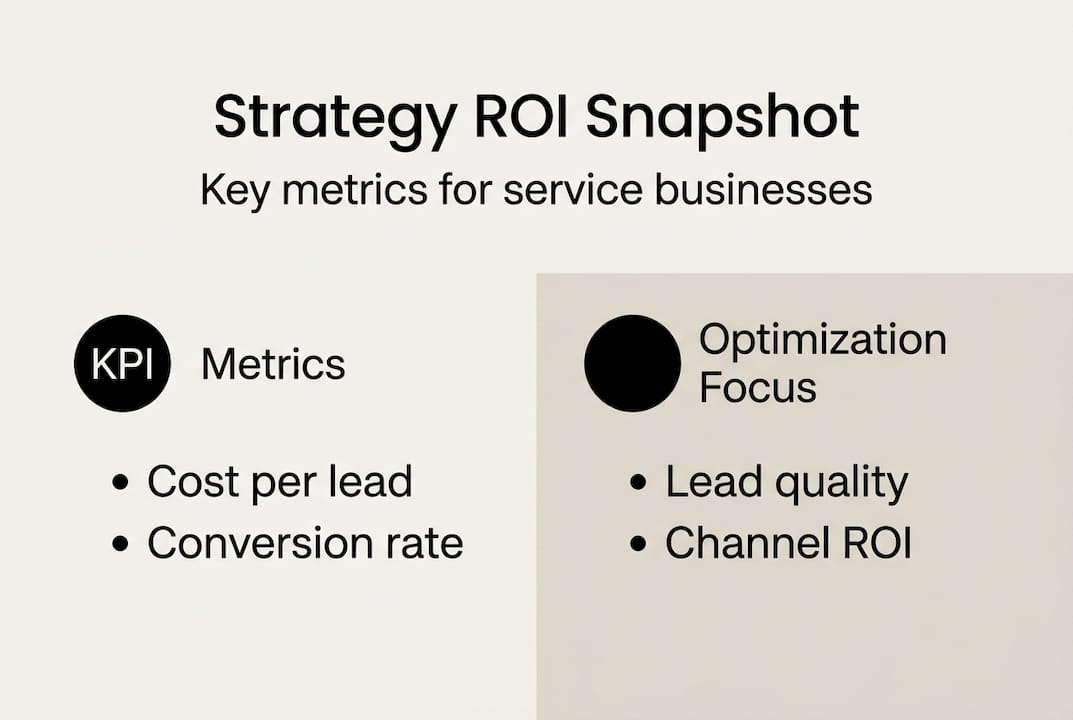
Here are the KPIs that matter most for service businesses:
| KPI | What it tells you |
|---|---|
| Cost per lead (CPL) | How efficiently your budget generates contacts |
| Conversion rate | How well your landing pages and calls to action perform |
| Customer lifetime value (CLV) | The long-term revenue impact of each new client |
| Return on ad spend (ROAS) | Direct profitability of paid campaigns |
| Organic traffic growth | Health and momentum of your SEO investment |
Use an SEO ROI calculator to model the long-term value of your organic investment before committing budget. This helps you set realistic expectations and compare SEO returns against paid channel performance.
The optimization process a strategist follows looks like this:
- Set KPIs before launch: Define what success looks like in measurable terms
- Track everything from day one: Use Google Analytics 4, call tracking, and CRM data together
- Analyze weekly, report monthly: Short-term data catches problems early; monthly reports reveal trends
- Adjust based on data, not assumptions: Pause underperforming ad groups, scale what converts
- Re-evaluate channel mix quarterly: As your business grows, the ideal channel balance shifts
Pro Tip: Start optimization with the channel that has the clearest ROI signal. For most service businesses, that is Google Ads. Once you have a profitable paid baseline, use those learnings to inform your SEO and content strategy.
For measuring SEO ROI specifically, track goal completions in Google Analytics alongside keyword ranking improvements. A keyword moving from position 8 to position 3 can double your organic traffic, and that traffic has real dollar value attached to it.
Common pitfalls and how to avoid them
To maximize ROI, you need to recognize where strategies break down. The most expensive mistakes in digital marketing are not usually bad tactics. They are misaligned plans that burn budget without connecting to business goals.
“Failing to align marketing tactics with specific business goals, like increasing local appointments for dental clinics, wastes resources and reduces ROI.” Understanding the importance of local SEO is one of the clearest ways to fix this misalignment.
Here are the most common pitfalls and how to avoid each one:
- Channel overwhelm: Trying to be everywhere at once spreads budget too thin. Start with two channels, master them, then expand. Paid search and local SEO are the right starting point for most service businesses.
- Poor conversion tracking: Running ads without tracking which ones generate actual leads is like driving with your eyes closed. Set up goal tracking in Google Analytics and use call tracking software from day one.
- Ignoring referral programs: Most home service and dental businesses underestimate how much revenue a formalized referral system can generate. Build it into your strategy from the start, not as an afterthought.
- Generic content that lacks local intent: A dental blog post titled “How to brush your teeth” will not rank in your city or attract local patients. Every content asset should target a specific location and a specific patient concern.
- No regular strategy review: Digital marketing is not a set-it-and-forget-it system. Without monthly reviews, you miss shifts in competitor behavior, algorithm updates, and changes in your own lead quality.
The fix for most of these pitfalls is the same: connect every tactic back to a measurable business goal before you spend a dollar.
Our perspective: Digital marketing strategy is not one-size-fits-all
Most strategy guides hand you a generic checklist and call it a plan. Run Google Ads. Post on social media. Write blogs. That advice is not wrong, but it is dangerously incomplete for businesses in specialized service industries.
Here is what we have learned working with ABA therapy clinics, dental practices, and home service companies: the buyer journey in each of these sectors is fundamentally different from ecommerce or SaaS. What works brilliantly for an online retailer, like retargeting ads and abandoned cart emails, often fails completely in local services where trust and timing drive every decision.
The uncomfortable truth is that most businesses copy their competitors’ marketing without understanding why those competitors made those choices. They see a competitor running Facebook ads and assume that is the right move. But without knowing the competitor’s margins, audience, or conversion data, copying their tactics is guesswork.
A tailored strategy for your business starts with your specific goals, your local market, and your capacity to follow through. Test one channel at a time. Measure obsessively. Do not scale what you can not yet explain.
Take your digital marketing strategy further with expert support
Understanding strategy is the first step. Executing it consistently, across the right channels, with the right messaging and tracking in place, is where most teams hit a wall. A proven strategist does not just hand you a plan. They stay involved, monitor performance, and make the adjustments that keep your lead pipeline healthy.
At ChitChat Marketing, we specialize in building and managing digital marketing strategies for ABA therapy, home service, and dental companies. From SEO web design services that convert visitors into leads, to Google Ads experts who optimize every dollar of your budget, we bring the full picture together. Reach out today for a free strategy consultation and find out exactly where your biggest growth opportunities are hiding.
Frequently asked questions
What is the difference between a digital marketing strategist and a digital marketing manager?
A digital marketing strategist creates the plan and oversees multi-channel direction, while a manager typically executes specific tactics and campaigns. The strategist defines the “what” and “why,” while the manager handles the “how” and “when.”
How quickly can digital marketing strategies show results for service businesses?
Paid channels like Google Ads can deliver leads within weeks, while SEO and referral programs typically build steady growth over several months. Sequencing paid first gives you early wins while longer-term channels develop.
Which digital channels are most effective for dental, ABA, or home services?
SEO, Google Ads, and formalized referral programs consistently perform well across all three industries, though the ideal mix depends on your market, budget, and goals. Lead generation best practices recommend starting with paid search and layering in organic over time.
How do I know if my digital strategy is working?
Track KPIs like cost per lead and conversion rate using analytics tools and regular monthly reports. If those numbers are improving over time, your strategy is working. If they are flat or declining, it is time to review your channel mix and messaging.
Recommended
- Digital Marketing Strategy for Small Businesses to Increase Leads – ChitChat Marketing LLC
- Aligning Digital Marketing Strategy With Business Objectives for ROI – ChitChat Marketing LLC
- How to Choose a Digital Marketing Agency That Drives Real Results – ChitChat Marketing LLC
- Analytics & data-driven decision making. – ChitChat Marketing LLC
- Stratégie de positionnement digital pour agences : guide 2026 – Vamyr Studio

Thomas Guardado is a seasoned digital marketing and SEO expert with over a decade of hands-on experience helping brands grow their online presence and dominate search results. Based in Connecticut, he specializes in organic search strategy, technical SEO, content optimization, and data-driven campaigns that turn clicks into customers.


Leave a comment