TL;DR:
- Homeowners struggle to find reliable home service providers amid conflicting reviews and low visibility.
- Effective strategies include automating review requests, developing referral programs, and offering maintenance plans to boost retention.
- Combining SEO and Google Ads attracts targeted leads, while traditional advertising methods become less effective in 2026.
Finding a reliable home service provider is genuinely hard for homeowners. They scroll through pages of options, read conflicting reviews, and still end up unsure who to call. For home service companies, the flip side is just as frustrating: marketing budgets get spent, phones ring occasionally, but too many of the callers are not the right fit. The disconnect between homeowners and quality providers comes down to visibility, trust, and the right marketing approach. This guide gives you evidence-backed strategies to close that gap and consistently attract more qualified leads in 2026.
Table of Contents
- Automate review requests for more Google reviews
- Leverage referral programs with systematic incentives
- Offer maintenance plans to increase customer retention
- Use SEO and Google Ads for targeted lead generation
- Compare the most effective marketing strategies
- Why old-school advertising falls short for home services
- Take your home service marketing to the next level
- Frequently asked questions
Key Takeaways
| Point | Details |
|---|---|
| Reviews drive leads | Automated review requests generate many more Google reviews, leading to a 38% increase in qualified leads. |
| Referral programs best value | Double-sided referral rewards outperform paid advertising on cost and are easy to implement right after service. |
| Maintenance plans maximize retention | Offering maintenance plans can raise retention rates to 74–91%, ensuring repeat business and steady revenue. |
| Combined SEO and ads | Using both SEO and Google Ads gives home service companies the broadest reach and most targeted leads. |
| Personalization wins | Personalized, automation-driven strategies connect best with homeowners, far surpassing generic advertising. |
Automate review requests for more Google reviews
Reviews are the single fastest trust signal homeowners use to choose a service provider. When someone needs a plumber or a roofing company, they go to Google, look at the star ratings, and scan the most recent reviews. If your company has fewer than 10 reviews, most homeowners will keep scrolling.
The challenge is that most happy customers do not leave reviews on their own. They appreciate your work, pay the invoice, and move on. Automated review requests solve this problem by reaching customers at exactly the right moment, right after a completed job. Automated review requests generate 5.2 times more Google reviews, and companies with 50 or more reviews see 38% more leads. Those numbers are significant and they compound over time.
Here is how to implement review automation effectively:
- Choose the right tool. Platforms like Podium, NiceJob, or Birdeye integrate with your CRM and send review requests automatically after a job is marked complete.
- Time your requests carefully. Send the request within one to two hours of service completion, when satisfaction is highest.
- Use SMS over email. Text message open rates are around 98% compared to roughly 20% for email. A short, friendly text works better.
- Include a direct link. Remove every possible click barrier by linking directly to your Google review page.
- Follow up once. If a customer does not respond in 48 hours, send one polite follow-up. More than that feels pushy.
Beyond collecting reviews, responding to them matters just as much. When you respond to a positive review, you reinforce the relationship. When you respond to a negative one professionally and with a solution, you show potential customers that you handle problems with care. Both behaviors support boosting Google reviews as a long-term trust strategy.
Pro Tip: Personalize your review request by mentioning the specific service performed. A text that says “Hi Maria, it was great completing your AC tune-up today!” performs significantly better than a generic request because it feels personal, not automated.
Working on SEO for home services alongside review automation creates a compounding effect. More reviews improve your local search ranking, which drives more traffic, which creates more opportunities for new reviews.
Leverage referral programs with systematic incentives
With reviews building your reputation, referrals give you a channel that generates leads with much lower friction. A referral comes pre-loaded with trust because a friend or neighbor already vouched for you. That makes it far easier to convert.
“Referrals beat paid channels on cost per sale, but they need systematic incentives delivered after a positive service experience. Double-sided rewards, where both the referrer and the new customer benefit, are the most effective approach.”
The key word in that insight is systematic. Most home service companies rely on organic word of mouth, which does happen, but sporadically. A structured referral program turns occasional recommendations into a reliable lead source.
Here is what makes a referral program work:
- Offer double-sided rewards. When both the existing customer and the new customer get something, participation rates go up. For example, the referrer gets a $50 credit and the new customer gets 10% off their first service.
- Promote the program at the right time. Ask for a referral right after a job goes well. Do not wait weeks until the satisfaction fades.
- Keep the incentive simple and immediate. Complex reward tiers confuse people. A straightforward discount or gift card is easy to understand and easy to act on.
- Include referrals in your post-service communication. After your automated review request, follow up a day later with a simple message explaining your referral program and how it works.
Good incentive ideas include service discounts (10 to 20% off a future visit), prepaid gift cards in small amounts ($25 to $50), complimentary add-ons like gutter cleaning or filter replacement, and priority scheduling during peak seasons.
Pro Tip: Track referrals and reward redemptions using a digital tool or even a simple spreadsheet. Knowing which customers refer the most, and rewarding them appropriately, builds a loyal ambassador group that generates leads continuously.
Pairing referral programs with strong SEO for home services means you are capturing organic leads from existing customers while simultaneously building organic search visibility for new ones. For companies in specific niches, like SEO for HVAC contractors, combining local search optimization with referral marketing covers both new and returning customer acquisition.
Offer maintenance plans to increase customer retention
Generating new leads matters, but retaining the customers you already have is even more valuable. A customer who returns every year for a maintenance visit costs you almost nothing to acquire and often refers others too.
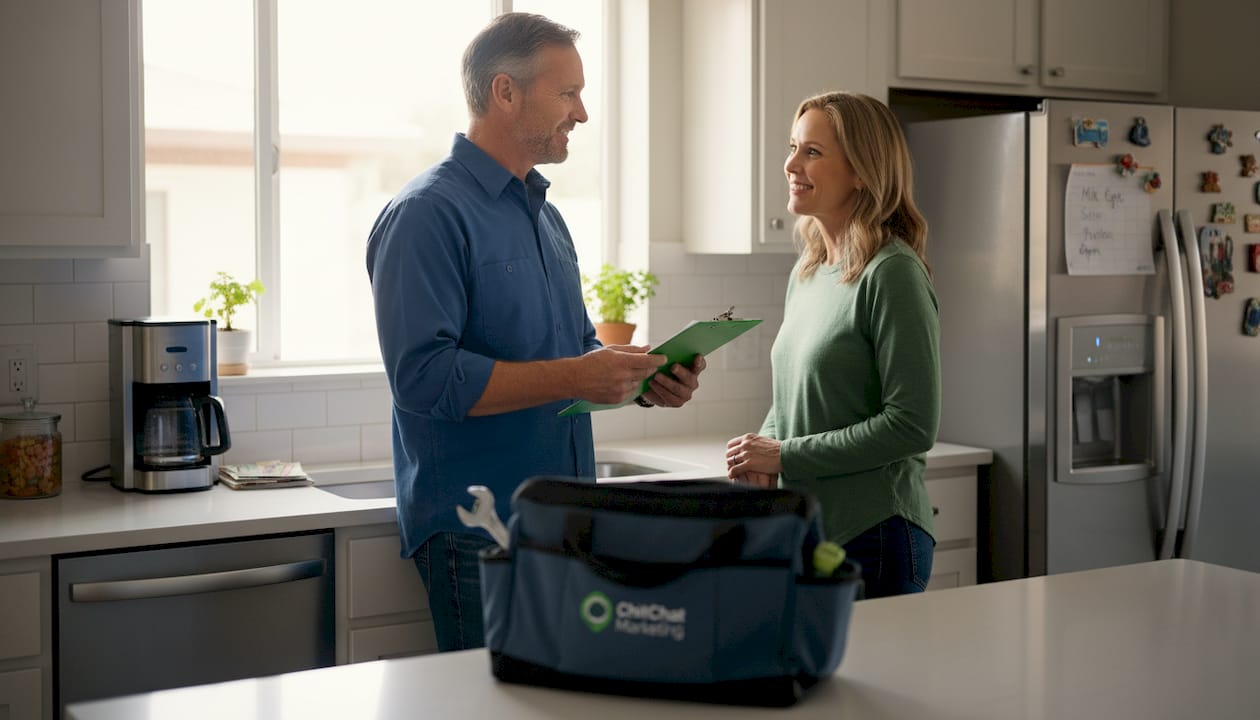
The data on customer retention in home services is striking. The average retention rate for home service businesses sits around 38%, with top performers reaching 65 to 75%. Companies that offer maintenance plans push that number to between 74 and 91%. For HVAC specifically, the average retention rate is 42%, top performers reach 71%, and companies with maintenance plans hit 89%.
| Business type | Average retention | Top performers | With maintenance plan |
|---|---|---|---|
| General home services | 38% | 65 to 75% | 74 to 91% |
| HVAC companies | 42% | 71% | 89% |
Maintenance plans convert one-time customers into recurring revenue. Instead of constantly chasing new leads to fill your calendar, you have a predictable base of returning clients who need your service every season.
Here is how to create and promote a maintenance plan:
- Define the service scope. Include two visits per year, priority scheduling, and a discount on repairs. Keep it simple enough to explain in one sentence.
- Set a fair annual price. Price it so the customer saves 15 to 20% compared to paying per visit. The savings motivate sign-up.
- Offer it at the point of service completion. After a technician finishes a job, the conversation about a maintenance plan feels natural. That is the best moment to introduce it.
- Automate renewal reminders. Use your CRM to send renewal notices 30 days before the plan expires. This prevents lapses and keeps retention numbers strong.
- Promote it on your website and in follow-up emails. Homeowners who are happy with your first service are the best candidates.
A solid maintenance plan also creates a natural referral flywheel. Satisfied plan members are likely to recommend your company to neighbors facing the same seasonal service needs. For specific industries, resources on SEO for HVAC and local SEO for roofing can help you get your maintenance plan landing pages in front of the right homeowners searching online.
Use SEO and Google Ads for targeted lead generation
Now that you have built loyalty and repeat business through reviews, referrals, and maintenance plans, the next goal is attracting new prospects who have never heard of your company. That is where home service SEO and Google Ads become your most powerful channels.
Search engine optimization (SEO) means optimizing your website and online presence so your company appears near the top of Google search results when homeowners look for services you offer. It is a long-term investment that builds organic traffic over months, but once it works, the leads come in without you paying for every click.
Google Ads are paid advertisements that appear at the top of search results immediately. You only pay when someone clicks your ad, and you can target specific keywords, locations, and even times of day. It is faster than SEO but requires ongoing budget.
| Factor | SEO | Google Ads |
|---|---|---|
| Speed to results | 3 to 6 months | Immediate |
| Cost per lead | Lower over time | Higher but predictable |
| Sustainability | Long-term | Stops when budget stops |
| Best for | Building brand authority | Quick lead generation |
| Lead quality | High (organic trust) | High (strong purchase intent) |
The smartest strategy combines both. Use Google Ads management to generate leads while your SEO strategy builds momentum. Once organic rankings improve, you can reduce ad spend or redirect it to competitive keyword battles.
Key actions to prioritize for SEO success in home services:
- Target local keywords. Use phrases like “HVAC repair in [city]” or “emergency plumber near me” rather than generic terms. Understanding the top SEO ranking factors for home improvement companies is essential groundwork.
- Optimize your Google Business Profile. Complete every field, upload real photos of your work, and post updates regularly.
- Add call extensions to your Google Ads. This puts your phone number directly in the ad so homeowners can call without even visiting your website.
- Build local citations. List your company consistently on directories like Yelp, Angi, and HomeAdvisor with the same name, address, and phone number everywhere.
- Create service-specific landing pages. A homeowner searching for roof replacement should land on a roofing-specific page, not your homepage. This improves conversion rates significantly.
Exploring social media marketing tools alongside SEO and ads can further extend your reach to homeowners who are not actively searching but are open to discovering a reliable local provider.
Compare the most effective marketing strategies
With all four strategies covered, here is a side-by-side view to help you decide where to start and how to scale.
| Strategy | Primary benefit | Time to results | Cost level | Best for |
|---|---|---|---|---|
| Review automation | Trust and visibility | 30 to 60 days | Low | All business sizes |
| Referral programs | Low-cost qualified leads | 30 to 90 days | Very low | Established customer base |
| Maintenance plans | Retention and recurring revenue | 60 to 180 days | Low | Service-based companies |
| SEO and Google Ads | Scalable new lead generation | 90 to 365 days | Medium to high | Growth-focused businesses |
The data supports prioritizing in this order. Automated review requests deliver 5.2 times more Google reviews and 38% more leads with 50 or more reviews, making it the highest-return starting point. Referrals follow because they are cost-effective and convert at high rates. Maintenance plans then lock in the customers you acquire, pushing retention rates from an average 38% all the way to 74 to 91%. SEO and ads then scale the whole engine.
| Business size | Recommended starting point | Next priority |
|---|---|---|
| Solo operator or startup | Review automation + referral program | Local SEO |
| Small team (2 to 10 employees) | All of the above plus maintenance plans | Google Ads |
| Mid-size company (10 or more employees) | Full stack: all four strategies | Advanced SEO and paid campaigns |
No single strategy wins in isolation. The compounding effect of reviews, referrals, retention, and digital marketing is what separates fast-growing home service companies from those that stay stuck.
Why old-school advertising falls short for home services
Here is an honest take that most marketing articles skip: traditional advertising methods like mailers, door hangers, and local newspaper ads are not dead, but they are dramatically less effective as standalone strategies for home service companies in 2026.
The reason is simple. Homeowners are not waiting for a mailer to tell them who to call. They search Google when something breaks. They check reviews before they call. They ask a neighbor. Every one of those touchpoints is a place where automated reviews, referral programs, and targeted SEO for home services outperform a printed postcard.
Old-school advertising also fails to personalize. A homeowner who just had a great experience with your company and receives a generic coupon mailer three weeks later gets no value from it. But a personalized text asking them to refer a friend, sent the day after a successful service call, feels relevant. That timing and personalization change how people respond.
The marketing strategies that work now are built around trust at scale. Automation lets you deliver personalized outreach to every customer without hiring a full-time marketing team. Referral programs turn your happiest customers into voluntary salespeople. Maintenance plans keep your schedule full without constant advertising spend. And digital marketing puts your business in front of people who are actively looking for exactly what you do.
This is not about abandoning all traditional tactics. Some service areas still see solid returns from door-to-door canvassing or local sponsorships. But those tactics work in addition to digital systems, not instead of them.
Take your home service marketing to the next level
Knowing the right strategies is a great start. Implementing them consistently, and making sure they work together, is where most companies need support.
At ChitChat Marketing LLC, we specialize in home service SEO and Google Ads management built specifically for home service businesses. Whether you need to improve your search rankings, launch a targeted ad campaign, or redesign your website for better conversions, we offer tailored strategies that generate steady, qualified leads. Our SEO web design services combine technical optimization with strong user experience, so your website works as hard as you do. Let us help you build a marketing system that delivers real results, not just traffic.
Frequently asked questions
How can automated review requests help my home service company?
Automated review requests generate 5.2 times more Google reviews, and companies with more than 50 reviews see 38% more leads, making it one of the highest-return tactics available.
What’s the average customer retention rate for home service businesses?
The average retention rate for home service companies is 38%, but businesses that offer maintenance plans can increase that number to between 74 and 91%.
Are referral programs better than paid ads for lead generation?
Referrals are more cost-effective than paid advertising, especially when you use double-sided rewards that benefit both the referring customer and the new customer they bring in.
What is the best digital marketing strategy for home service companies?
A combined SEO and Google Ads approach targeting local keywords, supported by review automation and strong local citations, delivers the most qualified leads at scale.
Which marketing strategy should small home service businesses start with?
Start by automating review requests and setting up a basic referral program, then add local SEO and Google Ads as your customer base and budget grow.
Recommended
- What Is SEO for Home Services? Boost Leads Fast
- SEO For Home Services | ChitChat For Home Service SEO
- Top SEO ranking factors for home improvement companies
- Local SEO for Roofing Contractors | Get More Roofing Leads & Jobs | ChitChat Marketing
- Modern Construction Lead Generation Guide
- Home Services Marketing Agency | AMW Media

Thomas Guardado is a seasoned digital marketing and SEO expert with over a decade of hands-on experience helping brands grow their online presence and dominate search results. Based in Connecticut, he specializes in organic search strategy, technical SEO, content optimization, and data-driven campaigns that turn clicks into customers.

Leave a comment