TL;DR:
- Most advertisers assume higher bids guarantee better ad placements, but Google prioritizes ad quality and relevance in addition to bid amount. Selecting the right PPC bidding strategy depends on campaign data maturity, goals, and proper conversion tracking, with manual bids suitable for beginners and smart bidding for data-rich, goal-focused campaigns. Patience and deliberate adjustments are essential, as rapid changes or overly aggressive targets can hinder campaign performance and delivery.
Most advertisers assume the highest bid wins the best ad placement. That assumption costs real money. Understanding what is PPC bidding strategy means recognizing that your bid amount is just one variable in a more complex system. Google evaluates ad quality, landing page experience, and real-time contextual signals alongside your bid to determine where your ad appears and what you actually pay. Whether you manage a small business ad budget or oversee campaigns at scale, getting your bidding strategy right separates profitable campaigns from ones that drain spend with little return.
Table of Contents
- Key takeaways
- How PPC bidding actually works
- Types of PPC bidding strategies
- Choosing the right bidding strategy
- Optimizing and adjusting bids for better ROI
- My honest take on PPC bidding strategy
- Let Chitchatmarketingllc handle your PPC bidding
- FAQ
Key takeaways
| Point | Details |
|---|---|
| Bid amount is not everything | Ad Rank includes quality score and contextual signals, so ad quality can outperform a higher bid. |
| Manual bidding suits new campaigns | Start with Manual CPC when you have fewer than 30 conversions per month before moving to Smart Bidding. |
| Match strategy to your goal | Lead generation, brand awareness, and eCommerce sales each call for a different bidding approach. |
| Patience is required with automation | Allow 7 to 14 days after target changes for Smart Bidding algorithms to stabilize. |
| Avoid aggressive target setting | Setting targets too low limits auction eligibility and reduces overall conversion volume. |
How PPC bidding actually works
PPC bidding is a real-time auction that happens every time a user searches on Google. Your ad does not simply win because you bid the most. Google calculates something called Ad Rank, and that number determines both your position and your cost per click.
Ad Rank factors include your bid amount, expected click-through rate, ad relevance to the search query, landing page experience, auction competitiveness, and the context of the search. Context covers signals like the user’s device, location, time of day, and search intent. These variables are all weighed together, every single auction, in milliseconds.
Here is a practical example. Suppose your competitor bids $4.00 per click, but their ad has a low Quality Score because their landing page is slow and their ad copy barely matches the search term. You bid $2.50, but your landing page loads fast, your ad speaks directly to the search intent, and your expected CTR is high. You can rank above them and pay less. Higher quality ads often win better placements at a lower cost per click than a competitor simply throwing money at the auction.
Pro Tip: Before raising your bids, check your Quality Score for each keyword. Improving a score from 4 to 7 can reduce your cost per click significantly without spending an extra dollar on your bid.
| Auction factor | What it measures | Impact on outcome |
|---|---|---|
| Bid amount | Maximum you are willing to pay per click | Sets the ceiling for auction eligibility |
| Expected CTR | Predicted likelihood of ad being clicked | Higher CTR improves Ad Rank directly |
| Ad relevance | How closely ad matches search intent | Low relevance reduces placement and raises cost |
| Landing page experience | Page quality, speed, and relevance | Poor experience lowers Ad Rank and Quality Score |
| Contextual signals | Device, location, time, search query | Adjusts bids in real time per individual auction |
Types of PPC bidding strategies
When most people research PPC bidding strategy explained, they are really asking: should I control bids manually, or let Google’s machine learning handle it? The answer depends on where your campaign is in its lifecycle and what data you have available.
Manual bidding options
Manual CPC gives you full control. You set a maximum bid for each keyword, and Google will not exceed it. This approach works well when you know your market, understand which keywords convert, and want tight control over spend. The trade-off is time. You need to review and adjust bids regularly to stay competitive.
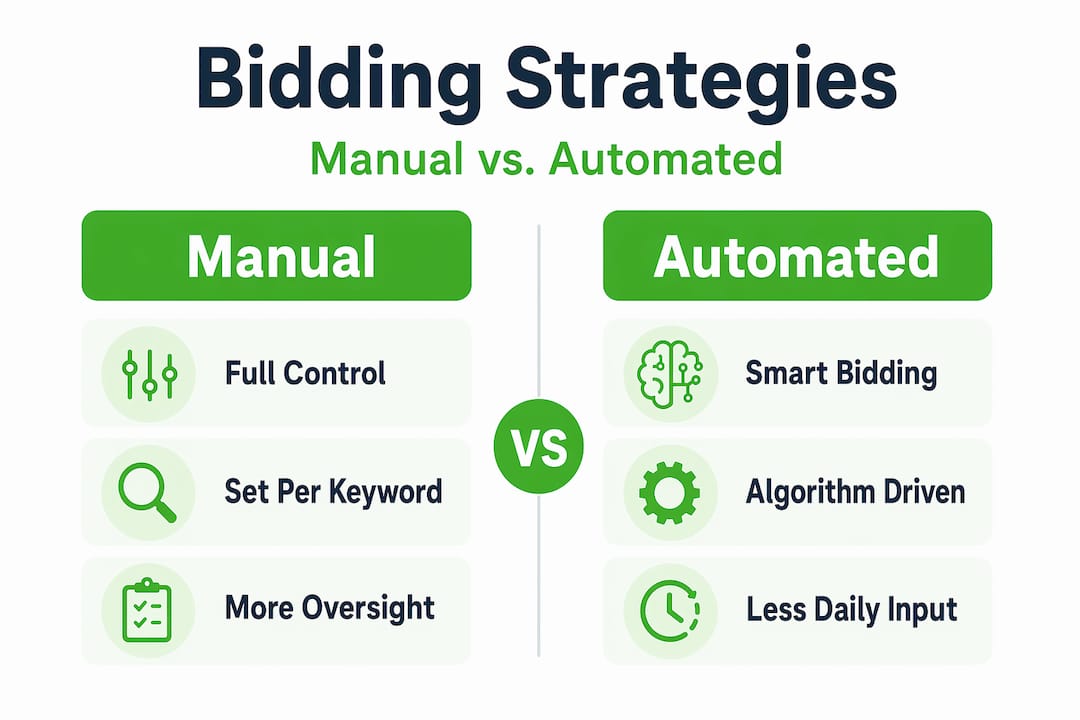
Enhanced CPC sits between manual and fully automated. Google adjusts your manual bids slightly upward or downward based on the likelihood of a conversion. You keep the steering wheel but let the algorithm nudge bids when signals look favorable.
Smart Bidding strategies
Smart Bidding algorithms process hundreds of signals including device, location, search query, and time of day to optimize bids for each individual auction in real time. These are the main options:
- Maximize Conversions gets you the most conversions within your budget. You can add an optional Target CPA to control cost per conversion.
- Maximize Conversion Value focuses on revenue rather than volume. Add a Target ROAS to tell Google what return you expect per dollar spent.
- Maximize Clicks is useful for driving traffic when conversions are not yet the priority.
- Target Impression Share works well for brand awareness, targeting a specific percentage of auction appearances.
Google and Microsoft have consolidated many of these strategies so that Target CPA and Target ROAS now function as optional targets within Maximize Conversions and Maximize Conversion Value, respectively.
Pro Tip: Never launch Smart Bidding without conversion tracking in place. The algorithm is only as good as the data it receives. Tracking gaps will cause the system to optimize toward incomplete information.
| Strategy | Primary objective | Best for | Key limitation |
|---|---|---|---|
| Manual CPC | Full bid control | New campaigns, tight budgets | Time-intensive management |
| Enhanced CPC | Conversion lift with manual base | Transitioning from manual | Less control than pure manual |
| Maximize Conversions | Volume of conversions | Campaigns with steady traffic | Can overspend without a Target CPA |
| Maximize Conversion Value | Revenue optimization | eCommerce, high-value services | Needs solid conversion value data |
| Target Impression Share | Brand visibility | Awareness campaigns | Not conversion focused |
| Maximize Clicks | Traffic volume | New sites, research phases | Traffic quality varies |
Choosing the right bidding strategy
Picking the right approach starts with an honest assessment of your campaign’s data maturity and your business goal. There is no universal best answer. What works for an eCommerce store with 200 monthly purchases will not suit a local service business getting 15 leads per month.
Follow this decision framework to find your starting point:
- Count your monthly conversions. If you have fewer than 30 conversions per month, start with Manual CPC or Enhanced CPC. Smart Bidding needs data to learn from. Without enough conversions, the algorithm guesses more than it optimizes.
- Define your primary goal. Are you generating leads, driving online sales, or building brand awareness? Lead generation campaigns align with Target CPA. eCommerce campaigns focused on revenue benefit most from Target ROAS. Awareness campaigns match Target Impression Share or Maximize Clicks.
- Check your conversion tracking. No tracking means no data for Smart Bidding to use. Set this up before anything else.
- Set a realistic starting target. If you move to Target CPA, base your initial target on your actual average CPA from recent data, not a wishful number. The same applies to Target ROAS.
- Transition gradually. Once you consistently hit 30 or more conversions per month, shift to Maximize Conversions. After another 30 days of stable performance, add a Target CPA if you want tighter cost control.
- Revisit strategy quarterly. Campaign goals, competition, and seasonality change. Your bidding strategy should reflect current conditions, not decisions you made six months ago.
Value-based bidding is worth calling out specifically for eCommerce businesses. It prioritizes higher-value conversions by optimizing toward revenue rather than raw conversion count. If a $500 order and a $50 order both count as one conversion in your tracking, the algorithm treats them equally. Assigning conversion values fixes that and gives you far more control over where your money goes.
Pro Tip: When starting a Smart Bidding strategy, give it a learning period of at least two weeks before judging its performance. Pulling the plug after three days because costs look high is one of the most common mistakes advertisers make.
Optimizing and adjusting bids for better ROI
Getting your bidding strategy live is only the beginning. The real work happens in how you manage, monitor, and adjust bids over time. This is where most advertisers either pull ahead or fall behind.
The most common mistake is making target adjustments too quickly. After any major change to your Target CPA or Target ROAS, allow 7 to 14 days for the algorithm to process the change and stabilize. The machine learning model needs a full conversion cycle to recalibrate. Changing targets again before that cycle completes resets the learning process and creates a cycle of poor performance.
Setting targets too aggressively creates a different problem. Overly aggressive CPA or ROAS targets reduce how often your ads enter auctions. Google will avoid auctions where it calculates the conversion is unlikely to meet your target. Fewer auction entries mean less traffic, fewer conversions, and ironically worse results than a slightly more realistic target would have produced.
Here are the most effective tactics for ongoing bid management:
- Use Bid Simulator before changing targets. This tool estimates how different CPA or ROAS settings would have affected your conversions and costs historically. It removes the guesswork from target adjustments.
- Avoid making multiple target changes within a single conversion cycle. Make one change, measure the result, then decide on the next step.
- Monitor your conversion lag. If your sales cycle is 14 days, a conversion attributed to a click last week has not been counted yet. Evaluating performance too soon creates false negatives.
- Keep conversion tracking accurate. Track calls, form fills, purchases, and any event that represents real business value. Tracking irrelevant micro-conversions inflates your data and misleads the algorithm.
Smart Bidding continuously updates its models to adapt to recent performance changes and each business’s specific conversion cycle. That adaptability is powerful, but only when you give the system clean data and enough time to work.
My honest take on PPC bidding strategy
In my experience working with advertisers across different industries and budget levels, the single biggest source of wasted ad spend is impatience. Businesses switch bidding strategies every two weeks, tweak targets every few days, and then conclude that Google Ads does not work for them. The algorithm never got a fair chance.
I have also seen the opposite failure: total over-reliance on automation without any monitoring. Smart Bidding is not a set-and-forget solution. I have seen campaigns where the algorithm optimized toward the wrong conversion event, inflated results, and led clients to believe they were succeeding while actual revenue stayed flat. Automation without oversight is still a liability.
What actually works is a hybrid mindset. Use manual or enhanced bidding to build smarter keyword strategies and gather clean conversion data early. Then transition to Smart Bidding with realistic targets, give it time to learn, and audit the data regularly. Do not change what is working just because a metric looks unusual for a few days.
My honest recommendation is to treat your bidding strategy the same way you would treat any business decision: base it on data, adjust deliberately, and measure over meaningful time horizons. Quick fixes rarely survive contact with real market conditions.
— Thomas
Let Chitchatmarketingllc handle your PPC bidding
Managing PPC bids effectively takes time, data analysis, and ongoing attention. Most small business owners and marketing teams have plenty of other priorities competing for that time.
Chitchatmarketingllc specializes in Google Ads campaign management that covers everything from initial campaign setup and conversion tracking to ongoing bid management and performance reporting. The team uses a data-driven approach to select the right bidding strategy for your goals, monitor algorithm performance, and make adjustments that protect your budget and grow your results. Whether you are just launching your first campaign or looking to get more from an existing account, Chitchatmarketingllc brings the expertise to make every ad dollar work harder. You can also explore how Google Ads supports business goals to understand the broader value of paid search before you invest.
FAQ
What is a PPC bidding strategy?
A PPC bidding strategy is the method you use to set how much you are willing to pay for ad placements in a pay-per-click auction. It determines how Google allocates your budget across auctions based on your campaign goal, whether that is conversions, clicks, revenue, or visibility.
How does Google decide which ad wins the auction?
Google calculates Ad Rank using your bid amount, Quality Score (which includes expected CTR, ad relevance, and landing page experience), and real-time contextual signals. A lower bid with a high Quality Score can outrank a higher bid with poor ad quality.
When should I switch from manual to Smart Bidding?
Switch to Smart Bidding once your campaign consistently generates at least 30 conversions per month. Below that threshold, the algorithm lacks sufficient data to make reliable bid decisions, and manual or Enhanced CPC gives you more control.
What happens if I set my Target CPA too low?
Setting your Target CPA too aggressively limits how often your ads enter auctions. Google avoids auctions where it predicts a conversion is unlikely to meet your target, which reduces traffic, lowers conversion volume, and can stall campaign performance.
How long does Smart Bidding need to learn after a change?
After changing a Target CPA or Target ROAS, allow 7 to 14 days for the algorithm to stabilize. Making additional changes before one conversion cycle completes resets the learning process and makes it harder to assess what is actually working.
Recommended
- Maximize Google Ads results with smarter keyword strategies
- Google Ads Management | ChitChat For Google Ads Services
- Google Ads for ABA clinics: drive more leads in 2026 – ChitChat Marketing LLC

Thomas Guardado is a seasoned digital marketing and SEO expert with over a decade of hands-on experience helping brands grow their online presence and dominate search results. Based in Connecticut, he specializes in organic search strategy, technical SEO, content optimization, and data-driven campaigns that turn clicks into customers.


Leave a comment