
TL;DR:
- Service area businesses rely on content, reviews, and schema markup over proximity signals.
- Creating dedicated local pages and accurately setting service areas improves search visibility.
- Persistent optimization efforts are essential for building trust and ranking in multiple regions.
If you run a service area business, you’ve probably tried following standard local SEO advice and wondered why it isn’t working. The reason is straightforward: most local SEO guidance is written for businesses with a physical storefront that customers walk into. When your business travels to clients, whether you’re an ABA therapy agency, a mobile dental practice, or a plumbing service, the rules change. Specialized tactics like schema markup and service area pages matter far more than simply being close to a customer’s pin on a map. This guide walks you through exactly what SAB SEO requires and how to apply it.
Table of Contents
- What is a service area business (SAB)?
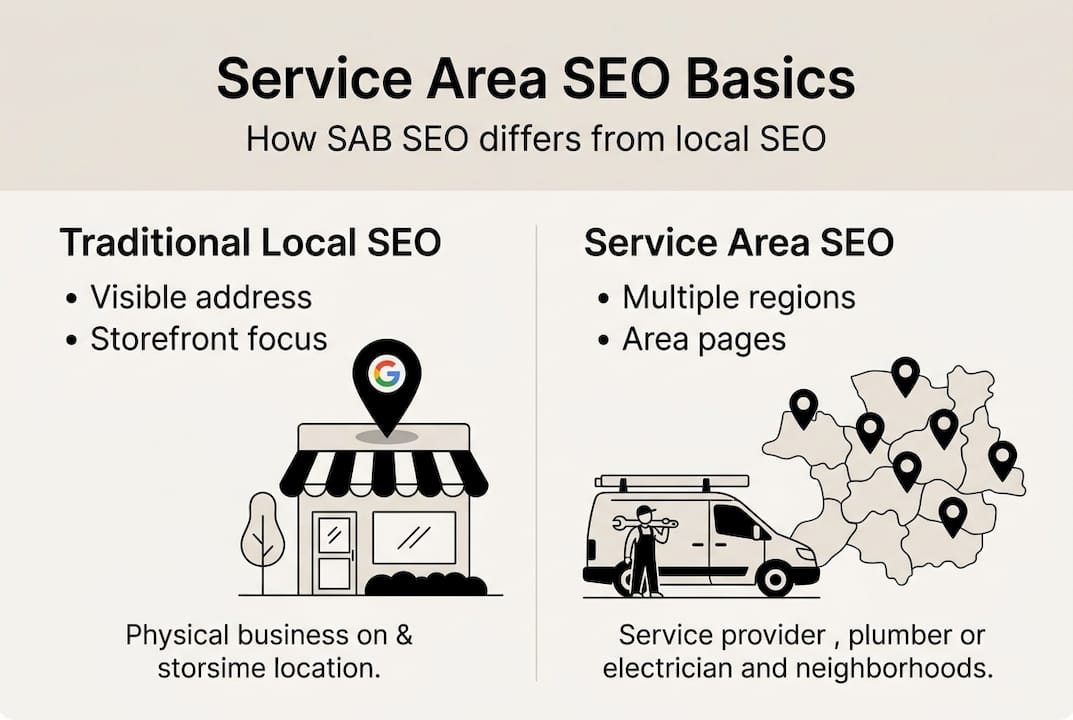
- How SAB SEO is different from traditional local SEO
- Core tactics for effective service area business SEO
- Real-world SAB SEO in action: Case scenarios and results
- Why most service area businesses overlook SEO’s unique requirements
- Ready to boost your SAB’s visibility?
- Frequently asked questions
Key Takeaways
| Point | Details |
|---|---|
| SABs require unique SEO | Service area businesses can’t rely on standard local SEO and must use targeted tactics to win clients. |
| Service pages drive results | Dedicated service area pages and proper schema markup deliver better rankings and visibility for SABs. |
| Address listing is nuanced | Whether to show your physical address is debated; focus on clarity for Google and your clients. |
| Real-world proof works | Case studies show tailored SAB SEO efforts consistently boost rankings and customer leads. |
What is a service area business (SAB)?
A service area business, or SAB, is any business that travels to serve clients rather than having customers visit a fixed location. You don’t need a lobby or a waiting room. What you need is a clear, optimized online presence that tells Google and your prospective clients exactly where you operate and what you offer.
Here are some common examples of SABs:
- ABA therapy agencies that send therapists to homes or schools
- Mobile dental practices that visit care facilities or offer in-home appointments
- Plumbers, electricians, and HVAC technicians who travel to job sites
- Landscaping and lawn care companies serving neighborhoods in a radius
- Home cleaning services operating across multiple ZIP codes
The key difference between an SAB and a traditional local business is how location works in the client acquisition process. A coffee shop benefits from foot traffic and proximity. Your ABA therapy agency benefits from showing up in search results when a parent in a specific neighborhood types “ABA therapy near me.” Those are very different visibility challenges.
“Traditional local SEO guidance focuses on storefronts, not SABs. Service businesses need a distinct approach to earn visibility in the areas they actually serve.”
One common misconception is that without a storefront, you simply can’t rank well locally. That’s not true. What you can’t do is rely on the same proximity signals that a brick-and-mortar business uses. Instead, you need to build authority through content, reviews, and structured data that clearly communicates your service areas to search engines.
Understanding ranking a service area business starts with accepting that your Google Business Profile (GBP), your website’s service area pages, and your schema markup are doing the heavy lifting that a physical address does for a storefront. Once you internalize that shift, the rest of your SEO strategy starts to make sense.
It’s also worth noting that SABs often serve multiple towns, counties, or even states. That geographic spread creates both an opportunity and a challenge. The opportunity is that you can target many local markets. The challenge is that you need to earn relevance in each of those markets individually, which requires deliberate, structured effort.
How SAB SEO is different from traditional local SEO
With a clear idea of what qualifies as a service area business, let’s explore how SEO for SABs breaks the standard local SEO mold.
SABs need specialized tactics like schema markup and dedicated service area pages rather than relying on proximity alone. Here’s a side-by-side comparison of how the two approaches differ:

| Factor | Traditional local SEO | SAB SEO |
|---|---|---|
| Address visibility | Displayed prominently | Optional; often hidden |
| Ranking signal | Physical proximity to searcher | Service area relevance and content |
| Google Business Profile | Location-based | Service area settings |
| Key content asset | Location landing page | Service area pages per city/region |
| Review strategy | One location focus | Gather reviews across all areas served |
| Schema markup | LocalBusiness schema | ServiceArea and areaServed schema |
One of the most debated questions in SAB SEO is whether you should show or hide your address in your Google Business Profile. Sterling Sky, a respected local SEO agency, recommends showing your address because it can help with “near me” searches. Whitespark, another well-known local SEO research firm, has tracked SABs rising in rankings without a visible address, as long as their service area settings and content are strong. The honest answer is that it depends on your situation. If you work from a legitimate commercial address, showing it can help. If you work from home and privacy matters, hiding it is perfectly acceptable under Google’s guidelines.
Here are the numbered steps that define a strong SAB SEO foundation:
- Set your service areas in Google Business Profile accurately
- Build individual service area pages for each city or region you serve
- Add structured data (schema) that specifies your service areas
- Collect and respond to reviews mentioning specific locations
- Optimize your website’s on-page content with location-specific keywords
For deeper guidance on on-page improvements, these SEO optimization tips and Google My Business SEO tips cover the technical details you’ll want to apply.
Pro Tip: On every key page of your website, including your homepage, service pages, and contact page, clearly state the cities and regions you serve. This reinforces your service area signals for both search engines and visitors who want to confirm you cover their location.
Core tactics for effective service area business SEO
Having compared how the basics of SAB SEO differ, let’s get specific about the actions you can take.
Service area pages and careful schema targeting are among the most consistently recommended tactics for SABs. Here’s how to put each one into practice:
Build dedicated service area pages. Create a unique page for each city, town, or region you serve. Each page should include location-specific content, not just a swapped city name. Mention local landmarks, neighborhoods, or community details that make the page genuinely useful. A page titled “ABA Therapy in Austin, TX” should read differently from one titled “ABA Therapy in Round Rock, TX.”
Optimize your Google Business Profile for service areas. Go into your GBP settings and add every area you serve. Be specific: use city names and ZIP codes rather than vague regional terms. Update these settings whenever you expand your coverage.
Use structured data sitewide. Add "LocalBusiness
schema withareaServedandserviceArea` properties to your website. This tells Google’s crawlers exactly where you operate, which helps your pages appear in relevant local searches even when you’re not physically close to the searcher.Gather reviews that mention locations. When you follow up with satisfied clients, ask them to mention the city or neighborhood in their review. A review that says “Best ABA therapy in Cedar Park” carries more local relevance than a generic five-star rating.
Build local citations consistently. Make sure your business name, phone number, and service area information are consistent across directories like Yelp, Healthgrades, and Angi. Inconsistent data confuses search engines and reduces your credibility.
The local SEO advantages for SABs are real, but they require a different approach than what most guides describe. If you want a structured starting point, a solid local SEO checklist can help you work through each element systematically. For a broader foundation, reviewing local SEO basics will fill in any gaps.
Pro Tip: Avoid listing every city in your state just to cast a wide net. Google can detect overstuffed area lists, and it may actually hurt your rankings. Stick to the areas where you genuinely and regularly provide services.
Real-world SAB SEO in action: Case scenarios and results
You’ve got the tactics. Now let’s see how these strategies produce real gains for service businesses like yours.
ABA therapy agency scenario: An ABA therapy agency operating across five suburban counties had a website with a single homepage and no service area pages. Their Google Business Profile listed only their home office address with no service area settings configured. Despite excellent reviews, they were invisible in searches from families in three of the five counties they served. After building dedicated service area pages for each county, adding areaServed schema, and updating their GBP service area settings, their organic search impressions grew significantly within four months. More importantly, lead inquiries from previously underperforming counties increased because parents could now find them through location-specific searches.
Mobile dental practice scenario: A mobile dental practice serving assisted living facilities saw similar results. Before optimization, their website ranked only for their home city. After creating city-specific landing pages and actively requesting reviews that mentioned facility locations, they began appearing in searches from neighboring cities. Their call volume from new facilities grew noticeably within six months.
Whitespark tracked service businesses rising in rankings through focused service area pages, confirming that content-driven local relevance can outperform proximity for SABs.
Here’s a summary of what these businesses did and what changed:
| SEO focus area | Action taken | Visibility change |
|---|---|---|
| Service area pages | Created one page per city served | Ranked in 3 new cities within 90 days |
| GBP service area settings | Added all counties and ZIP codes | Appeared in local pack for new areas |
| Schema markup | Added areaServed to all pages | Improved crawl understanding of coverage |
| Location-specific reviews | Asked clients to mention city in review | Higher review relevance for target areas |
Key steps these businesses took:
- Audited existing pages to identify coverage gaps
- Wrote original, location-specific content for each service area page
- Updated schema markup across the entire site
- Created a review request process that encouraged location mentions
- Monitored Google Search Console for impressions by location
For a deeper look at what drives these outcomes, the benefits of local SEO and strategies to improve website ranking provide additional context.
Why most service area businesses overlook SEO’s unique requirements
With direct case scenarios in mind, let’s challenge the most common SAB SEO mistakes and reveal what really drives success.
Here’s the uncomfortable truth: most SAB owners follow SEO advice that was never written for them. They read guides designed for restaurants and retail shops, then wonder why their rankings stagnate. Industry advice for SABs often conflicts or lags behind current realities, which means you can easily spend months on tactics that simply don’t move the needle for your type of business.
The real challenge for SABs is that you can’t win on proximity. A plumber two miles from a searcher will always have a geographic advantage over one five miles away, assuming all else is equal. But “all else” is rarely equal. You win by building trust through reviews that name specific locations, by creating service area pages that answer real questions from real clients, and by using schema markup that removes any ambiguity about where you operate.
The businesses we’ve seen succeed with SAB SEO aren’t chasing the latest algorithm update. They’re doing persistent, unglamorous work: updating service area pages, asking for reviews, and keeping their GBP accurate. That consistency, applied through a service area business SEO guide built for your specific business type, is what separates the practices that grow from the ones that stay invisible.
Ready to boost your SAB’s visibility?
Applying these strategies takes time, and doing them correctly from the start makes a real difference in how quickly you see results. At ChitChat Marketing LLC, we specialize in helping service area businesses like ABA therapy agencies and mobile dental practices build the kind of online presence that attracts qualified leads in every area they serve.
Our SEO web design service is built specifically to support businesses that don’t have a storefront but still need to dominate local search. From service area page architecture to schema implementation and GBP optimization, we handle the technical details so you can focus on serving your clients. Explore our service area SEO tips or reach out to start a conversation about your growth goals.
Frequently asked questions
What is a service area business in Google’s terms?
A service area business is one that serves customers at their locations and doesn’t operate a public-facing storefront, such as plumbers, mobile therapists, or home care providers. Google’s guidelines for SABs allow these businesses to hide their address while still appearing in local search results.
Does my SAB need a physical address listed to rank well?
Listing an address is debated among local SEO experts. Some, like Sterling Sky, say it supports “near me” searches, while others point to SABs rising in rankings without a visible address when service area content is strong. Google’s guidelines allow you to hide your address if you visit clients rather than receive them.
What’s the first step to improving my SAB SEO?
Start by creating dedicated service area pages for every city or region you serve and optimizing your Google Business Profile service area settings. Service area pages and schema are consistently recommended as the highest-impact starting points for SABs.
Are service area businesses treated differently by Google algorithms?
Yes. Google uses different ranking signals for SABs, placing more weight on service area relevance, content quality, and review signals than on physical proximity. SABs need schema and service area pages to compete effectively in the areas they serve.
Recommended
- Key Advantages of Local SEO Services That Help Your Business Grow – ChitChat Marketing LLC
- How to Rank a Service Area Business: Step-by-Step Guide for SMBs – ChitChat Marketing LLC
- Local SEO explained: boost visibility and drive customers – ChitChat Marketing LLC
- Top Benefits of Local SEO for Small Businesses to Boost Leads & Sales – ChitChat Marketing LLC


Leave a comment