TL;DR:
- Branded search plays a crucial role in lead generation by targeting high-intent, decision-ready users actively seeking your brand. Segmenting campaigns by buyer stage and aligning landing pages enhances conversion rates and reduces churn. In an AI-driven search landscape, building brand recognition now ensures long-term visibility and authority.
Most marketers treat branded search like a safety net. Someone types your company name, you show up, end of story. But that framing misses something significant. The role of branded search in lead gen goes far beyond protecting your name from competitors. Search ads convert up to 600% better than display ads because they catch people mid-decision, not mid-scroll. If you are not actively shaping what happens when someone searches your brand, you are leaving qualified leads on the table every day.
Table of Contents
- Key takeaways
- The role of branded search in lead gen, defined
- How branded search drives leads across the buyer journey
- Branded search in an AI-driven search world
- Practical strategies to maximize branded search ROI
- My honest take on branded search and pipeline growth
- Put your branded search strategy to work
- FAQ
Key takeaways
| Point | Details |
|---|---|
| Branded search converts higher | Branded search captures users in active decision mode, driving far better conversion rates than generic traffic. |
| Segmentation multiplies results | Splitting campaigns by prospect, new customer, and loyal user unlocks targeted messaging that reduces churn and grows revenue. |
| AI rewards brand recognition | In 2026, AI-driven search surfaces trusted brands first, making branded search volume a direct input to your visibility. |
| Measurement matters more now | New attribution signals like Attributed Branded Searches connect ad engagement to future sales for smarter budget decisions. |
| Strategy beats defense | Treating branded search as a pipeline tool rather than brand protection changes the ROI you can expect from every campaign. |
The role of branded search in lead gen, defined
Before you can use branded search strategically, you need to be clear on what it actually is and why it behaves differently from everything else in your search program.
Branded search refers to any query that includes your company name, product name, or a close variation. Think “Chitchatmarketingllc SEO services” or “ChitChat Google Ads pricing.” Non-branded search, by contrast, captures queries like “affordable SEO for small business” where the user has no specific brand in mind yet.
The behavioral difference between these two is enormous. Someone searching your brand name already knows you exist. They may have seen an ad, gotten a referral, visited your site before, or read a review. They are not in discovery mode. They are in evaluation or decision mode. That is a fundamentally different kind of attention.
Here is why that distinction matters for lead generation:
- Conversion intent is higher. Users arrive with context and curiosity already built up.
- Bounce rates are lower. Brand-aware visitors spend more time on your site and engage more deeply.
- Cost per acquisition drops. You spend less to convert someone who already has a favorable impression of your brand.
- Brand trust signals compound. Strong branding increases organic clicks and link-building potential, which feeds your overall SEO health.
The importance of branded search becomes clearest when you compare it directly to generic traffic. Generic keywords drive volume. Branded keywords drive qualified leads. You need both, but they serve different purposes in your funnel, and you should measure them differently.
How branded search drives leads across the buyer journey

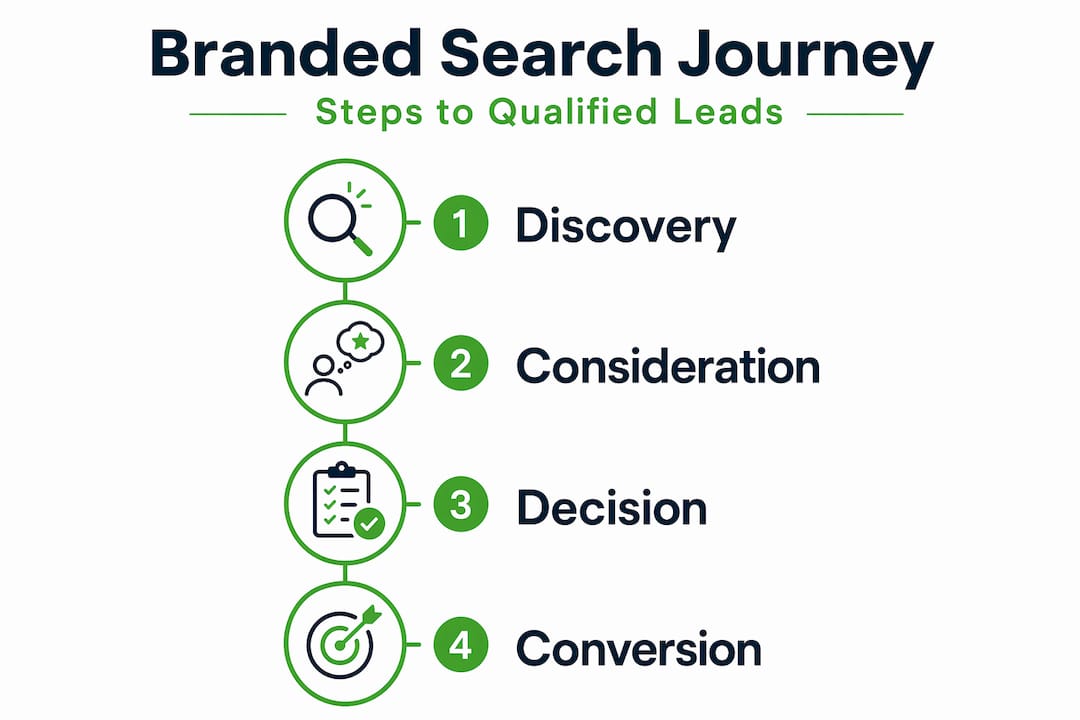
Understanding the buyer journey helps you see exactly when branded search enters the picture and how it influences the decision to convert. The journey moves from awareness to consideration to decision, and branded search tends to concentrate its power in the middle and late stages.
Here is how to map branded search tactics to each stage practically:
- Awareness stage. Prospects do not search your name yet. They find you through non-branded queries, social media, or referrals. Your job here is generating the impressions that make future branded searches possible.
- Consideration stage. Prospects have heard of you and now want to verify your credibility. They search “[your brand] reviews,” “[your brand] pricing,” or “[your brand] vs. competitor.” This is where branded search captures high-intent prospects who are actively comparing options.
- Decision stage. Prospects search your brand directly and land on your site ready to act. A well-designed landing page aligned with their specific search intent closes the deal here.
- Retention stage. Existing customers search your brand when they need support, want to upgrade, or are looking for additional services. Branded search is not just for acquisition. It protects and grows existing relationships too.
Segmenting branded search campaigns by where people are in this journey changes your results dramatically. A prospect searching “[brand] vs. competitor” needs different messaging than a loyal customer searching “[brand] account login.” Treating them the same wastes budget and dilutes your conversion rate.
Pro Tip: Create three distinct ad groups within your branded campaign: one for prospects (use proof points like case studies and testimonials), one for new customers (highlight onboarding and support), and one for loyal users (promote upgrades or referral programs). This single change can meaningfully lower your cost per lead.
One concrete scenario: a software company running a single branded campaign saw a 40% drop in lead quality after combining prospect traffic with existing customer traffic on the same landing page. Once they separated the two audiences and tailored the landing page copy to each, lead quality improved and sales cycle length shortened. Targeted messaging per journey stage reduces churn and increases lifetime value. That is the impact of branded search when it is built around the buyer, not just the keyword.
Branded search in an AI-driven search world
The search environment has changed significantly, and branded search has become more strategically important because of it, not less. Understanding how AI reshapes search helps you allocate budget and effort correctly.
AI-driven search engines now surface answers, summaries, and recommendations before users even click a link. In that environment, brand recognition outranks keyword rankings as the primary driver of visibility. AI systems are trained to recommend brands that users trust and engage with repeatedly. If your branded search volume is growing, it signals to Google and other AI platforms that your brand has genuine authority.
Here is a comparison that puts this shift in context:
| Factor | Pre-AI search (2020-2023) | AI-driven search (2024-2026) |
|---|---|---|
| Primary ranking signal | Keyword optimization | Brand trust and authority |
| User behavior | Click through to websites | Read AI summaries, click selectively |
| Branded search role | Defensive, brand protection | Offensive, pipeline and authority building |
| Visibility metric | Keyword ranking position | Branded search volume growth |
For small businesses staying visible in AI search, building branded search volume is now a direct competitive advantage. The businesses that invest in brand recognition today are the ones AI systems will surface tomorrow.
There are several practical ways this plays out:
- AI overviews on Google now feature brand names prominently when those brands have strong search signals behind them.
- Voice search queries frequently include brand names because users ask for specific businesses they already know.
- Branded search volume growth tracks directly with increases in local visibility and AI-mentioned authority.
The brands that ignore this shift will find themselves increasingly invisible as AI search becomes the default way people find products and services. Understanding foundational SEO with AI is the starting point for making branded search work in this new context.
Practical strategies to maximize branded search ROI
Now that the theory is clear, here is how you actually build a branded search program that generates qualified leads consistently. These are the tactics that move the needle.
Segment your audiences before writing a single ad
The biggest mistake in branded search campaigns is writing one message for everyone. A prospect who just heard about you needs social proof. A returning visitor who abandoned your pricing page needs a specific offer or risk-reduction message. Segment first, then write copy. Your click-through rate and conversion rate will both improve.
Build landing pages around search intent, not your homepage
When someone searches your brand name combined with a qualifier like “reviews,” “pricing,” or “services,” send them to a page that matches that specific intent. A generic homepage is a conversion killer for high-intent branded traffic. Build dedicated landing pages for your top branded query types and track them separately in your analytics.
Pro Tip: Run a search term report on your branded campaign monthly. You will often find query patterns you never anticipated, like “[brand] + specific service” or “[brand] + city name.” Each of those patterns is an opportunity for a targeted landing page.
Use new Google Ads formats designed for lead quality
Google’s Business Agent for Leads conversational ads are a meaningful shift in how branded search can engage prospects. Instead of a static ad, users interact with a conversational format that qualifies their needs, filters intent, and captures contact information with less friction. This is particularly effective for service businesses where lead quality is more important than lead volume.
Track attribution signals beyond last click
Attribution signals like Attributed Branded Searches and Qualified Future Conversions now connect earlier ad touchpoints to downstream sales. This matters because branded search often appears late in the conversion path, making it look less valuable than it actually is in last-click models. When you shift to data-driven attribution, branded search consistently proves its worth in pipeline contribution.
Avoid the brand-only campaign trap
Running branded search in isolation from your broader keyword strategy creates blind spots. Branded search vs generic search serve different audience segments and different funnel stages. You need both, coordinated, to cover the full lead generation picture. Use your branded campaign data to inform your non-branded keyword strategy. High-performing branded landing pages often translate directly into winning landing page structures for non-branded traffic.
My honest take on branded search and pipeline growth
I have seen businesses spend significant budget on generic search campaigns while treating their branded search as an afterthought, bidding on their name defensively just to block competitors. That approach is leaving real pipeline growth unrealized.
What I have learned from working on lead generation programs is that branded search is where your most convertible traffic lives. These are the people who already know you. The real opportunity is in what you do when they arrive. Are you surfacing the right proof points? Are you addressing the objections that come up at the consideration stage? Or are you just landing them on a homepage and hoping?
The segmentation insight is one I keep coming back to. When you split your branded audience by where they are in the relationship with your business, everything gets sharper. The messaging is more relevant, the landing page matches their expectation, and the conversion rate reflects that alignment.
I also think the AI shift is under-discussed in most branded search conversations. AI systems reward brands with strong authority, and branded search volume is one of the clearest signals of that authority. If you want to stay visible as AI-generated search results become more dominant, investing in branded search today is not just a lead gen tactic. It is a long-term visibility strategy.
The marketing funnel framework has not changed, but the signals that move people through it have. Branded search is now one of the most reliable of those signals, and treating it as such changes how you allocate budget and measure success.
— Thomas
Put your branded search strategy to work
If this article has clarified the branded search benefits and you are ready to build a program that actually drives leads, Chitchatmarketingllc can help you get there. The team specializes in SEO and Google Ads built specifically for lead generation, not just traffic.
Whether you need Google Ads management built around branded search campaigns or an SEO web design strategy that converts branded traffic into qualified leads, Chitchatmarketingllc brings the structure and expertise to make it work. Every campaign is built around your specific funnel stages, audience segments, and conversion goals. The result is a lead generation program that grows with your brand, not one that just protects it.
FAQ
What is branded search in marketing?
Branded search refers to any query containing your company name, product name, or close variation. It captures users who already know your brand and are actively evaluating or ready to convert.
Why does branded search convert better than other ad types?
Branded search converts better because it reaches users during active decision-making rather than passive browsing. Conversion rates can be 600% higher compared to display advertising.
How does branded search support lead generation?
Branded search supports lead gen by capturing high-intent prospects at the consideration and decision stages, surfacing proof points at the moment of intent, and enabling precise audience segmentation for tailored messaging.
How does AI affect the importance of branded search?
AI-driven search prioritizes brands with established recognition and strong search signals. Growing branded search volume signals authority to AI systems, directly improving your visibility in AI-generated search results.
How do you measure the impact of branded search on leads?
Use data-driven attribution models and track Google’s Attributed Branded Searches signal to connect branded ad engagement to downstream pipeline. Segment branded traffic in your analytics to measure conversion rates and lead quality separately from generic traffic.
Recommended
- SEO vs Google Ads: Which is Better for Lead Generation? (2025) – ChitChat Marketing LLC
- Lead Generation Strategies That Actually Drive Sales
- How To Generate Sales Leads Without Cold Calling? – ChitChat Marketing LLC

Thomas Guardado is a seasoned digital marketing and SEO expert with over a decade of hands-on experience helping brands grow their online presence and dominate search results. Based in Connecticut, he specializes in organic search strategy, technical SEO, content optimization, and data-driven campaigns that turn clicks into customers.

Leave a comment