TL;DR:
- Having a website alone is insufficient; modern ABA marketing requires active management of local SEO, reviews, and advertising to attract qualified families. The key pillars for success include optimizing your Google Business Profile, ethically gathering reviews, and blending SEO with Google Ads for immediate and long-term lead generation. Consistent, outcomes-focused marketing and professional support help ABA clinics grow sustainably in a competitive digital landscape.
Having a website for your ABA therapy practice is a good start, but it is not enough to consistently attract qualified families searching for services in your area. The competition for top Google rankings has intensified, and Google’s algorithms now prioritize practices that actively manage their online presence through local SEO, reviews, and targeted advertising. This guide walks you through the foundational tactics that drive real results: optimizing your Google Business Profile, building compliant review strategies, blending organic SEO with Google Ads, and tracking every lead so you know exactly what is working and what needs to change.
Table of Contents
- Understanding modern ABA marketing: Why traditional approaches fall short
- Essential components of effective ABA marketing
- SEO and Google Ads: A complementary lead-generation engine
- Action steps: Implementing high-impact ABA marketing
- What most ABA clinics overlook about marketing success
- Take your ABA clinic’s marketing further with professional support
- Frequently asked questions
Key Takeaways
| Point | Details |
|---|---|
| Local SEO matters most | Optimizing your Google Business Profile and managing reviews are the fastest ways to boost visibility and get calls. |
| Compliant reviews strategy | Stay within BACB guidelines by adapting your review requests to avoid direct client solicitation. |
| SEO and Google Ads synergy | Combining SEO for long-term growth and Google Ads for immediate leads gives ABA clinics the best results. |
| Track and adapt | Always monitor your campaign results and make adjustments to target quality leads more efficiently. |
Understanding modern ABA marketing: Why traditional approaches fall short
For years, ABA therapy practices relied on a familiar mix of flyers in pediatricians’ offices, word-of-mouth referrals, and listings in local directories. Those tactics still have some value, but they cannot carry the full weight of your client acquisition efforts anymore. The families you want to reach are searching on Google right now, and if your practice does not appear prominently, they will call someone else.
Consider a few realities shaping the modern landscape:
- Most parents begin the search for ABA services online, comparing multiple providers before making contact.
- Google’s local search results now show a map pack with only three visible businesses. If you are not in those three spots, you are largely invisible to local searchers.
- Practices that invest in why ABA companies need SEO consistently outperform those that rely on passive methods.
- Digital marketing creates a documented, trackable pipeline that referral networks simply cannot replicate.
The core issue is not that traditional marketing is wrong. It is that it is no longer sufficient. Families expect to find thorough, credible information online before they ever pick up a phone. If your practice does not show up with a complete, trustworthy profile, you are giving that family a reason to choose a competitor.
The solution is not to abandon referrals. It is to build a digital marketing engine that works around the clock, filling your inquiry pipeline while you focus on delivering quality care. GBP optimization and ongoing review management are repeatedly emphasized as high-leverage local visibility tactics, often the fastest route to calls from new families.
Now that we have set the stage for why intentional marketing is crucial, let’s clarify the foundational elements every successful ABA therapy practice needs online.

Essential components of effective ABA marketing
Strong ABA marketing rests on three interconnected pillars: a fully optimized Google Business Profile, a steady stream of ethical reviews, and a well-structured website built for local search. Neglect any one of these, and the other two will underperform.
Optimizing your Google Business Profile
Your Google Business Profile (GBP) is the single most visible representation of your practice in local search. It appears in Google Maps, the local pack, and Google Search results. A complete profile includes your business name, address, phone number, hours, service areas, photos of your clinic, and a detailed description of your ABA therapy services.
GBP optimization and review management are proven high-leverage tactics for local visibility. Beyond filling in the basics, you should post weekly updates, respond to every review within 24 hours, and use the Q&A section to address common parent questions directly on your profile. These actions signal to Google that your business is active and trustworthy.
Managing reviews within BACB ethics guidelines
Reviews are one of the strongest ranking signals in local search. Practices with more frequent, higher-quality reviews consistently appear more often in the local pack. However, the BACB Ethics Code restricts BCBAs from soliciting testimonials from current or former clients, which means the standard tactic of emailing clients asking for a Google review is not straightforward in this field.
The goal to aim for is maintaining an average rating above 4.0 stars, which most data suggests is the threshold families use to filter credible providers.
| Strategy | Standard approach | BACB-compliant approach |
|---|---|---|
| Requesting reviews | Email blast to current clients | Encourage general online feedback from non-client contacts |
| Responding to reviews | Generic thank-you replies | Personalized, professional responses without disclosing client info |
| Showcasing testimonials | Website page with client quotes | Staff and caregiver testimonials from non-restricted relationships |
| Review platform focus | Any review site | Google, Healthgrades, and directories not tied to direct client relations |
Pro Tip: Train your front desk or billing staff to verbally mention that online reviews from community members (not clients) help your clinic serve more families. This keeps you compliant while still building social proof.
Learn more about building a site that supports these efforts with ABA website SEO best practices.
After establishing the must-have building blocks, it is time to examine the central tools: SEO and paid advertising, and how each one delivers the leads you want.
SEO and Google Ads: A complementary lead-generation engine
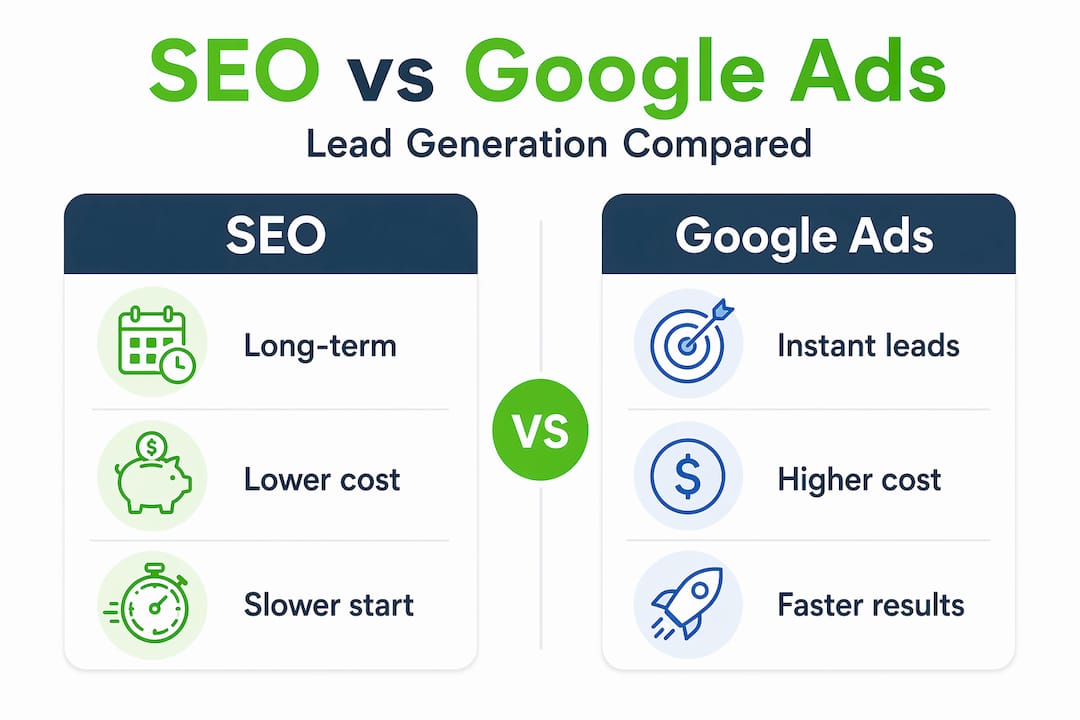
Many ABA clinic owners frame SEO and Google Ads as an either-or decision. That framing costs you leads. Each channel has distinct strengths, and when used together, they cover each other’s gaps in a way that neither can do alone.
What SEO delivers for ABA clinics
SEO is the process of improving your website so that it ranks organically in Google search results. It includes on-page optimization (keyword placement, page speed, mobile responsiveness), technical structure, and local content like city-specific service pages. The payoff from SEO is durable. Once you rank, you generate qualified traffic without paying for every click.
The tradeoff is time. Organic rankings typically take three to six months to build meaningfully. During that window, you need another channel to generate inquiries.
What Google Ads delivers for ABA clinics
Google Ads places your practice at the top of search results immediately. When a parent searches “ABA therapy near me” or “autism therapy for kids in [your city],” your ad appears above the organic results. Google Ads for ABA/healthcare are commonly benchmarked around lead quality and conversion tracking, with particular attention to landing page alignment and negative keywords to reduce wasted spend.
The risk with Google Ads is inefficiency if campaigns are not set up properly. A generic landing page, a broad keyword list with no negatives, and missing call tracking will drain your budget without producing results.
Comparing SEO vs. Google Ads at a glance
| Factor | SEO | Google Ads |
|---|---|---|
| Time to results | 3 to 6 months | Immediate |
| Cost structure | Ongoing optimization investment | Pay per click |
| Lead quality | High (organic trust signal) | High (intent-based targeting) |
| Longevity | Builds over time | Stops when budget stops |
| Conversion tracking | Requires setup | Built into Google Ads platform |
| Best for | Long-term visibility and brand authority | Fast inquiries and precise targeting |
Explore a detailed breakdown at SEO vs. Google Ads for ABA to decide how to weight your investment.
How to blend both methods effectively
The most effective ABA practices use Google Ads to generate leads now while their SEO strategy builds long-term visibility. Over time, as organic rankings improve, you can reduce your ad spend in areas where you already rank well and redirect the budget to new service areas or specialties.
Use effective ABA marketing strategies as your framework for integrating both channels under a single, measurable plan.
- Start Google Ads on your highest-intent keywords immediately.
- Run parallel SEO work: optimize GBP, build local content, and fix technical issues.
- Track which keywords are converting in Ads and target those same terms with organic content.
- As organic rankings rise, shift ad budget toward less competitive long-tail terms or new locations.
Pro Tip: Use the search terms report inside your Google Ads account every two weeks. Any irrelevant queries that triggered your ads should be added as negative keywords. This single habit can reduce wasted spend by 15 to 30 percent over a few months.
Now let’s move from strategy to practical steps you can take today to enhance your ABA clinic’s online presence and see fast results.
Action steps: Implementing high-impact ABA marketing
Knowing the strategy is only half the work. Execution is where most practices stall. The following step-by-step checklist covers the actions that typically produce the fastest improvement in lead volume.
-
Claim and complete your GBP. If you have not already claimed your Google Business Profile, do it today. Fill in every field: name, address, phone, website, hours, service categories (use “Applied Behavior Analysis” as a primary category), photos, and a full business description with your target city names. GBP optimization is often the fastest route to calls from new families.
-
Audit your website for local SEO basics. Check that your name, address, and phone number (NAP) match exactly across your website, GBP, and every directory listing. Even small inconsistencies confuse Google and suppress rankings.
-
Build city-specific service pages. If you serve multiple zip codes or cities, create a dedicated page for each one. Each page should mention the city name naturally, describe the ABA services offered there, and include a local phone number if possible.
-
Set up conversion tracking before launching ads. Install Google Tag Manager and configure goals for phone calls, form submissions, and appointment requests. Running Google Ads for ABA clinics without conversion tracking means you have no idea which keywords or ads are producing real leads.
-
Create a dedicated landing page for each ad campaign. The page should match the ad’s message, focus on a single call to action (schedule a consultation), load in under three seconds, and display clearly on mobile. A mismatched landing page is one of the top reasons ABA Google Ads campaigns fail.
-
Review your site’s design and user experience. Families are evaluating your credibility in seconds. A professional, fast, mobile-friendly site directly impacts whether inquiries happen at all. See ABA therapy web design essentials for specific guidance.
-
Track results weekly and adjust monthly. Review your GBP insights (calls, profile views, direction requests), your Google Ads cost per lead, and your organic traffic trends every week. Make meaningful changes based on a full month of data.
Pro Tip: Use negative keywords from day one in your Google Ads campaigns. Add terms like “free,” “jobs,” “salary,” “training,” and “certification” to your negative keyword list before your first ad goes live. These searches have zero chance of producing a client inquiry and will waste your budget fast.
Having mapped out practical steps, let’s step back and reconsider the entire ABA marketing challenge from a wider-angle view.
What most ABA clinics overlook about marketing success
Here is an honest observation after working with therapy practices across many markets: most ABA clinics do not fail at marketing because of bad tactics. They fail because of inconsistency and a lack of accountability.
The “set and forget” mindset is the most common trap. A clinic hires someone to build a website and set up a Google Ads campaign, then checks results three months later expecting a full appointment book. Marketing does not work that way. Google’s algorithm changes. Competitor clinics increase their ad spend. Seasonal search volume shifts. A strategy that worked in January may need real adjustments by April.
The second trap is ignoring compliance as a marketing concern. Many BCBAs are so careful about clinical ethics that they delegate marketing entirely to someone with no knowledge of the BACB Ethics Code. When that happens, review solicitation, testimonial pages, or client case studies get published without proper oversight. The resulting compliance issues create far bigger problems than low Google rankings.
The third and most important oversight is measuring tactics instead of business outcomes. It is easy to celebrate a drop in cost per click or an increase in page-one rankings. It is harder, but far more valuable, to track how many of those clicks turned into enrolled clients and how much revenue those clients generated. Practices that connect their marketing data to actual intake and enrollment numbers are the ones that make smarter budget decisions and grow faster.
Our honest editorial take: clinics that treat marketing as an ongoing, adaptive function rather than a one-time project consistently see better ROI. That means reviewing your strategy quarterly, staying current with Google’s updates, and always connecting marketing metrics to real business outcomes. Deeper ABA marketing insights can help you build that kind of systematic approach.
Take your ABA clinic’s marketing further with professional support
Understanding the strategy is the first step. Executing it consistently while running a busy clinical practice is where many owners hit a wall. You were trained to deliver exceptional care, not to manage Google Ads campaigns and monitor keyword rankings every week.
At ChitChat Marketing, we specialize in helping ABA therapy practices attract more qualified families through SEO, Google Ads, and professionally designed websites built for conversion. Our Google Ads management services are tailored to the specific compliance and targeting needs of behavioral health practices. Our SEO web design for ABA builds sites that rank, convert, and reflect the professionalism your families expect. If you are ready to stop guessing and start growing, we are ready to help.
Frequently asked questions
What are the most effective digital marketing channels for ABA clinics?
Local SEO and Google Ads are the most effective channels, enabling ABA clinics to target families searching for services nearby and capture high-quality leads. GBP optimization and review management are consistently identified as the fastest path to inbound calls.
How do ABA clinics get Google reviews without violating BACB ethics?
ABA clinics should encourage general online feedback from community members and non-client contacts while avoiding direct solicitation of testimonials from current or former clients. The BACB Ethics Code restricts BCBAs from soliciting client testimonials, so traditional review outreach tactics need to be adapted for this field.
How can I measure the ROI of my ABA marketing campaigns?
Track calls and form submissions through your GBP, set up conversion tracking for Google Ads, and compare cost per lead to average client value over time. Google Ads for healthcare is routinely benchmarked using lead quality and conversion tracking metrics, including landing page performance and negative keyword efficiency.
Is SEO or Google Ads better for ABA therapy businesses?
Both serve different but complementary purposes: local visibility tactics like SEO build long-term trust and organic traffic, while Google Ads for healthcare delivers immediate, intent-based inquiries. Using both together typically produces the strongest lead volume and the lowest cost per enrolled client over time.
Recommended
- Google Ads for ABA clinics: drive more leads in 2026 – ChitChat Marketing LLC
- Google Ads Management | ChitChat For Google Ads Services
- Marketing tips for home service companies to get more leads
- SEO vs Google Ads: Which is Better for Lead Generation? (2025) – ChitChat Marketing LLC

Thomas Guardado is a seasoned digital marketing and SEO expert with over a decade of hands-on experience helping brands grow their online presence and dominate search results. Based in Connecticut, he specializes in organic search strategy, technical SEO, content optimization, and data-driven campaigns that turn clicks into customers.


Leave a comment