TL;DR:
- Content marketing transforms a dental website into an active patient acquisition tool by creating relevant, optimized content. Strategies include SEO, social media, and paid ads, with local relevance boosting community trust and search visibility. Long-term success relies on consistent, compliant content efforts that build digital authority and minimize legal and usability risks.
Your dental practice has a website. Maybe it lists your services, shows your office photos, and includes a contact form. But if new patient inquiries are trickling in slowly, the website alone is not doing enough. Content marketing is the strategy that transforms a static digital brochure into an active patient acquisition tool. This guide walks you through what content marketing means for dentists, which strategies actually move the needle, how local relevance amplifies your results, and why compliance is not optional. By the end, you will have a clear picture of what winning dental practices are doing differently online.
Table of Contents
- What is content marketing for dentists?
- Core strategies: From SEO to social media and paid advertising
- Localizing your content: Stand out in your community
- Website compliance and content safety: Boosting trust and performance
- What most dentists miss about content marketing
- Grow your practice with expert-driven content marketing
- Frequently asked questions
Key Takeaways
| Point | Details |
|---|---|
| SEO builds long-term value | Investing in content and SEO drives sustained patient growth with lower cost per acquisition. |
| Paid ads deliver quick wins | PPC can attract leads fast but requires ongoing spend and strategic management. |
| Local content boosts visibility | Tailoring content to specific communities strengthens search rankings and patient trust. |
| Compliance drives patient trust | Accessible and compliant content enhances engagement, conversions, and legal safety. |
| Consistency is key | Regular content updates and strategy reviews keep your practice competitive and visible. |
What is content marketing for dentists?
Now that we understand the limitations of a basic website, let us clarify what content marketing actually means for dentists.
Content marketing is the practice of creating and publishing useful, relevant information that helps your target audience, which in your case is potential and existing patients, find answers, build trust, and ultimately choose your practice. It is not advertising in the traditional sense. You are not shouting “come to our clinic.” You are showing up when someone searches “why does my tooth hurt after eating sweets” or “best family dentist near Riverside.”
For dental practices, content marketing typically includes:
- Blog posts that answer common patient questions, such as how to manage tooth sensitivity or what to expect during a root canal
- Educational videos showing procedures, introducing your team, or explaining treatment options in plain language
- FAQs that address concerns before a patient even picks up the phone
- Local community guides that position your practice as a neighborhood resource
- Patient testimonials and case studies that build social proof and trust
- Service pages that go beyond a simple list and explain the benefits and process of each treatment
Generic websites fail to compete because they offer little beyond basic information that every other dental site also publishes. Search engines reward depth, relevance, and freshness. A page written three years ago with two paragraphs about “teeth cleaning services” will not rank above a competitor who regularly publishes helpful, detailed content around the same topic.
Understanding SEO marketing for dentists is the foundation that connects all your content efforts to actual search visibility. Without it, even excellent content can remain invisible.
Core strategies: From SEO to social media and paid advertising
With content marketing defined, let us dig into the main strategies dentists can use to drive patient inquiries and grow their practices.

A strong dental content strategy typically works across three interconnected channels: search engine optimization, social media, and paid advertising. Each plays a different role, and together they create a more resilient marketing system.
1. Search engine optimization (SEO)
SEO is the process of making your website content visible to search engines like Google so that patients find you when searching for services you offer. For dentists, this means targeting keywords such as “cosmetic dentist in [your city],” “emergency dental care,” or “Invisalign provider near me.” Well-optimized content includes clear headings, naturally placed keywords, internal links, fast page load times, and mobile-friendly design. A thorough dental marketing guide can walk you through each of these elements step by step.
2. Paid advertising (PPC)
Pay-per-click advertising, commonly known as PPC, places your practice at the top of search results immediately. You pay each time someone clicks your ad. This approach is especially effective when you are launching a new location, promoting a seasonal offer, or need leads fast. The downside is that the moment you stop paying, the leads stop coming. PPC experts can help you structure campaigns that maximize your return without wasting budget on unqualified clicks.
3. Social media content
Platforms like Facebook and Instagram are powerful for building community awareness. Sharing before-and-after photos (with patient consent), office culture content, and educational tips keeps your practice top of mind between appointments. Social media does not directly drive search rankings, but it builds the brand recognition that makes paid and organic campaigns more effective.
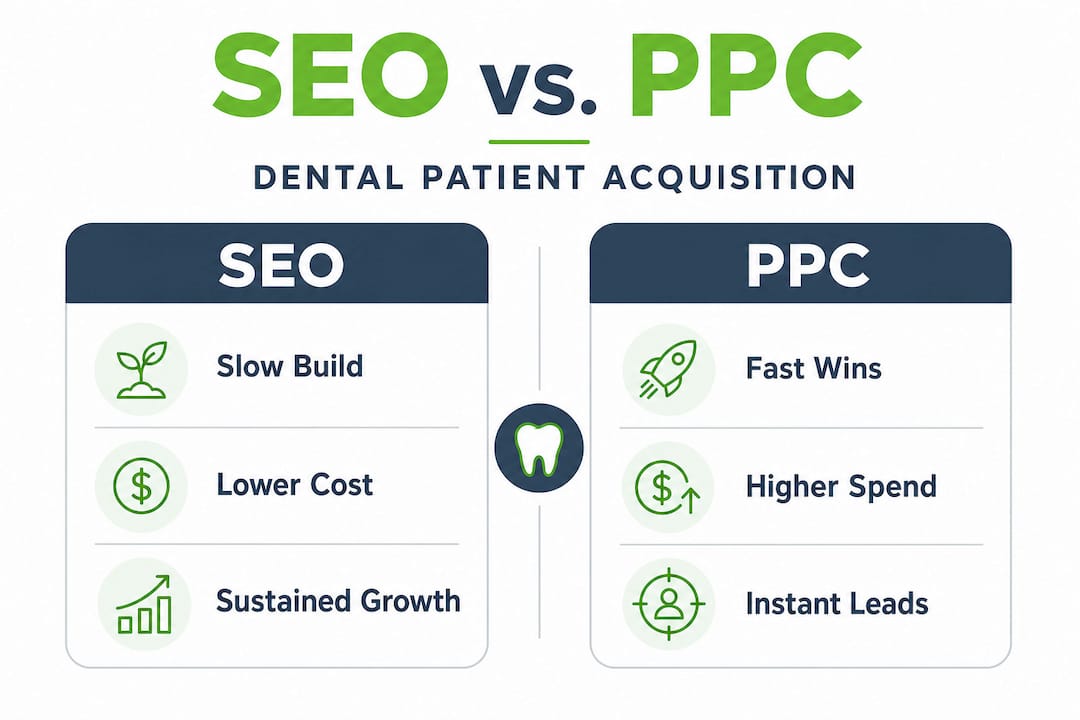
Here is a quick comparison of SEO versus PPC to help you decide where to prioritize:
| Factor | SEO | PPC |
|---|---|---|
| Time to results | 6 to 12 months | Days to weeks |
| Cost over time | Lower cost per acquisition | Ongoing spend required |
| Sustainability | Long-term traffic without per-click cost | Stops when budget stops |
| Conversion quality | High intent, organic trust | High intent, immediate reach |
| Best for | Building authority and long-term growth | Fast lead generation |
The data is clear: organic SEO tends to yield a lower cost per patient acquisition over time, while paid ads deliver faster results but require continuous investment. Neither is inherently better. The question is which one fits your current practice goals.
Pro Tip: The most effective dental marketing combines SEO and PPC simultaneously. Use PPC to capture leads while your SEO content builds momentum. Over time, you can reduce paid spend as organic traffic grows, which lowers your overall cost per new patient.
Explore SEO services for dentists to see what a structured SEO program looks like when applied specifically to dental practices.
Localizing your content: Stand out in your community
Strategic content should not just be national or generic. Let us see how localizing your message can drive real results.
Think about how patients actually search for a dentist. They rarely type “best dentist in America.” They type “dentist near downtown Austin” or “pediatric dentist in Naperville.” This is why local relevance is one of the highest-leverage moves you can make in dental content marketing.
Localizing your content means creating material that speaks directly to the neighborhoods, communities, and concerns of the patients you want to attract. Practical ways to do this include:
- Writing neighborhood-specific landing pages for each area you serve, including the city name and nearby landmarks
- Featuring real patient testimonials from local community members (with proper consent)
- Using authentic local imagery rather than stock photos, including your actual office exterior and nearby streets
- Creating content around local events, such as sponsoring a community health fair or participating in a school dental education program
- Highlighting local partnerships with nearby pediatricians, orthodontists, or wellness centers
For practices with more than one location, multi-location dental content should be customized for each local market rather than using the same generic page with different city names swapped in. Patients and search engines both notice when content feels copied and pasted.
Here is a summary of what localized content delivers compared to generic content:
| Content type | Local search visibility | Patient trust | Conversion rate |
|---|---|---|---|
| Generic service pages | Low | Low | Below average |
| Localized landing pages | High | Moderate | Above average |
| Community-focused blog posts | Moderate to high | High | High |
| Local testimonials and case studies | Moderate | Very high | Very high |
The data tells a clear story. Localized content consistently outperforms generic content across every metric that matters to a growing practice.
Optimizing local SEO for dentists involves more than just mentioning your city name. It includes your Google Business Profile, local citation consistency, review generation, and geo-targeted content that resonates with specific communities.
Pro Tip: Partner with a local business, school, or nonprofit and create content around the collaboration. A post titled “How [Your Practice Name] supported the Lincoln Elementary School Dental Health Week” generates genuine community interest, earns local backlinks, and signals to Google that you are an active part of the area you serve.
Website compliance and content safety: Boosting trust and performance
Beyond content creation, let us examine the crucial compliance and safety factors that influence dental marketing success.
Compliance in dental marketing covers three major areas: ADA (Americans with Disabilities Act) accessibility, HIPAA (Health Insurance Portability and Accountability Act) privacy rules, and dental advertising regulations. Ignoring any one of these can expose your practice to legal risk, damage patient trust, and even hurt your search rankings.
ADA accessibility means your website must be usable by people with disabilities. This includes providing alt text for images, captions for videos, sufficient color contrast, and keyboard navigability. Many dental websites fail basic accessibility checks, which creates a poor user experience for a segment of your potential patient base.
HIPAA rules govern how you handle patient information in your marketing. You cannot use a patient’s name, photo, or health details without specific written consent. Even well-meaning testimonial pages can cross HIPAA lines if the practice has not obtained proper authorization.
Advertising regulations set by state dental boards restrict certain claims. Phrases like “best dentist in the city” or “guaranteed results” may violate rules that prohibit false or misleading advertising. Before publishing any promotional content, know your state’s specific guidelines.
Key compliance checkpoints for your dental website include:
- Image alt text describing all visual content accurately
- Closed captions on all videos featuring spoken content
- A clear privacy policy that explains data collection practices
- HIPAA-compliant patient intake forms and contact forms
- No unpermitted use of patient identifiable information in testimonials
- Advertising claims that are truthful, verifiable, and compliant with your state dental board
“Dental websites and marketing efforts increasingly need accessibility and HIPAA/advertising-rule awareness. Accessibility improvements can improve engagement and user experience, which supports SEO and conversions.” Dental website compliance guide
Accessibility is not just a legal obligation. It is a competitive advantage. An accessible website loads more efficiently, earns higher engagement metrics such as lower bounce rate and longer session duration, and provides a better experience for all users regardless of ability. Those engagement signals tell Google that your site is worth ranking.
What most dentists miss about content marketing
Having covered all the tactical aspects, let us reflect on what separates successful dental marketers from those who struggle.
Here is an honest observation from watching dental practices approach content marketing: most of them treat it like a one-time project. They build a website, publish a handful of blog posts, and then wait. When results do not materialize in 60 days, they conclude that content marketing does not work. But that thinking misunderstands how content actually builds value.
Content marketing is cumulative. Each article, each local landing page, each optimized service page adds to a growing body of digital authority. A practice that publishes two quality blog posts per month consistently for two years has a fundamentally different online presence than one that published ten posts two years ago and then stopped. Search engines reward recency and consistency. So do patients who notice your practice keeps showing up with helpful, current information.
The second thing most dentists miss is the relationship between compliance and performance. Practices that skip accessibility or fudge their advertising claims to sound more impressive often see worse long-term results, not better. A site that delivers a poor experience for users with accessibility needs will have higher bounce rates. Misleading claims can trigger board complaints that damage your reputation far more than modest, honest marketing ever would.
And finally, the biggest blind spot is the expectation of fast wins without real strategy. Some practices invest heavily in PPC but neglect their website’s landing pages, so paid traffic arrives and immediately leaves because the page does not answer the patient’s question. Others spend on SEO for dentists without tracking which keywords are actually converting new patient calls versus casual browsers.
The practices that win long-term are the ones that document what works, keep refining their content, and treat marketing as an ongoing investment rather than a one-time expense. They track metrics like cost per new patient, lead source, and conversion rate by service line. They adapt when something is not working rather than abandoning the strategy entirely.
Grow your practice with expert-driven content marketing
With a smarter approach to content and compliance, you are ready to take your marketing from good to great. Here is how to get started.
Building a content strategy that actually attracts new patients requires more than good writing. It requires technical SEO, smart design, and paid advertising working together in a system built for your specific practice goals.
At ChitChat Marketing, we specialize in exactly that. Our SEO web design services ensure your site is built to rank and convert from day one. Our affordable SEO services give dental practices a consistent content and optimization strategy without requiring a massive budget. And when you need fast lead generation, our Google Ads solutions put your practice in front of patients who are actively searching for care. Let us help you build a marketing system that works as hard as you do.
Frequently asked questions
How long does it take to see results from dental content marketing?
SEO-driven content typically brings noticeable results in 6 to 12 months, while PPC can deliver leads much faster, sometimes within days of launching a campaign. SEO has a longer time-to-ROI compared with PPC’s more immediate effects, which is why combining both approaches is often the smartest path.
Why is localization important for dental practices with multiple locations?
Localization ensures your content is relevant to each specific community you serve, which boosts local search rankings and builds patient trust faster than generic content. Content localized for each market directly supports local search visibility and helps each office attract patients in its specific area.
What are key compliance concerns for dental marketing content?
Dental content must meet ADA accessibility standards, follow HIPAA privacy rules, and comply with state dental board advertising regulations to protect your practice and build patient confidence. Dental marketing compliance covers everything from alt text on images to how patient testimonials are collected and displayed.
Should dental practices use both SEO and paid ads?
Combining SEO with paid advertising maximizes both short-term lead volume and long-term patient growth at the lowest sustainable cost. Organic SEO yields lower cost per patient acquisition over time, but PPC fills the gap while your organic presence builds momentum.
Recommended
- SEO Marketing for Dentists: Convert Searches into Patients – ChitChat Marketing LLC
- Step-by-Step Dental Marketing Guide: Attract More Patients
- Local SEO For Dentists| ChitChat For Dental SEO

Thomas Guardado is a seasoned digital marketing and SEO expert with over a decade of hands-on experience helping brands grow their online presence and dominate search results. Based in Connecticut, he specializes in organic search strategy, technical SEO, content optimization, and data-driven campaigns that turn clicks into customers.
Leave a comment