TL;DR:
- Many service marketers mistakenly believe larger Google Ads budgets guarantee better results, but success depends on strategic keyword use. Proper match types, negative keywords, and continuous refinement optimize lead quality and reduce costs, aligning spend with intent. In 2026, combining structured targeting with AI-driven signals is essential for maximizing Qualified lead generation from Google Ads campaigns.
Most marketing managers running Google Ads for service businesses believe that bigger budgets automatically mean better results. That assumption is costly. The real performance lever in any Google Ads campaign is keyword strategy. When you choose the right keywords, structure your match types properly, and cut out irrelevant traffic with negatives, your cost per lead drops and your qualified lead volume climbs. This guide covers everything you need: why keywords matter more than spend, how match types work, how to use negatives effectively, and how to build an ongoing workflow that keeps improving your results.
Table of Contents
- How keywords shape Google Ads success
- Decoding keyword match types: broad, phrase, and exact
- Harnessing negative keywords for qualified traffic
- Boosting ad relevance with dynamic keywords and Quality Score
- A step-by-step keyword workflow for service businesses
- Our take: Why intent and AI—not just keywords—drive Google Ads success in 2026
- Take your keyword strategy to the next level
- Frequently asked questions
Key Takeaways
| Point | Details |
|---|---|
| Keyword targeting powers results | Careful keyword selection and match type choice make or break Google Ads lead quality and ROI. |
| Negatives filter wasted spend | Adding and reviewing negative keywords weekly keeps ad budgets focused on high-value prospects. |
| Quality Score boosts ROI | Improving your Quality Score can lower your ad costs by up to 50 percent. |
| Balance AI with discipline | Leverage advanced targeting and automation, but strategic keyword and negative management remain essential. |
How keywords shape Google Ads success
Keywords are not just search terms you add to a campaign. They are the trigger mechanism that determines when and for whom your ads appear. Every time someone searches on Google, an auction runs instantly behind the scenes. Your keywords tell Google which auctions to enter on your behalf.
Keywords in Google Ads trigger ad auctions by matching user search queries through three main match types: broad, phrase, and exact.
That distinction matters because not every auction is worth entering. A plumber running ads for “emergency pipe repair” does not want to show up for “DIY pipe repair YouTube tutorial.” Entering the wrong auctions wastes budget and drives up your cost per qualified lead.
Here is why keyword precision pays off financially. Google assigns every ad a Quality Score, a rating from 1 to 10 based on three factors:
- Expected click-through rate (CTR): How likely users are to click your ad
- Ad relevance: How closely your keyword, ad copy, and intent align
- Landing page experience: How well your landing page matches the user’s need
A higher Quality Score can lower your cost-per-click (CPC) by up to 50%. That means two campaigns with the same budget can produce dramatically different results depending entirely on keyword alignment. For service businesses chasing qualified leads, this is one of the highest-leverage improvements available.
Doing thorough local keyword research before you launch a campaign is essential. Knowing which terms your target customers actually type, including location modifiers and service-specific phrases, directly impacts how efficiently your budget works. You should also understand how ranking a service area business differs from ranking a storefront, since your keyword targets and bid strategy will reflect that difference.

Decoding keyword match types: broad, phrase, and exact
Once you understand why keywords matter, the next question is how to use them. Google offers three main match types, and each one makes a different trade-off between reach and control.
| Match type | How it works | Best use case | Risk level |
|---|---|---|---|
| Broad match | Shows for synonyms, related searches, AI-enhanced queries | Discovery and scaling with Smart Bidding | High without negatives |
| Phrase match | Shows when the phrase appears in order within the query | Targeted reach with moderate control | Medium |
| Exact match | Shows only for queries matching the keyword exactly or closely | Maximum precision and lead quality | Low but limited volume |
Here is how each plays out in practice for a service business:
-
Broad match works by casting the widest net possible. Broad match reaches the widest queries including synonyms and related searches, enhanced by AI signals like landing pages and past user behavior. For example, bidding on “HVAC service” in broad match might also trigger your ad for “home cooling repair” or “air conditioning company near me.” That can be powerful or wasteful depending on your negative keyword list.
-
Phrase match triggers your ad when someone’s search contains your keyword phrase in the correct order, with other words allowed before or after. A phrase match for “roof repair Austin” would show for “best roof repair Austin TX” but not for “Austin roof replacement company.” This gives you meaningful control without the narrow limitations of exact match.
-
Exact match shows your ad only for searches that closely match your keyword. Bidding on [exact match] for “emergency locksmith Dallas” means your ad appears almost exclusively for that search and its very close variants. Lead quality is highest, but volume is lower.
The landscape in 2026 is shifting significantly. Traditional keyword control is giving way to intent and AI signals. Google’s systems increasingly determine relevance based on user history, device behavior, and landing page content rather than exact query matching alone.
Pro Tip: When starting a new campaign, launch with phrase and exact match to build conversion data. After accumulating 30 to 50 conversions, test broad match with Smart Bidding turned on. You will let the AI optimize reach while your historical data keeps it focused on quality.
A smart approach is to think about the optimal number of keywords for each ad group. Packing 50 keywords into one group dilutes relevance and hurts your Quality Score. Aim for 5 to 15 tightly themed keywords per ad group to keep your ads, keywords, and landing pages aligned.
Harnessing negative keywords for qualified traffic
Even a well-structured keyword list will attract some irrelevant clicks. Negative keywords are how you stop paying for those clicks before they drain your budget.
A negative keyword tells Google: “Do not show my ad if the search includes this word or phrase.” For service businesses, negative keywords are often the difference between a campaign that breaks even and one that generates a consistent, profitable flow of leads.
The guidance on best practices is clear. Service businesses should use 2 to 3 word phrases focusing on high-intent terms like location plus service, and add at least 3 negatives per ad group to filter irrelevant traffic. That is a minimum, not a ceiling.
Here are practical negative keyword examples by business type:
- Locksmith: Add negatives like “DIY,” “how to pick,” “free,” “jobs,” “training,” “certification”
- Medical clinic: Add negatives like “veterinary,” “home remedy,” “insurance comparison,” “lawsuit,” “malpractice”
- HVAC company: Add negatives like “parts,” “manual,” “repair yourself,” “YouTube,” “Craigslist”
- Plumber: Add negatives like “plumber salary,” “plumbing school,” “pipe parts price,” “DIY tutorial”
Negative keywords prevent ads from showing on irrelevant queries. Use broad or phrase negatives to block entire concepts, and review your search terms report weekly to catch new patterns.
Pro Tip: Export your search terms report every Monday morning. Sort by impressions and look for any query that generated clicks but zero conversions. Add those as negatives before you run another week of spend.
Over-negating is a real risk. If you block too many terms, you limit Google’s ability to find new converting audiences. Consider combining your negative keyword strategy with local SEO strategies to capture organic traffic for terms that are too broad or expensive to bid on. You can also explore marketing tips for service businesses to identify the customer intent signals most common in your niche before building your negative list.
Boosting ad relevance with dynamic keywords and Quality Score
Relevance is what separates a good Google Ads campaign from a great one. Two tools help you build that relevance at scale: dynamic keyword insertion and Quality Score optimization.
Dynamic keyword insertion (DKI) automatically updates your ad headline to include the exact search query a user typed, as long as it fits within character limits. If someone searches “emergency roof repair Denver,” your headline might read: “Emergency roof repair Denver available now.” That level of personalization drives higher CTR because the ad looks like an exact match to what the searcher wanted.
Dynamic keyword insertion and ad customizers dynamically insert keywords or data into ads for higher relevance, which can meaningfully lift CTR and improve Quality Score simultaneously.
Here is a benchmark table to help you assess where your campaign stands:
| Metric | Average benchmark | Strong performance |
|---|---|---|
| Search CTR | 3.5% | 6%+ |
| Conversion rate | 3.2% | 7%+ |
| Quality Score (non-brand) | 5 to 6 | 7+ |
| Cost per lead (services) | Varies by vertical | Trending downward QoQ |
According to 2024 Google Ads benchmarks, average search CTR ranges from 3.5% to 6.66%, and conversion rates from 3.2% to 7.52%. If your numbers fall below these ranges, your keyword and ad alignment likely needs work.
The connection between Quality Score and cost is direct. A QS of 7 or higher for non-brand keywords typically means you are paying less per click than competitors with lower scores, even when bidding for the same positions. To reach that score, your keyword, ad headline, ad description, and landing page must all reinforce the same intent and message.
You can also strengthen performance by understanding the local SEO advantages that complement your paid campaigns. When your organic and paid presence align on the same high-intent local keywords, you build more trust with searchers and see stronger overall conversion rates.
A step-by-step keyword workflow for service businesses
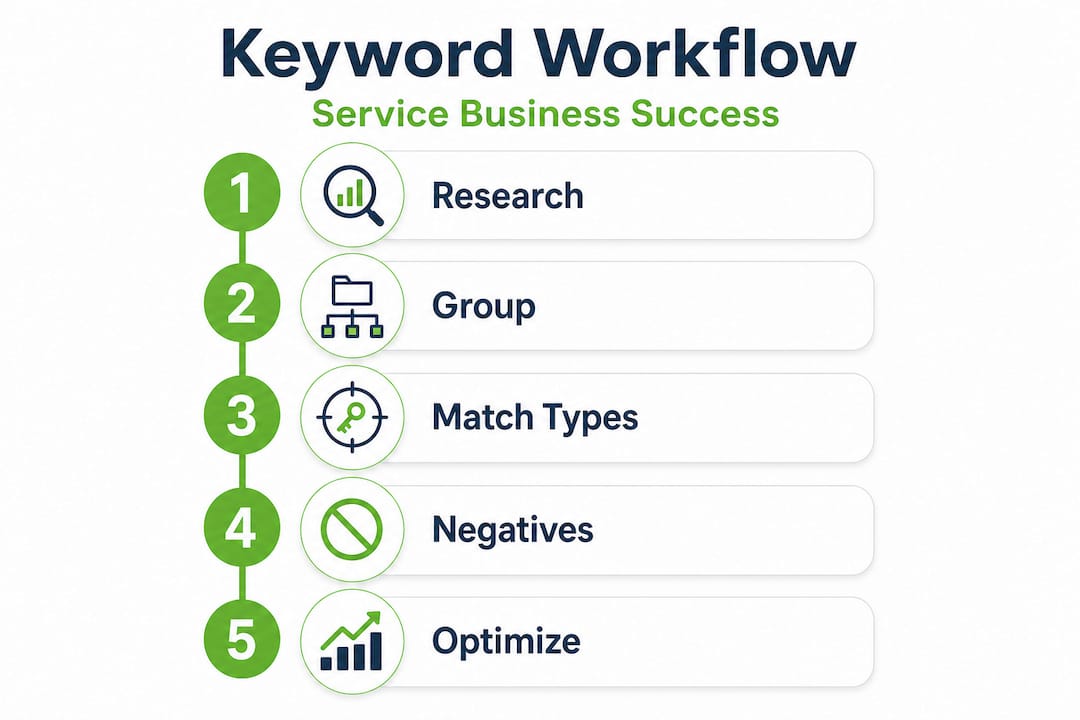
Knowing the concepts is one thing. Executing them consistently is another. Here is a practical workflow you can follow every time you build or refresh a keyword strategy for a service business campaign.
-
Identify high-intent local phrases. Use Google Keyword Planner, your own search terms report, and competitor analysis to build a list of 50 to 100 candidate keywords. Focus on phrases that combine a service type with a location or urgency modifier. For example: “emergency HVAC repair Chicago” or “licensed electrician near me.”
-
Organize by intent and theme. Group keywords into tightly themed ad groups. Each group should reflect one service or one stage of the buyer journey. Avoid mixing “emergency” and “routine” services in the same group. They signal different intent and need different ad copy.
-
Assign match types strategically. Start with phrase and exact match for your highest-value keywords. Use broad match only in a separate testing campaign with Smart Bidding enabled. This keeps your core campaign efficient while allowing AI to explore new opportunities in a controlled way.
-
Build your negative keyword list before launch. Before spending a single dollar, add a foundational negative list covering DIY intent, informational queries, job seeker terms, and unrelated service categories. You can pull from your industry research and competitor analysis.
-
Enable dynamic keyword insertion in your headlines. Set up at least one DKI headline per ad to personalize your message to the exact search query. Make sure your fallback headline (the default if the keyword is too long) still makes sense and includes your main value proposition.
-
Review and refine weekly. Every week, pull your search terms report and check for new irrelevant queries. Add negatives, adjust bids on underperforming keywords, and pause any exact match terms with high spend and zero conversions.
Pro Tip: Use Google’s “Auction Insights” report monthly to see which competitors are appearing alongside your ads. If a competitor consistently outranks you on your top keywords, analyze their landing pages and ad copy for alignment signals you might be missing.
Real campaigns prove this works. A local locksmith case study shows that shifting to exact and phrase match high-ticket keywords combined with aggressive negatives cut wasted spend significantly. A medical clinic that clustered queries by intent saw a 275% lift in conversions. These results come from structure and discipline, not budget increases.
For ongoing improvement, look at service business SEO tips to identify keyword gaps between your paid and organic performance. The combination of paid precision and organic presence creates a compounding effect on lead volume over time.
Our take: Why intent and AI—not just keywords—drive Google Ads success in 2026
Here is something most Google Ads articles will not tell you: keywords are necessary but no longer sufficient on their own. In 2026, the marketers winning on Google Ads treat keywords as a strategic framework, not a magic list.
AI now plays a dominant role in ad delivery. Google’s systems look at the user’s search history, device behavior, location signals, and even the content of your landing page to decide when to show your ad. That means two campaigns with identical keyword lists can produce very different results depending on how well the surrounding signals support relevance.
The mistake we see most often is binary thinking. Marketing managers either trust Google’s AI completely and run broad match without guardrails, or they over-control with thousands of negative keywords and exact match only, strangling their reach. Both extremes cost money.
Broad match with Smart Bidding is recommended, but it requires vigilant negative keyword management to avoid irrelevant spend. Over-negating can limit reach just as much as under-negating creates waste. The right answer lives in the middle: use AI-enhanced match types to expand your reach intelligently, and use structured negatives to keep that reach profitable.
The marketers seeing outsized results in 2026 combine meticulous campaign structure with machine learning benefits. They use exact and phrase match for their known, high-converting queries. They use broad match in isolated testing campaigns to discover new converting intent patterns. And they review performance weekly to keep both approaches calibrated.
Keywords set the playbook. Intent and AI run the game. Your job as a marketing manager is to build a playbook disciplined enough to guide the AI toward qualified leads, not just clicks. That is the shift that separates campaigns that generate calls from campaigns that generate reports. Visit our expert Google Ads management page to see how we structure campaigns around this principle.
Take your keyword strategy to the next level
Building a keyword strategy that consistently drives qualified leads takes time, testing, and expert-level knowledge of how Google’s auction system evolves. If your current campaigns are generating clicks but not conversions, or you are spending more than you should per lead, the framework in this guide gives you a strong starting point.
Our Google Ads management services are built specifically for service businesses that want more qualified leads without wasted ad spend. We combine proven keyword frameworks with ongoing optimization to make sure every dollar works harder. Pair that with our home service SEO to build long-term organic visibility alongside your paid campaigns. Ready to see what a smarter, ROI-focused strategy can do for your business? Reach out for a free consultation and let’s build a plan that actually delivers results.
Frequently asked questions
What is the most effective keyword match type for local service businesses?
Phrase and exact match types usually deliver the highest lead quality for local service businesses, especially when paired with targeted negatives that filter out informational and DIY queries.
How often should I update my negative keywords list?
Review your search terms and update negative keywords at least once a week to catch new irrelevant queries before they drain your budget over multiple days.
How does Quality Score affect my Google Ads costs?
A higher Quality Score can reduce your cost-per-click by up to 50%, meaning you can outrank competitors while spending less per click.
Should I trust Google’s AI-driven Smart Bidding and broad match?
Smart Bidding with broad match can work well, but broad match requires vigilant negative keyword management to control irrelevant traffic and prevent wasted spend on low-intent queries.
Recommended
- Google Ads for ABA clinics: drive more leads in 2026 – ChitChat Marketing LLC
- How Google Ads Can Help You Advance Your Business Goals – ChitChat Marketing LLC
- Google Ads Management | ChitChat For Google Ads Services
- Keyword Research Tips for SEO Strategy – ChitChat Marketing LLC

Thomas Guardado is a seasoned digital marketing and SEO expert with over a decade of hands-on experience helping brands grow their online presence and dominate search results. Based in Connecticut, he specializes in organic search strategy, technical SEO, content optimization, and data-driven campaigns that turn clicks into customers.

Leave a comment