TL;DR:
- In 2026, SEO success depends on technical eligibility, managing AI crawlers, and ensuring content authenticity across markets.
- Operational discipline, including regular audits and clear ownership, has become essential for maintaining AI-driven search visibility and business outcomes.
Most marketing professionals still measure SEO success by where their pages rank on Google. That mindset is becoming obsolete fast. In 2026, AI-driven search engines don’t just crawl and index your content. They evaluate whether your site is even eligible for consideration before making any selection decisions. The rules have shifted from chasing keyword positions to proving technical credibility, managing AI bot access, and demonstrating entity authority across every market you serve. This guide breaks down what those shifts mean for your strategy and how you can adapt now.
Table of Contents
- SEO eligibility: The new technical baseline
- Managing AI crawlers and llms.txt: New standards for 2026
- International SEO in 2026: Earning trust with entity lineage and freshness
- From ranking to outcomes: Building your 2026 SEO success stack
- Why SEO discipline in 2026 means operational change, not just new tactics
- Elevate your 2026 SEO strategy with expert help
- Frequently asked questions
Key Takeaways
| Point | Details |
|---|---|
| Technical SEO is eligibility | In 2026, technical SEO is required for search engines to even consider your content. |
| AI bot management matters | Monitoring and governing AI crawlers is now critical for controlling web visibility. |
| Entity clarity leads internationally | AI-first search demands strong entity and local validation for global SEO success. |
| Shift to outcome-based SEO | Prioritize eligible content, selection by AI, and measurable conversions over traditional ranking goals. |
SEO eligibility: The new technical baseline
With the context set, let’s start by examining how the technical rules of SEO have transformed.
You may have heard that technical SEO still matters. That’s true, but the framing has changed significantly. Technical SEO in 2026 now functions as an eligibility standard for AI-powered retrieval systems, not a guaranteed path to top rankings. Think of it this way: passing a background check doesn’t get you the job, but failing one removes you from the running entirely.
AI-driven search engines filter out technically deficient sites before any content evaluation happens. That means your technical SEO essentials are no longer about gaining an edge. They are about staying in the game at all.
The good news is that the web has made measurable progress. Consider these benchmarks:
- HTTPS adoption has surpassed 91% across indexed pages, making a secure connection table stakes rather than a differentiator.
- Canonical tag implementation has risen steadily, reducing duplicate content confusion for both traditional crawlers and AI retrieval systems.
- Robots.txt errors have declined as more teams audit their crawl configurations regularly.
- Core Web Vitals compliance continues to matter, especially as AI engines use page experience signals to assess content quality.
These numbers signal that the baseline is rising. If is SEO still relevant is a question you’ve been asking, the answer is absolutely yes. But relevance now means meeting a stricter eligibility threshold, not gaming an algorithm.
What qualifies as good SEO hygiene in 2026?
- Consistent HTTPS across all pages, including subdomain and redirect chains
- Accurate and regularly reviewed robots.txt files
- Proper canonical tags on paginated, filtered, or duplicate pages
- Clean XML sitemaps with only indexable, live URLs
- Passing Core Web Vitals scores on mobile and desktop
- No orphaned pages or broken internal link structures
Pro Tip: Schedule a technical SEO audit every quarter, not just annually. AI systems recrawl frequently, and a hidden penalty or crawl block can remove your pages from AI retrieval pools without triggering a visible ranking drop.
Managing AI crawlers and llms.txt: New standards for 2026
Once technical eligibility is in place, attention shifts to new operational realities like AI crawler management.

Here is something most marketing teams haven’t fully addressed yet: AI bots are now a significant portion of your site’s crawl traffic, and they operate differently from traditional Googlebot. LLM crawler management is becoming a real operational concern, and ignoring it means losing control over how your content is consumed and potentially cited by AI-powered search results.
The growth in AI bot traffic is substantial. Look at these crawl presence figures:
| AI Crawler | Desktop crawl share (2025) | Desktop crawl share (2026) | Mobile crawl share (2025) | Mobile crawl share (2026) |
|---|---|---|---|---|
| GPTBot (OpenAI) | ~2.1% | ~4.5% | ~2.0% | ~4.2% |
| ClaudeBot (Anthropic) | ~1.8% | ~3.6% | ~1.7% | ~3.4% |
| Other LLM bots | ~1.0% | ~2.3% | ~0.9% | ~2.1% |
These are not trivial numbers. GPTBot nearly doubled its crawl presence year over year. That traffic is reading your content and potentially synthesizing it into AI-generated answers, summaries, and citations. Your AI search optimization strategies need to account for this reality.
Three operational steps to manage AI crawlers in 2026:
- Audit your AI bot traffic. Use your server logs or analytics tools to identify which AI crawlers are accessing your site, how frequently, and which pages they prioritize. This gives you real data to act on.
- Update your robots.txt file. If certain content is proprietary, behind a paywall, or not intended for AI training or summarization, use robots.txt directives to restrict specific bot user agents like GPTBot or ClaudeBot.
- Create and maintain an llms.txt file. This is a newer governance standard that allows you to communicate directly with LLM systems about how your content should be used. Think of it as a policy document for AI bots, sitting at the root of your domain.
What should your llms.txt file include? At minimum, it should specify which content is available for AI synthesis, any restrictions on commercial use of your content, and preferred citation formats if you want to encourage attribution.
Pro Tip: Assign specific responsibility for LLM bot governance to someone on your web or marketing operations team. Without clear ownership, these files go stale and your policies become unenforceable.
International SEO in 2026: Earning trust with entity lineage and freshness
Beyond technical and crawler management, let’s see how international SEO strategy must evolve.
If your business targets customers in multiple countries or languages, the old playbook of hreflang tags and geo-targeted landing pages still has value, but it is no longer sufficient. International SEO in 2026 is increasingly about entity lineage, local validation, and governance of content freshness across every market you serve.
Here is the critical shift: AI-powered search systems can select a preferred version of your content before traditional localization signals are even processed. If your brand identity is ambiguous or inconsistent across markets, an AI engine may default to a version of your site that doesn’t serve the right audience.
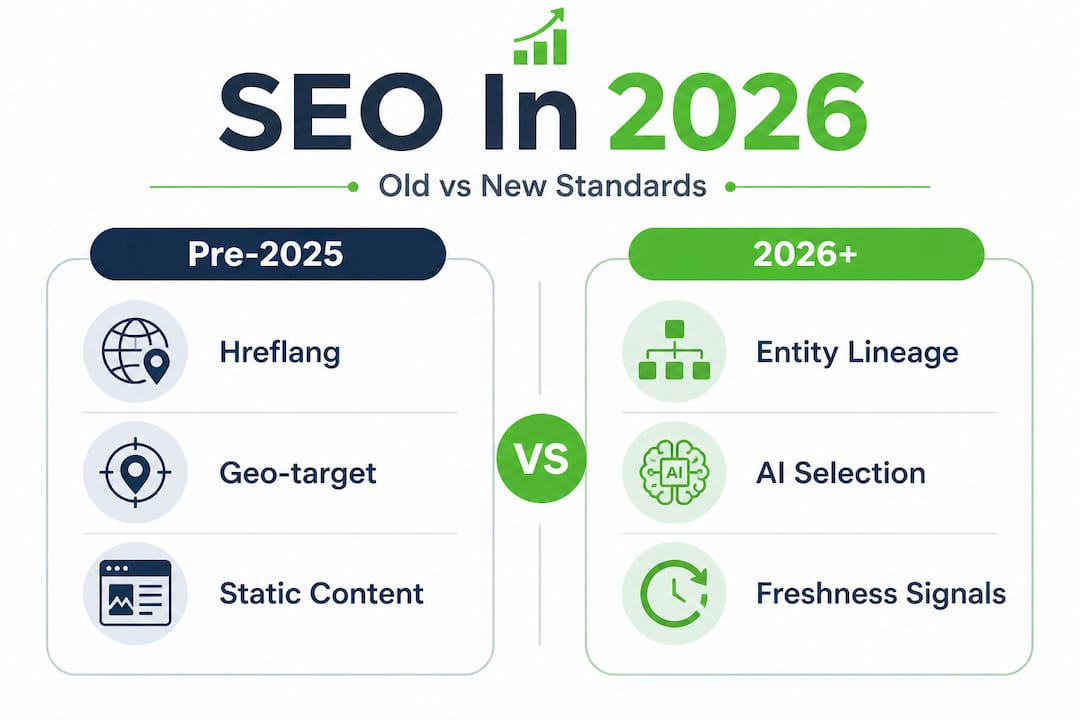
Old approach vs. new approach to international SEO:
| Factor | Old approach (pre-2025) | New approach (2026) |
|---|---|---|
| Localization signal | Hreflang tags | Entity clarity and consistent brand presence across markets |
| Local authority | Local backlinks | Local validation through directories, citations, and community signals |
| Content updates | Update when it feels needed | Freshness governance with scheduled audits |
| AI readiness | Not a consideration | Structured data and entity markup for AI retrieval |
What entity lineage means in practice:
Your entity lineage refers to how clearly and consistently your brand, company name, locations, and services are represented across the entire web. If your business name appears differently on your website, Google Business Profile, LinkedIn, local directories, and social profiles, AI systems struggle to form a coherent picture of who you are and which audience you serve.
Here are the key areas to address:
- Name, address, and phone (NAP) consistency across every local listing and directory
- Schema markup that explicitly connects your brand, services, and locations
- Local validation signals like reviews, local news mentions, and community-level citations
- Freshness governance meaning a documented process for auditing and updating content on a fixed schedule, especially for service pages, pricing, and location-specific information
Content that goes stale is a particular risk with AI-driven search. If a competitor updates their local service pages monthly and you update yours annually, AI retrieval systems will increasingly favor the fresher, more reliable source. Explore international SEO strategies to see how these principles apply across different market contexts.
From ranking to outcomes: Building your 2026 SEO success stack
With technical and international layers clarified, the real focus shifts to what constitutes SEO success in 2026.
Ranking reports still have their place, but they tell an incomplete story. Small-to-mid-sized businesses need to shift planning away from pure ranking targets and toward an outcome stack that includes eligibility, selection, and real business impact. This is the framework that separates forward-thinking SMBs from those still chasing page-one positions.
“SEO success in 2026 is not a ranking. It’s a chain of outcomes: your site is eligible, your content is selected by AI systems, and that visibility converts into leads or revenue.”
The three-layer SEO outcome stack:
- Eligibility: Your site passes the technical and governance standards required for AI and traditional search systems to consider your content. This includes clean code, proper bot directives, secure connections, and accurate structured data. Without this, nothing else matters.
- Selection: Your content is chosen for synthesis, citation, or display by search engines and AI-powered answer systems. Selection depends on authority, entity clarity, content freshness, and how well your content answers specific queries with depth and accuracy.
- Outcome: Selected visibility leads to measurable business results. This means tracking not just clicks and impressions but also which pages drive conversions, qualified leads, and actual revenue.
To understand how to connect these layers, look at how measuring SEO ROI has evolved. The tools now exist to track from a search impression all the way through to a closed sale, and you should be using them.
Building SEO into your web presence:
Your SEO web design practices directly influence all three layers of the outcome stack. A site that loads fast, structures content logically, and uses clear internal linking supports eligibility and selection simultaneously. A site that buries calls-to-action or forces users through confusing navigation undermines the outcome layer even when eligibility and selection are strong.
Pro Tip: Build your monthly reporting dashboard around eligible pages, AI-cited pages, and conversion metrics. Rankings still have value as a directional signal, but they should not be the primary metric your team reports on in 2026.
Why SEO discipline in 2026 means operational change, not just new tactics
Stepping back, it is important to see why these shifts demand more than just a tactical adjustment. They require a genuine change in how your marketing operation is organized and managed.
Most marketing teams treat SEO as a project. You conduct an audit, implement fixes, publish some content, and then move on until the next quarterly review. That approach worked reasonably well when search was primarily driven by keyword matching and link signals. It doesn’t work when AI systems are continuously re-evaluating your site’s credibility, freshness, and governance.
The teams winning at SEO in 2026 are not the ones who found a clever new ranking trick. They are the ones who operationalized SEO and marketing discipline into their regular workflows. That means:
- Documented processes for content updates, technical checks, and bot governance reviews
- Clear ownership of each SEO layer, from technical hygiene to entity management to performance reporting
- Cross-functional alignment between marketing, web development, and content teams so that SEO requirements are built into every project from the start
The uncomfortable truth is that most SMBs underinvest in the operational infrastructure of SEO. They spend on content creation but have no formal process for auditing whether that content stays accurate and fresh. They implement technical fixes reactively rather than proactively. They have no one specifically responsible for monitoring AI bot behavior on their site.
Entity clarity is another area where operational discipline pays off. If your brand name, service descriptions, and location data are managed inconsistently because different team members update different platforms without coordination, you create confusion for AI retrieval systems. That confusion costs you selection opportunities, which directly reduces business outcomes.
The organizations that will lead in search visibility over the next three years are building SEO into their culture, not just their marketing budget. That is the real transformation this moment demands.
Elevate your 2026 SEO strategy with expert help
Ready to turn insight into action? Implementing everything covered in this guide takes expertise, the right tools, and a consistent operational approach that many in-house teams simply don’t have bandwidth for.
At ChitChat Marketing LLC, we help small and mid-sized businesses build the technical foundation, AI governance policies, and content frameworks needed to compete in 2026’s search environment. Whether you need a thorough SEO audit to identify eligibility gaps, want to improve your site’s structure with SEO-focused web design, or are looking for practical SEO optimization tips tailored to your market, we are here to guide you. Let’s build a strategy that generates real leads, not just rankings.
Frequently asked questions
What is llms.txt and why does it matter for SEO in 2026?
llms.txt is a new governance file standard that allows website owners to communicate policies directly to AI and LLM crawlers, helping manage how your content is accessed, synthesized, and cited by AI-driven search systems.
Will optimizing for classic ranking factors like keywords still work in 2026?
Classic factors like keyword relevance still contribute, but technical eligibility standards have become the higher priority. Without meeting AI-era eligibility requirements, even well-optimized keyword content may not be selected for visibility.
How can small businesses track their SEO success in 2026?
Move beyond rankings and measure which pages are eligible for AI selection, which are actually cited or surfaced in AI-driven results, and which ones drive measurable business impact like leads and revenue.
Is international SEO still worth the effort with AI-driven search?
Absolutely, but the strategy must shift toward entity lineage and freshness governance. Building consistent brand and location signals across every market, combined with regular content audits, is what earns AI-driven visibility in international search.
Recommended
- SEO Optimization Tips That Drive Real Business Growth – ChitChat Marketing LLC
- Is SEO Dead? The Reality You Need to Know for 2025
- Best Platforms for AI Search Optimization: Competitor Analysis 2025 – ChitChat Marketing LLC
- Mastering Squarespace SEO: Essential Tips
- How to build high-performing ad creatives in 2026
- 5 strategic ways to create brand impact in 2026

Thomas Guardado is a seasoned digital marketing and SEO expert with over a decade of hands-on experience helping brands grow their online presence and dominate search results. Based in Connecticut, he specializes in organic search strategy, technical SEO, content optimization, and data-driven campaigns that turn clicks into customers.

Leave a comment