TL;DR:
- Home service businesses must prioritize local SEO, including Google Business Profile optimization and consistent citations, to attract qualified leads. Active, ongoing engagement through reviews, updates, and fresh content significantly improves rankings and visibility. Consistent weekly efforts and professional support can accelerate growth and outperform competitors relying on one-time setup.
You put in long days delivering quality work, but your phone stays quiet because competitors show up first in Google searches. Local search visibility is where most home service leads begin, and missing even a few foundational SEO steps can cost you dozens of qualified calls every month. This checklist walks you through ten concrete actions, from optimizing your Google Business Profile to earning local backlinks, so you can build a steady, predictable pipeline of leads without relying entirely on paid ads or word of mouth.
Table of Contents
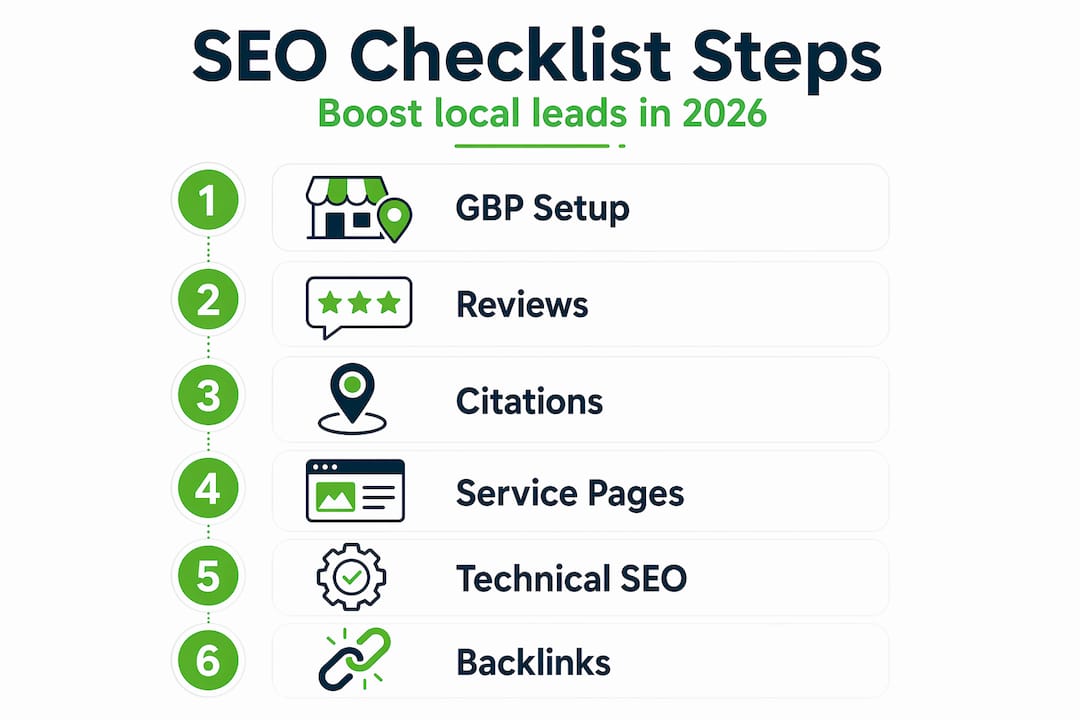
- Understand the SEO landscape for home services
- Optimize your Google Business Profile for maximum impact
- Build consistent citations and win at local trust
- Create high-impact local service pages on your website
- Technical SEO: Site health essentials for home services
- Earn local backlinks and mentions for authority
- Local SEO: What most home services get wrong (and how to win in 2026)
- Take your home service SEO further with expert support
- Frequently asked questions
Key Takeaways
| Point | Details |
|---|---|
| Google Business Profile is vital | Optimizing and actively managing your GBP drives the largest portion of local visibility for home services. |
| Citations and consistency win trust | Accurate and consistent NAP details across all platforms prevent ranking losses and build local trust. |
| Service pages must be unique | Each city and service needs a standalone, well-optimized web page with helpful content. |
| Technical SEO supports growth | A fast, secure, mobile-friendly site ensures your entire SEO foundation performs at its best. |
| Local links boost authority | Genuine mentions and backlinks from relevant local sources improve your reputation and Google ranking. |
Understand the SEO landscape for home services
Before you start checking boxes, you need to know what actually moves the needle in home services. Local SEO is not the same as general SEO. It is hyper-focused on geography, trust signals, and real-time activity. Understanding the home service SEO basics will save you from wasting time on tactics that do not apply to your market.
The local SEO benefits are significant: most homeowners searching for a plumber, roofer, or HVAC tech do not scroll past the first few results. If you are not in that local pack, you are invisible to them.
Here is how the ranking weight breaks down for home service businesses:
| Ranking factor | Estimated weight |
|---|---|
| Google Business Profile (GBP) | 35% |
| Reviews and star ratings | 20% |
| Local citations (NAP consistency) | 15% |
| Website content and on-page SEO | 30% |
According to the Ultimate Local SEO Checklist, local SEO for home services is 60-70% GBP, reviews, and citations combined, with activity like posts and review responses signaling relevance far more than static, one-time optimizations.
What to prepare before you start:
- Your exact business name, address, and phone number (called NAP)
- A complete list of services you offer
- All service area cities or zip codes
- Login credentials for any existing directory profiles
- At least 10 to 15 photos of your work, team, and vehicles
Understanding how local SEO works gives you a strategic edge. You are not just filling out profiles. You are building a web of trust signals that tells Google you are a legitimate, active, and relevant business in your area.
Pro Tip: Do not start submitting to directories until your NAP is locked in. Inconsistencies created at the start are painful to fix later and directly hurt your rankings.
Optimize your Google Business Profile for maximum impact
Your Google Business Profile (GBP) is the single most powerful tool in your local SEO toolkit. It is the listing that appears in Google Maps and the local pack, and it often gets clicked before your website does. Getting this right is non-negotiable.
The Ultimate Local SEO Checklist confirms that GBP optimization is the foundation of any home service SEO strategy, covering accurate NAP, correct categories, a full services list, photos and videos, and regular posts.
Step-by-step GBP optimization checklist:
- Claim and verify your profile if you have not already done so
- Choose the most specific primary category (e.g., “Plumber” not just “Home Services”)
- Add up to nine secondary categories that reflect your full service range
- Enter your exact NAP, business hours, and service area
- Write a 750-character business description using natural language and your top two or three service keywords
- Upload at least 15 high-quality photos including team shots, job sites, and before/after work
- Add a 30 to 90-second video showcasing your work or process
- Build out your services section with individual entries for each offering
- Enable messaging so leads can contact you directly
- Post an update, offer, or project spotlight at least once per week
Here is a quick comparison between a weak and strong GBP:
| Element | Weak profile | Strong profile |
|---|---|---|
| Photos | 2 stock images | 20+ real job and team photos |
| Categories | 1 generic category | Primary + 5 relevant secondary |
| Posts | None in 6 months | Weekly updates or offers |
| Reviews | 3 reviews, no responses | 50+ reviews, all responded to |
| Services | Not listed | Every service individually detailed |
“Your GBP is your digital storefront. A neglected profile tells Google and potential customers the same thing: this business is not paying attention.”
Responding to reviews, both positive and negative, is critical. A business that replies within 24 hours signals active management. For tips on optimizing your GBP, you can go deeper on photo strategies and category selection. You can also review Google business best practices for additional guidance.
Pro Tip: Use the Q&A section of your GBP proactively. Post and answer your own frequently asked questions. This fills a visible content gap and can contain search-relevant terms that boost your local relevance.
Explore more home service SEO tactics to layer on top of your GBP work for compounding results.
Build consistent citations and win at local trust
Citations are online mentions of your business name, address, and phone number across directories and websites. They function as trust votes for Google. The more consistent and widespread they are, the more confident Google is that your business is real and relevant.
As the Off-Page SEO Checklist explains, inconsistent NAP citations cause entity mismatch, a situation where Google cannot confidently connect different listings to the same business, and this directly lowers your local visibility.
Where to submit your business data:
- Google Business Profile (if not already done)
- Yelp for Business
- Bing Places for Business
- Apple Maps Connect
- Angi (formerly Angie’s List)
- HomeAdvisor
- Houzz (for remodelers and contractors)
- BBB (Better Business Bureau)
- Nextdoor Business
- Local Chamber of Commerce directory
Citation best practices:
- Use your business name exactly as it appears on your license or signage
- Never abbreviate your address differently across listings (e.g., “St.” vs “Street”)
- Use a single, consistent local phone number, not a toll-free number
- List each service area location as its own entry when the directory allows it
- Audit your existing listings every six months using a citation tracking tool
A strong citation profile can make the difference between ranking third and ranking seventh in the local pack, especially in competitive markets. For deeper local SEO strategies for service area businesses, the fundamentals apply regardless of whether you have a physical location or work from a vehicle.
Create high-impact local service pages on your website
Your website is where trust converts into leads. Generic “We serve the greater metro area” pages do not rank. Dedicated service plus location pages do.
According to the Local SEO Checklist for Home Service 2026, dedicated service and location pages like /plumbing-denver/ need unique content that includes headlines, problems solved, your process, FAQs, testimonials, CTAs, and schema markup, with no thin duplicates.
How to build a high-converting local service page:
- Target one service and one city per page (e.g., “Roof repair in Austin, TX”)
- Write 800 to 1,500 words of genuinely useful content
- Include a clear headline using the service and location naturally
- Describe the specific problems homeowners in that area face
- Explain your process step by step so prospects know what to expect
- Add three to five real customer testimonials from that area
- Include before and after photos with descriptive alt text
- Write a five to eight question FAQ section using real customer questions
- Place a strong call to action (CTA) at the top and bottom of the page
- Implement LocalBusiness or Service schema markup for rich results
Here is a content structure comparison for these pages:
| Page element | Basic version | High-impact version |
|---|---|---|
| Word count | 200-300 words | 800-1,500 words |
| Photos | Generic stock | Real project before/after |
| Testimonials | None | 3-5 location-specific reviews |
| Schema markup | Missing | LocalBusiness + Service schema |
| FAQ section | Not included | 5-8 questions with detailed answers |
Pro Tip: Do not copy the same page and swap out the city name. Google detects near-duplicate content quickly and either ignores those pages or penalizes them. Write each page from scratch using different examples, different customer quotes, and different local context. Refer to SEO ranking factors for a full breakdown of what Google rewards on these pages.
Technical SEO: Site health essentials for home services
Great content will not rank if your site has technical problems. Home service websites are often built quickly on templates, which means broken links, slow load times, and missing security settings are common issues.
The Technical SEO Checklist confirms that technical SEO essentials for local businesses include mobile-friendliness, fast Core Web Vitals, HTTPS, fixed broken links and redirects, schema markup, and strong internal linking.
Key technical checks to run today:
- Test mobile-friendliness using Google’s Mobile-Friendly Test tool
- Check Core Web Vitals scores (aim for “Good” in all three metrics: LCP, FID, CLS)
- Confirm your entire site runs on HTTPS, not HTTP
- Crawl for broken links and 404 errors using a free site audit tool
- Review all redirects and remove chains (redirect chains slow your site down)
- Add schema markup for LocalBusiness, Service, and Review entities
- Audit your internal linking to ensure every service page links to related pages
Review the full technical SEO essentials breakdown to prioritize fixes by impact. If your site was built without SEO in mind, consider updating it with SEO web design tips baked in from the start.
Pro Tip: Check your Core Web Vitals monthly, not just once. Large image uploads or new plugins can silently slow your site down and hurt rankings without any obvious sign.
Earn local backlinks and mentions for authority
Backlinks from other websites act as endorsements in Google’s eyes. For home service businesses, the best links come from locally relevant and industry-relevant sources, not just any website.
The SEO AI Search Checklist makes clear that local backlinks from relevant sources like chambers of commerce, suppliers, and local sites carry more weight than a large volume of low-quality links.
Practical ways to earn local backlinks:
- Join your local Chamber of Commerce and get listed on their member directory
- Partner with material suppliers or manufacturers who list certified contractors on their sites
- Sponsor a local event, sports team, or charity and request a link from their website
- Offer to write a guest post or home maintenance tips column for a local neighborhood blog
- Reach out to local news sites when you complete a notable project or renovation
- Ask happy customers to mention your business in HOA newsletters, community Facebook groups, or neighborhood forums
These marketing tips apply offline too. Many home service businesses find that showing up in the community naturally generates the online mentions that improve rankings. For broader content strategy guidance, content marketing best practices and social media solutions can extend your reach further.
Pro Tip: Relevance beats volume every time. One backlink from a trusted local news site is worth more than twenty links from generic directories.
Local SEO: What most home services get wrong (and how to win in 2026)
Here is something most SEO articles will not tell you directly: the majority of home service businesses that struggle with local rankings are not failing because they missed a technical setting or forgot a keyword. They are failing because they treat SEO as something you do once and then forget.
We see it constantly. A business spends two weeks setting up a perfect GBP, gets ten reviews, publishes a few service pages, and then goes quiet for six months. Meanwhile, a competitor with a messier website but consistent weekly posts, fresh photos, and ongoing review responses climbs right past them.
Google’s local algorithm heavily rewards recent activity. A business that posted an update yesterday, responded to a review this morning, and uploaded new job photos last week signals relevance in a way that a static, perfectly optimized profile simply cannot match. This is especially true in competitive metro markets where dozens of providers offer the same services.
The practical lesson is this: build local SEO into your weekly business routine the same way you schedule estimates and follow-up calls. Block 30 minutes every Friday to post a GBP update, respond to any new reviews, and share a quick project photo. That consistency compounds over months into rankings your competitors cannot easily take from you.
For service area businesses in particular, the principles of service area SEO reinforce this point. Businesses that treat their digital presence as a living, active asset consistently outperform those who treat it as a one-time setup task.
The businesses winning local search in 2026 are not the ones with the most expensive websites. They are the ones showing up consistently, authentically, and frequently.
Take your home service SEO further with expert support
Applying this checklist on your own is absolutely possible, but the results compound much faster when you have experienced support handling the technical details, content strategy, and ongoing optimization alongside you.

If you want to stay ahead of where local search is heading, reviewing the latest SEO trends for 2026 is a smart starting point. When your site needs a stronger foundation, our SEO web design service builds performance and local visibility directly into your site architecture. And if you are not sure where your current site stands, our SEO audits identify exactly what is holding you back and what to fix first. We help home service businesses generate more qualified leads through targeted SEO and Google Ads strategies designed for your market.
Frequently asked questions
What is the most important SEO factor for home services?
Your Google Business Profile, combined with consistent reviews and regular activity, drives the majority of local search visibility. Local SEO for home services is 60-70% GBP, reviews, and citations, with ongoing activity signaling relevance more than one-time setup.
How many service pages should my home service website have?
You should have a dedicated page for each service and location combination you serve. Each page should be 800 to 1,500 words with unique content, as service and location pages with thin or duplicated content are largely ignored by Google.
Why is NAP consistency important?
Inconsistent Name, Address, and Phone across directories creates entity mismatch, where Google cannot confidently connect your listings to a single verified business. Inconsistent NAP data directly reduces your local search visibility.
How can I quickly check if my website meets technical SEO standards?
Use free tools like Google’s Mobile-Friendly Test and PageSpeed Insights to check mobile performance and Core Web Vitals. The technical SEO essentials to prioritize are HTTPS security, mobile responsiveness, and fixing broken links for the fastest ranking improvement.
Recommended
- What Is SEO for Home Services? Boost Leads Fast
- Marketing tips for home service companies to get more leads
- Top SEO ranking factors for home improvement companies
- SEO trends in 2026: Boost visibility and stay ahead

Thomas Guardado is a seasoned digital marketing and SEO expert with over a decade of hands-on experience helping brands grow their online presence and dominate search results. Based in Connecticut, he specializes in organic search strategy, technical SEO, content optimization, and data-driven campaigns that turn clicks into customers.


Leave a comment