TL;DR:
- Many service websites struggle to convert visitors into leads despite decent traffic, with average rates below 4%. Improving conversion rates involves assessing baseline performance, crafting a clear value proposition, optimizing for mobile, reducing form friction, and continuously testing. Trust signals and tailored messaging significantly outperform urgency tactics in personal services like ABA therapy, dental, and home services.
Your marketing budget is working, traffic is coming in, but the leads just aren’t materializing. That gap between visitors and actual inquiries is one of the most frustrating problems facing ABA therapy practices, home service companies, and dental offices today. Conversion rates across service sectors average just 1.5% to 7.4%, meaning the majority of visitors leave without taking action. Even a modest 1% improvement in your conversion rate can mean dozens of additional qualified leads every month. This guide walks you through practical, proven steps to close that gap.
Table of Contents
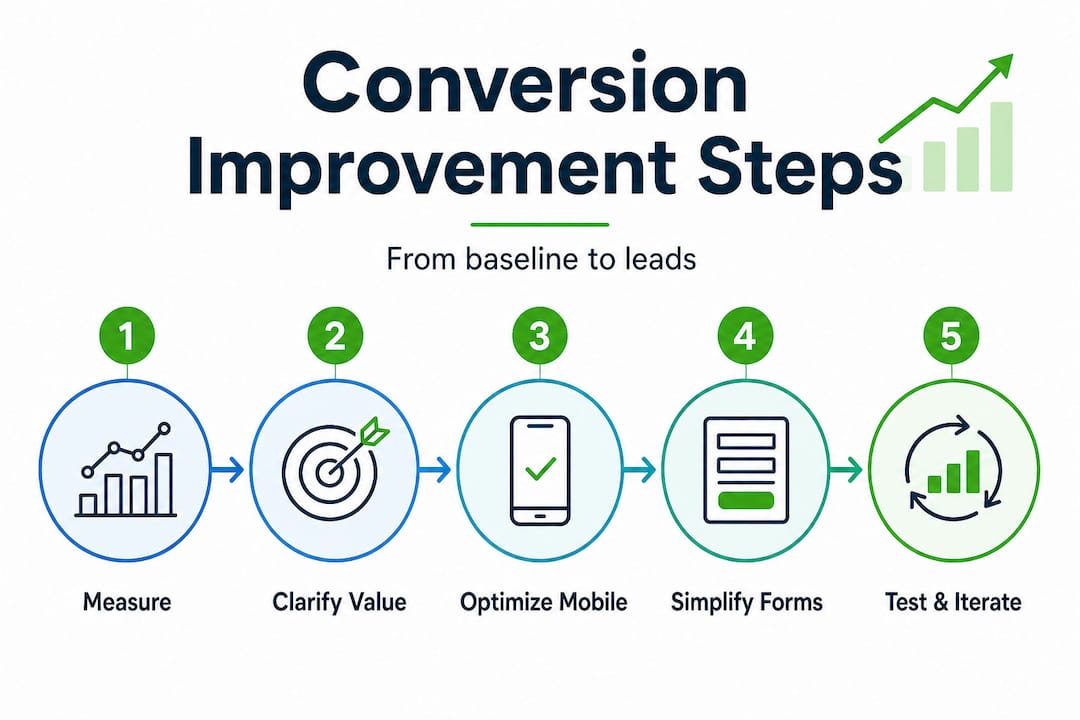
- Assessing your current website conversion rate
- Crafting a compelling value proposition above the fold
- Optimizing your website for mobile users
- Reducing friction in forms and lead capture
- Testing and iterating for conversion gains
- Our take: Why most conversion advice falls short for service brands
- Improve your website conversion rate with expert help
- Frequently asked questions
Key Takeaways
| Point | Details |
|---|---|
| Benchmark conversion rates | Understand your current website conversion rate and compare it to industry averages to set actionable goals. |
| Value above the fold | Place a clear, benefit-focused value proposition in the top section of your website to boost engagement. |
| Mobile-first design | Optimize for mobile by ensuring fast load times, thumb-friendly CTAs, and simple forms. |
| Reduce lead form friction | Keep lead capture forms short and avoid forced account creation to minimize abandonment. |
| Continuous testing | A/B test headlines and CTAs to discover what best converts visitors into qualified leads. |
Assessing your current website conversion rate
Before you can improve your conversion rate, you need to know what it actually is. A conversion rate is simply the percentage of website visitors who complete a desired action, like submitting a contact form, booking a consultation, or calling your office. The formula is straightforward: divide total conversions by total visitors, then multiply by 100.
To measure this accurately, you should have Google Analytics or a similar platform connected to your site with goal tracking enabled. Every form submission, phone call click, or appointment request should be tagged as a conversion event. Without this setup, you’re essentially flying blind on whether any of your optimization efforts are paying off.
| Sector | Average conversion rate | Top 10% benchmark |
|---|---|---|
| ABA therapy / professional services | 1.5% to 7.4% | 3.5% to 5%+ |
| Home services | 2% to 5% | 5%+ |
| Dental practices | 2% to 4% | 4.5%+ |
| All industries average | 1.5% to 3.34% | 3.5%+ |
Industry benchmarks show that the top 10% of service sites consistently hit 3.5% or higher. If you’re sitting below 2%, there’s meaningful room to grow.
Once you have your baseline, diagnose the root cause of underperformance. Start by reviewing these common signals:
- High bounce rate: Visitors leave without engaging. Work through bounce rate reduction strategies to understand why.
- Low time on page: Content isn’t holding attention or answering visitor questions.
- Drop-off at the form: Traffic reaches your lead form but leaves before submitting.
- Low mobile engagement: Mobile visitors convert at much lower rates than desktop users.
Your SEO web design structure also plays a direct role. A poorly organized site creates confusion, and confused visitors don’t convert. Review your site architecture and page load times alongside conversion data. For SEO improvement, technical health and conversion health are closely linked. Reviewing a conversion optimization guide for SMBs can also help you prioritize which issues to fix first.
Crafting a compelling value proposition above the fold
With your baseline established, your next priority is what visitors see the moment they land on your page. “Above the fold” refers to everything visible before scrolling. If your value proposition isn’t crystal clear in that space, you’re losing visitors before they even consider your service.

A value proposition answers three questions instantly: What do you offer? Who is it for? Why should they choose you over anyone else? For a dental practice, that might be “Same-day appointments for families in [City]. No waitlist.” For a home service company, it could be “Licensed plumbers available 24/7 in under an hour.”
Research on CRO best practices confirms that a clear value proposition above the fold, using F or Z-pattern layouts, is one of the highest-impact changes you can make. The F-pattern works well for text-heavy pages where users scan headings and first sentences. The Z-pattern works better for pages with visual elements, guiding eyes from the logo to a headline to a CTA button.
The table below shows the key difference between benefit-focused and feature-focused headlines:
| Headline type | Example | Why it works |
|---|---|---|
| Feature-focused | “ABA therapy with BCBA-certified staff” | Informs but doesn’t connect emotionally |
| Benefit-focused | “Help your child thrive with personalized ABA therapy” | Speaks to the parent’s goal directly |
| Benefit-focused | “Get your HVAC fixed today, guaranteed” | Resolves anxiety and adds trust signal |
Benefit-focused headlines outperform feature-focused ones in most service contexts because they speak to what the visitor actually wants, not just what you provide. Your content marketing approach should reinforce this messaging throughout every page, not just the homepage. Review your web design layout to confirm the visual hierarchy directs eyes to your primary call to action.
Pro Tip: Use a free heat map tool like Hotjar on your homepage for two weeks. If the heat map shows most clicks going to your navigation menu rather than your CTA button, your value proposition isn’t strong enough to pull visitors toward conversion.
Optimizing your website for mobile users
After building instant value above the fold, you have to serve visitors where they actually browse, and that’s overwhelmingly on mobile devices. For ABA therapy intake coordinators, dental office managers, and homeowners searching for services, mobile is often the first and only screen they use.
Desktop vs. mobile conversion rates tell an important story: desktop typically converts at 3.2% to 3.9%, while mobile lags at 2% to 3.5%. Every 100 milliseconds of additional page load time reduces conversions by 7%. That makes speed a direct revenue issue, not just a technical preference.
Here’s a numbered checklist for mobile conversion optimization:
- Compress all images using tools like TinyPNG or Squoosh before uploading to your site.
- Place your primary CTA button in the thumb zone, roughly the lower third of the screen, so it’s easy to tap without repositioning the hand.
- Use single-column forms on mobile. Multi-column layouts force awkward horizontal scrolling.
- Enable click-to-call so your phone number is tappable directly from search results and landing pages.
- Minimize render-blocking scripts by deferring JavaScript loading until after the main content loads.
- Set font sizes at 16px or larger so users don’t have to pinch and zoom to read your content.
Your responsive web design setup is the foundation of mobile performance. A responsive site isn’t just about fitting different screen sizes. It also means rethinking layout priorities for touch-based navigation. Check your technical SEO checklist for additional speed and performance factors that affect both rankings and conversions simultaneously.
Pro Tip: Use Google’s free PageSpeed Insights tool and Google Search Console’s Core Web Vitals report together. PageSpeed gives you technical recommendations, while Core Web Vitals shows you real-world performance data from actual visitors. Address issues flagged in both.
Reducing friction in forms and lead capture
A seamless mobile experience still depends on your lead capture forms being as easy as possible to complete. Form friction is one of the most underestimated causes of lost leads, especially in service businesses where the intake process already feels complex to potential clients.
The data is clear on this point. Forced account creation causes 26% of potential leads to abandon a form entirely. For a dental practice asking new patients to create a portal login before requesting an appointment, this is a significant barrier. Let people submit their information without requiring registration first.
Beyond the login issue, focus on reducing the number of required fields. In most cases, you only need a name, phone number or email, and a brief description of the service needed. Everything else can be gathered after the initial contact is made.
“Progress indicators in multi-step forms increase completion rates by 8% to 12%, while transparent communication about next steps reduces form abandonment by 30% to 45%.”
Friction points to eliminate from your forms right now:
- Requiring a phone number AND an email when one is sufficient for initial contact
- CAPTCHA on every form submission that creates extra steps for genuine leads
- Vague submit buttons that say “Submit” instead of something action-oriented like “Request my free consultation”
- No confirmation message after submission, leaving visitors unsure if it worked
- Long dropdown menus for service selection when a short text field or two radio buttons would work just as well
- No autofill support, which forces mobile users to type every field manually
Your service booking strategies and even your footer design can support conversion by making contact information and quick-action links easy to find from anywhere on the page. An optimized footer with a secondary CTA and phone number captures visitors who scroll all the way down but didn’t act on the main CTA.
Testing and iterating for conversion gains
Once you’ve reduced friction and optimized the fundamentals, the next step is systematic testing. This is where many service businesses stop short. They make one round of improvements and then move on. But conversion optimization is an ongoing cycle, not a one-time project.
A/B testing, where you show version A to half your visitors and version B to the other half, lets you make data-driven decisions about what actually works. According to CRO best practices, testing headlines, CTAs, and form designs consistently yields some of the biggest conversion gains. One documented case showed that shortening a CTA from a full sentence to three words doubled the conversion rate on that page.
Here’s a prioritized order for what to test first:
- Headline on your main landing page. This has the highest exposure and smallest change requirement.
- CTA button text and color. “Get a free estimate” versus “See my options” can produce meaningfully different results.
- Form length. Test a three-field form against a five-field form to measure abandonment differences.
- Hero image or video. Real photos of your team consistently outperform generic stock photos in service industries.
- Social proof placement. Move testimonials above the form versus below it and measure the impact.
- Page layout. Test a single long-form page against a shorter page with a more prominent CTA.
Pro Tip: Don’t call a test complete until you’ve reached statistical significance, typically a 95% confidence level. Most free A/B testing tools like Google Optimize alternatives or VWO’s free tier will calculate this for you. Running tests for less than two weeks or with fewer than 500 visitors per variation gives you unreliable data that could lead to poor decisions.
Keep a running log of every test you run, including the hypothesis, the result, and what you decided to implement. This builds institutional knowledge over time. Staying current with digital marketing trends also helps you identify new testing opportunities before your competitors do.
Our take: Why most conversion advice falls short for service brands
Here’s something most generic conversion guides won’t tell you: the majority of CRO tactics were developed for ecommerce. Adding urgency timers, optimizing cart abandonment flows, and running aggressive popup sequences work well when you’re selling products. They often backfire in ABA therapy, dental, and home service contexts.
Parents researching ABA providers for their children are not impulse buyers. Homeowners with a plumbing emergency need reassurance about who’s coming into their home, not a countdown timer. Dental patients who’ve avoided the dentist for years need to feel safe, not pressured. In these industries, trust signals convert more reliably than urgency tactics.
What we’ve seen work specifically for service businesses is this: lead with proof of competence and human connection. Real staff photos, verified Google reviews featured prominently, clear licensing and certification badges, and transparent pricing information all outperform generic “limited time offer” language. They reduce perceived risk, which is the actual barrier to conversion in personal service industries.
There’s also a lead quality dimension that ecommerce guides completely ignore. For an ABA therapy practice, a lead from a parent who watched a 90-second intake video before submitting a form is worth ten times more than a lead from someone who clicked without reading anything. Slightly higher friction in the form of a qualifying question or a short explainer video can reduce volume but increase the percentage of leads that actually convert to clients.
Effective bounce rate reduction in service businesses is also tied to matching messaging to search intent. If someone searches “ABA therapy for toddlers near me” and lands on a generic therapy page, they bounce. If they land on a page specifically about early intervention services with relevant testimonials, they stay and inquire. Specificity converts.
Improve your website conversion rate with expert help
Getting your website to consistently produce qualified leads takes more than a single round of changes. It requires ongoing attention to SEO, design, user behavior, and testing.
At ChitChat Marketing LLC, we help ABA therapy practices, home service companies, and dental offices build websites and run Google Ads campaigns that are specifically designed to attract and convert qualified leads. Whether you need help diagnosing why your current site underperforms or you want a complete strategy for lead generation growth, our team brings focused experience in your industry. We combine technical SEO, conversion-focused design, and paid search to drive results you can measure. Reach out to explore what’s possible for your specific goals.
Frequently asked questions
What is a good website conversion rate for service businesses?
A typical service sector conversion rate ranges from 1.5% to 7.4%, with top-performing sites reaching 3.5% or higher. Your specific benchmark will depend on your niche and traffic quality.
How can I quickly check if my site is optimized for mobile conversions?
Run your URL through Google’s PageSpeed Insights and check for mobile speed issues, then verify your forms use single-column layouts and your CTA buttons are easy to tap. Loading under three seconds is a strong starting point.
What’s the most common reason visitors abandon lead forms?
Forced account creation causes up to 26% of users to abandon service booking forms. Removing the login requirement and reducing required fields to the minimum necessary both have an immediate positive effect.
How often should I run A/B tests for conversion improvements?
Test high-impact elements like headlines and CTAs continuously as long as you have enough traffic to reach statistical significance. A good rule of thumb is to always have at least one active test running on your highest-traffic pages.
Recommended
- Why Responsive Web Design Is Your Lead-Generation Engine – ChitChat Marketing LLC
- 10 Proven Steps on How to Improve SEO for Website – ChitChat Marketing LLC
- SEO Web Design: Build a Website That Ranks and Converts – ChitChat Marketing LLC
- ABA website SEO guide: boost visibility and grow your practice
- Marketing funnel explained: boost leads and conversions
- Build a lead generation workflow that converts clicks

Thomas Guardado is a seasoned digital marketing and SEO expert with over a decade of hands-on experience helping brands grow their online presence and dominate search results. Based in Connecticut, he specializes in organic search strategy, technical SEO, content optimization, and data-driven campaigns that turn clicks into customers.


Leave a comment