
TL;DR:
- Google rankings for home improvement businesses are driven by proximity, relevance, and behavioral signals.
- Building a focused service area, verified profiles, and unique location pages enhances local SEO presence.
- Consistent, authentic reviews and ongoing engagement are crucial for sustained visibility and credibility.
Posting a few before-and-after project photos and hoping Google notices is a strategy that rarely moves the needle. If your home improvement business isn’t showing up when local homeowners search for your services, the problem isn’t your work quality. It’s your SEO approach. Most contractors focus on the obvious things like keywords and website design while missing the behavioral signals, service area precision, and review quality that actually determine where Google places you in local search results. This article breaks down exactly what drives rankings for home improvement businesses and gives you a clear, practical path to more visibility and more qualified leads.
Table of Contents
- What really drives SEO rankings for home improvement companies?
- Building a winning service area and local presence
- The impact of reviews, behavioral signals, and reputation
- Common pitfalls and advanced SEO considerations
- A fresh take: What home improvement SEO experts get wrong (and what actually works)
- Need expert help? Next steps to elevate your home improvement SEO
- Frequently asked questions
Key Takeaways
| Point | Details |
|---|---|
| Focus your service area | Targeting a well-defined, accurate service area strengthens your local ranking and lead quality. |
| Prioritize review quality | High-quality, authentic, and recent reviews influence both trust and visibility more than sheer volume. |
| Leverage behavioral signals | Google rewards businesses that drive real clicks, calls, and engagement from local searchers. |
| Avoid duplicate content | Create unique pages for each location to maximize relevance and prevent search ranking penalties. |
| Stay consistent | Keep your business info, including name, address, and service area, up to date everywhere online. |
What really drives SEO rankings for home improvement companies?
Now that misconceptions are out of the way, let’s explore what actually influences SEO ranking for home improvement companies.
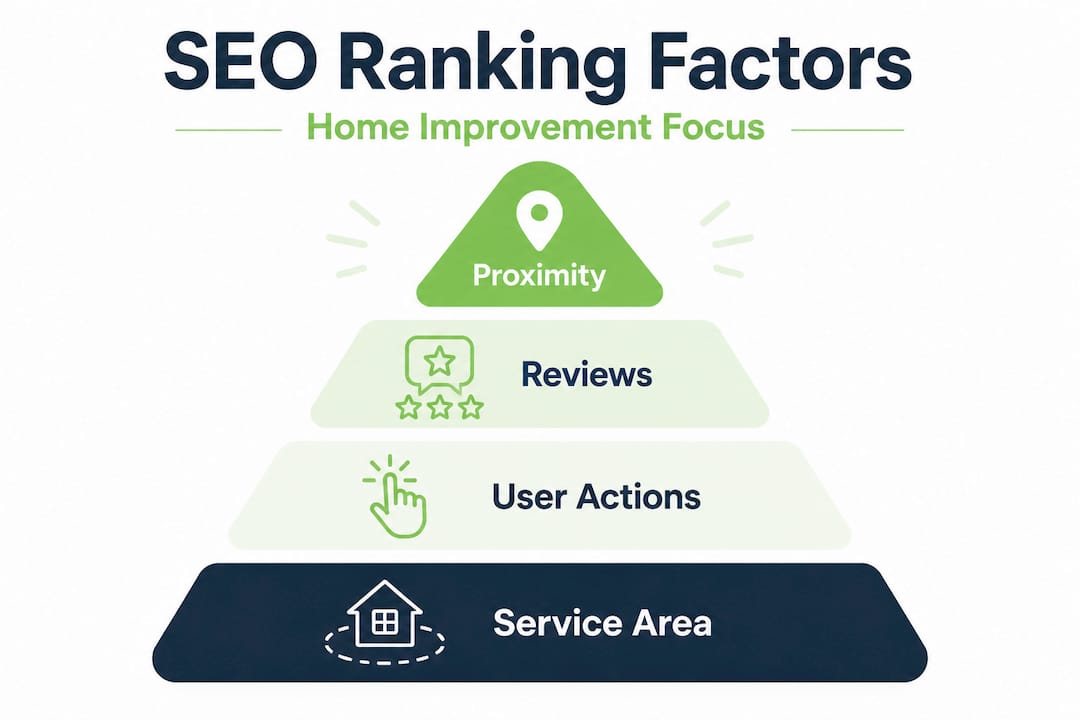
Many business owners assume that simply having a website with the right keywords is enough. It’s not. Google evaluates your business using three core pillars: proximity, relevance, and behavioral signals. Each one plays a specific role in where you appear in local search results.
Proximity refers to how close your business is to the person searching. You can’t control where your customers are located, but you can influence proximity signals by setting accurate service areas on your Google Business Profile. Relevance is about how well your business matches what the searcher is looking for, which means your categories, services, and content need to be precise and specific. Behavioral signals are actions users take after finding you online, including clicks, calls, and requests for directions.
As noted in research on local SEO for contractors, proximity cannot be directly controlled but is influenced by accurate service areas, while behavioral signals like clicks, calls, directions boost rankings significantly.
Here’s what behavioral signals actually look like in practice:
- Click-through rate (CTR): How often someone clicks on your listing compared to how often it appears in results
- Phone calls: Users clicking your phone number directly from Google
- Requests for directions: Map interactions that indicate real intent to visit or hire
- Website visits from Google Maps: Direct traffic from your Business Profile
- Review engagement: How frequently users read and interact with your reviews
“Google treats user behavior as a vote of confidence. When searchers consistently choose your listing over competitors, the algorithm interprets that as a signal that your business is the most relevant and trustworthy option in that area.”
Reviews also play a direct role. Recent, high-quality reviews tell Google that your business is active, trusted, and preferred by real customers. The recency of reviews matters just as much as the total number. A business with 10 reviews in the last month will typically outperform a competitor with 200 reviews from two years ago.
If you want to understand how all of this fits together, the 2026 service area SEO guide offers a detailed breakdown of how service area businesses can optimize each of these factors. For a broader overview, home services SEO best practices walks through the full strategy.
Building a winning service area and local presence
With ranking factors clear, the next step is structuring your local presence for maximum impact.

One of the most common mistakes home improvement businesses make is setting their service area too wide. It feels logical to cast a wide net, but Google’s algorithm actually rewards specificity. When you claim a service area that spans 50 cities, you dilute your local signals across too many locations and end up ranking well in none of them.
Here’s a proven process for building your local presence the right way:
- Define your actual service area. Think about where 80% of your current customers come from. Start there. Set your Google Business Profile service area to match realistic travel distances, typically 15 to 25 miles from your base of operations.
- Claim and verify your Google Business Profile. Verification is non-negotiable. Unverified profiles receive significantly less visibility in local search results.
- Choose the most specific business categories. If you specialize in kitchen remodeling, select “Kitchen Remodeler” rather than just “Contractor.” Precision matters.
- Create unique location pages for each service area. If you serve multiple cities, each location deserves its own dedicated page with original content, local photos, and city-specific service descriptions.
- Keep your NAP (Name, Address, Phone) consistent. Every directory, social profile, and citation must show the exact same business information. Inconsistency confuses Google and reduces your credibility.
Pro Tip: Service-area businesses (SABs) that hide their physical address should still use conservative service areas and create unique pages per location to prevent content duplication from hurting rankings.
| Local presence element | Recommended action | Impact level |
|---|---|---|
| Google Business Profile verification | Complete immediately | High |
| Service area definition | Keep focused and accurate | High |
| Location-specific pages | Create one per major city served | High |
| NAP consistency | Audit all directories quarterly | Medium |
| Business categories | Use the most specific options available | Medium |
| Photos and posts | Update weekly with real project content | Medium |
Multi-location home improvement businesses face an added layer of complexity. Each location needs its own unique page with original content to avoid duplication issues that confuse Google. Copying the same service description across ten city pages is a surefire way to dilute your ranking power.
For more strategies on expanding without losing local relevance, see how to grow your service area reach and review the service area ranking steps that have helped similar businesses improve their local visibility.
The impact of reviews, behavioral signals, and reputation
Beyond service area setup, user behavior and reputation signal your business’s relevance and reliability.
There’s a genuine debate in the local SEO community about whether reviews directly cause higher rankings or simply correlate with them. The honest answer is that causation is still contested, but the correlation is undeniable. Businesses with a strong, steady flow of authentic reviews consistently outperform those with stagnant or minimal review profiles. According to discussion in the local SEO community, the focus should be on velocity and quality rather than chasing a raw volume of reviews.
Here’s a practical comparison of review strategies and their outcomes:
| Review strategy | Short-term effect | Long-term result |
|---|---|---|
| Bulk fake reviews | Temporary visibility boost | Risk of suspension and ranking penalties |
| No review outreach | Slow decline in competitive markets | Low trust signals, poor rankings |
| Inconsistent organic reviews | Moderate visibility | Unpredictable performance |
| Consistent, quality review outreach | Steady rank improvement | Strong trust signals and durable rankings |
Pro Tip: The easiest way to get more real reviews is to send a follow-up message to every completed customer within 24 to 48 hours of finishing the job. Keep the request short and direct, with a link to your Google review page.
Behavioral signals work alongside reviews to tell Google how engaged your audience is. When someone finds your listing, clicks through to your website, calls directly from the search result, and then books a job, that entire sequence sends strong positive signals. To understand how this all fits into the bigger picture, local SEO explained provides a clear breakdown of these mechanics.
Here’s what you should actively encourage and track:
- Calls from your Google Business Profile
- Website clicks from local search results
- Direction requests from Google Maps
- Engagement with your photos and posts on Google
- Responses to questions posted on your profile
The benefits of local SEO go well beyond rankings. A strong local presence also builds offline reputation, increases referral rates, and makes your paid advertising more effective because customers already recognize your name when they see your ad.
Common pitfalls and advanced SEO considerations
While it’s tempting to cast a wide net, avoiding common SEO mistakes ensures your efforts translate into long-term results.
Home improvement businesses often share the same set of avoidable mistakes. Identifying them early saves you time, money, and the frustration of watching competitors rank above you despite having fewer qualifications.
Here are the most damaging pitfalls to watch out for:
- Duplicate location content. Copying the same page content across multiple city pages is one of the fastest ways to lose ranking power. Google prefers unique pages per location with original descriptions, local photos, and city-specific service details.
- Outdated NAP information. If you’ve moved, changed your phone number, or rebranded, every directory listing needs to reflect that change immediately. A mismatch between your website and your Google Business Profile is a credibility red flag that Google takes seriously.
- Over-expanding service areas. Claiming you serve every city in a 100-mile radius might feel ambitious, but it weakens your relevance signals in the areas where you actually do most of your work. Targeted accuracy beats geographic ambition every time.
- Ignoring on-page SEO for service pages. Your individual service pages (roofing, kitchen remodeling, bathroom renovation) need their own optimized titles, headers, and descriptions. A generic “Services” page doesn’t give Google enough specificity to rank you for particular searches.
- Failing to build local citations. Listings on directories like Angi, HomeAdvisor, Houzz, and the Better Business Bureau reinforce your NAP consistency and build authority signals that support your Google rankings.
- Neglecting mobile performance. Most homeowners search for contractors from their phones. Slow load times, broken layouts, or hard-to-click buttons on mobile directly increase your bounce rate (the percentage of visitors who leave without taking action) and hurt your ranking signals.
Use the local SEO checklist to audit your current setup and identify gaps. Once you’ve addressed the basics, exploring the advantages of local SEO will help you see how these fundamentals compound into measurable business growth over time.
The advanced layer involves tracking your local pack rankings (the top three map listings shown in Google search results), monitoring your competitors’ review velocity, and running regular citation audits. These aren’t optional for serious growth. They’re the difference between maintaining your position and slowly losing ground to a competitor who is more deliberate about their SEO strategy.
A fresh take: What home improvement SEO experts get wrong (and what actually works)
Having covered the essentials and pitfalls, let’s challenge some widely accepted wisdom and share ground-level experience.
Most SEO advice that circulates online is either too generic to apply to a roofing or remodeling business specifically, or it pushes tactics that produce short-term results at the expense of long-term credibility. Here’s the uncomfortable truth: a lot of the “quick win” strategies you’ll see recommended in Facebook groups and marketing blogs are built on unstable foundations.
Take the review debate as a concrete example. The local SEO community discussion makes it clear that reviews correlate strongly with rankings, but the causal relationship is still debated. What we know for certain is that businesses caught using fake reviews face listing suspensions and public reputation damage that is very difficult to recover from. The risk-to-reward ratio simply doesn’t favor shortcuts here.
What we’ve seen work consistently is a focus on three things: precise targeting, authentic engagement, and patience. Businesses that define a realistic service area, deliver excellent work, ask every customer for a genuine review, and keep their Google Business Profile active and accurate tend to outperform competitors who spend money on tactics rather than fundamentals.
There’s also a tendency to treat SEO as a one-time project. You optimize your Google Business Profile, build a few pages, and then wait. But local search is competitive and dynamic. Competitors are actively building reviews, updating their content, and earning new citations every week. Standing still is the same as falling behind.
The businesses that win in local search over the long run treat SEO as an ongoing system, not a one-time task. They understand that why local SEO matters goes beyond getting found. It’s about building a sustainable pipeline of qualified leads that doesn’t dry up every time ad spend drops.
Our honest take: the home improvement companies that generate the most consistent leads from SEO are not the ones with the biggest budgets or the most aggressive strategies. They’re the ones who do the basics exceptionally well, stay consistent, and let their real reputation do the heavy lifting.
Need expert help? Next steps to elevate your home improvement SEO
If you’re ready to stop guessing and accelerate real results, here’s how to take the next step.
Knowing what to do and actually executing a complete local SEO strategy are two very different things. Most home improvement business owners are already stretched thin managing jobs, crews, and customer communication. Spending hours optimizing service area pages and monitoring citation consistency isn’t always realistic.

That’s where working with SEO specialists pays off. At Chit Chat Marketing, we help home improvement businesses build the kind of local presence that generates real, qualified leads consistently. From SEO website design for contractors built specifically to convert local traffic, to implementing advanced SEO tips that give you an edge in your market, we take the guesswork out of the process. You focus on the work you’re great at, and we handle the strategy that keeps your phone ringing.
Frequently asked questions
What are the top ranking factors for home improvement SEO in 2026?
Accurate service areas, trusted reviews, and user actions like clicks, calls, and directions are the most influential SEO ranking factors for home improvement companies in 2026.
How often should I update my business information for local SEO?
Update your business name, address, phone, and service areas immediately whenever they change to maintain consistency, since Google prefers verified, consistent business information to determine rankings.
Do fake reviews help SEO rankings?
No. Fake reviews risk penalties and listing suspensions, while authentic, quality reviews built at a steady pace support both trust and long-term rankings.
Should home improvement businesses target many cities at once?
It’s best to define a focused, accurate service area and create unique localized pages for each location instead of overextending across too many cities at once.
Recommended
- SEO For Home Services | ChitChat For Home Service SEO
- Steps on How to Improve Website Ranking on Google Search – ChitChat Marketing LLC
- SEO for Flooring Contractors: Tips to Rank and Get More Jobs – ChitChat Marketing LLC
- SEO for Plumbers | Get More Plumbing Leads & Booked Jobs | ChitChat Marketing
- 50 SEO Marketing Techniques – Part 1 | MB Web
- Optimize local search: Ultimate Guide 2025

Thomas Guardado is a seasoned digital marketing and SEO expert with over a decade of hands-on experience helping brands grow their online presence and dominate search results. Based in Connecticut, he specializes in organic search strategy, technical SEO, content optimization, and data-driven campaigns that turn clicks into customers.


Leave a comment