
TL;DR:
- Content is essential for SEO as it provides the material for ranking and relevance signals.
- Effective SEO content is thorough, strategically keyworded, well-structured, and answers user questions clearly.
- Building topical authority through deep, high-quality content can rank well even with fewer backlinks.
Most marketing managers assume that loading a page with the right keywords is enough to move the needle on search rankings. It is not. Content is foundational to SEO because it gives search engines the material they need to index, rank, and match your pages to real user queries. This article breaks down why content carries so much weight in SEO, what makes it effective, how it connects to backlinks and authority, and how to handle AI-generated content without putting your rankings at risk.
Table of Contents
- Why content matters more than ever for SEO
- What makes content effective for SEO?
- Content, backlinks, and authority: Unpacking the relationship
- Navigating AI-generated content for SEO success
- Our take: What most SEO guides miss about content’s impact
- How to put effective SEO content to work for your organization
- Frequently asked questions
Key Takeaways
| Point | Details |
|---|---|
| Content is SEO’s foundation | Search engines rely on quality content to determine site relevance and authority. |
| Depth and structure win | Longer, well-organized content attracts more traffic, backlinks, and higher rankings. |
| Quality over quantity | High-value, user-focused content outperforms generic posts or keyword stuffing. |
| AI content needs oversight | AI-generated text must meet quality standards and provide unique value to boost SEO safely. |
| Links boost, but don’t replace, content | Strong content naturally earns backlinks, but topical authority can also drive rankings. |
Why content matters more than ever for SEO
Search engines do not rank websites. They rank pages, and they rank them based on what those pages say, how they say it, and how useful that information is to the person searching. If your site does not have content that answers questions, solves problems, or communicates expertise, there is nothing for Google to evaluate.
“Content is foundational to SEO as it provides material for search engines to index, rank, and match to user queries, signaling relevance, expertise, and user satisfaction.” — Google Search Central
This is not a new idea, but it is one that gets overlooked when businesses focus too much on technical fixes or backlink campaigns. Those elements matter, but they amplify content. They do not replace it. A meta-analysis of SEO studies with an effect size of d=1.049 confirms that content quality, keyword optimization, and backlinks together significantly boost organic rankings and traffic. Note the word “together.” One without the others produces limited results.
Here is what effective SEO actually requires:
- Content quality: Original, accurate, and genuinely helpful material that answers user intent
- Keyword optimization: Strategic placement of terms users actually search for, not just volume stuffing
- Backlinks: Third-party endorsements that signal trustworthiness and authority
- Technical performance: Fast load times, mobile responsiveness, and clean site structure
Of these, content is the starting point. You can learn more about SEO-friendly content strategies that work for service and healthcare businesses, or explore SEO foundations with AI to understand how the landscape is shifting.
Pro Tip: Think of your content as the foundation of a house. Keywords, backlinks, and technical SEO are the walls and roof. Without a solid foundation, everything else will eventually fall apart.
What makes content effective for SEO?
Understanding that content matters is one thing. Knowing how to create content that actually performs is another. Not all content is created equal. A 500-word blog post that skims the surface of a topic will almost never outrank a detailed, well-structured page that thoroughly addresses what a user needs.
Research consistently shows that top-ranking pages are 3.5x longer, and deep content drives four times more traffic and attracts significantly more backlinks than thin pages. The first result on Google has, on average, 3.8 times more backlinks than the pages ranked below it. Depth and comprehensiveness are not optional extras. They are ranking factors in practice.
Here are the key characteristics of SEO content that performs:
- It covers the topic thoroughly. Surface-level posts rarely rank. Pages that address a topic from multiple angles, anticipate follow-up questions, and include examples tend to earn more visibility over time.
- It uses keywords strategically. Effective keyword research for SEO means identifying terms your audience actually uses and placing them naturally in titles, H1 headings, and early in the body text. Keyword stuffing does the opposite of what you want.
- It has a strong semantic structure. Using H2 through H4 headings to organize content helps both readers and search engine crawlers understand how your page is organized. This is not just about aesthetics. It directly affects how search engines interpret your content’s meaning and relevance.
- It front-loads answers. With AI-driven features like Google’s AI Overviews pulling direct answers from pages, getting to the point quickly matters more than ever. Put your key answer in the first paragraph of each section.
- It includes internal links and schema markup. On-page SEO steps like internal linking help search engines understand the relationship between your pages and keep users engaged longer.
The SEO Content Optimization Guide from Search Engine Land reinforces that keyword placement in titles and H1s, combined with semantic structure using H2-H4 hierarchy, internal linking, and schema, are the core mechanics that make content rankable.
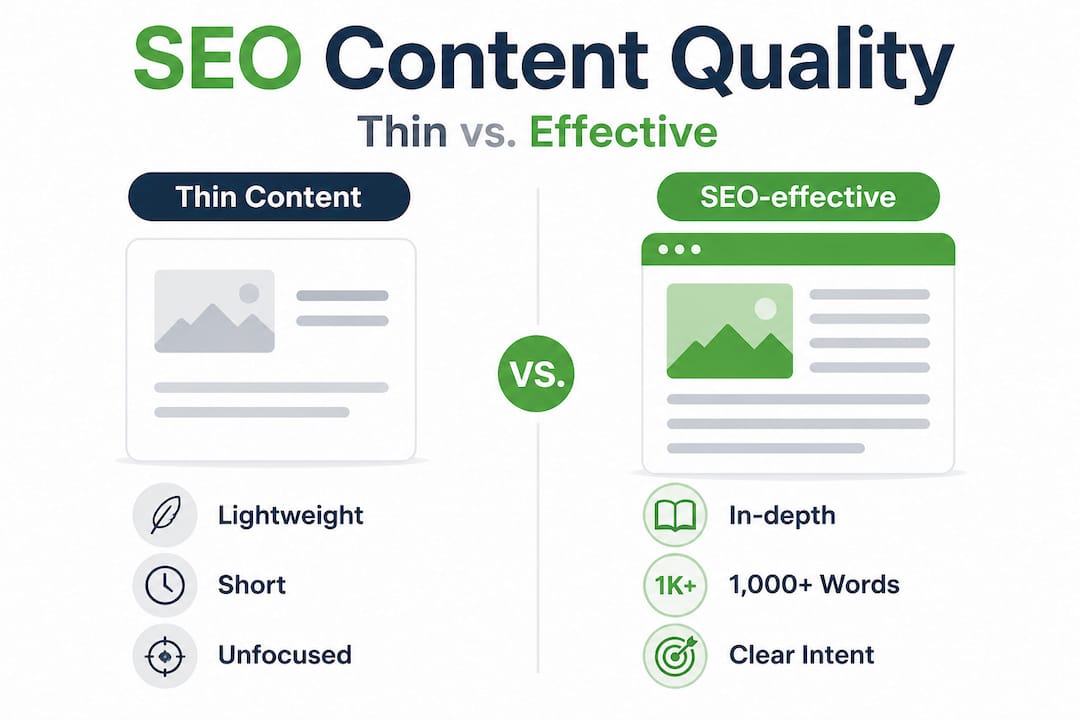
Here is a quick comparison of how effective and ineffective content approaches differ:
| Factor | Thin content | Effective SEO content |
|---|---|---|
| Length | Under 500 words | 1,000+ words with depth |
| Keyword use | Stuffed or absent | Natural, strategic placement |
| Headings | Minimal or flat | H2-H4 hierarchy used properly |
| User intent | Partially addressed | Fully addressed with examples |
| Internal links | None or random | Contextual and purposeful |
| Schema markup | Missing | Implemented where relevant |
Pro Tip: When writing SEO-friendly blog titles, include your primary keyword near the front of the title and keep it under 60 characters so it displays fully in search results.
Content, backlinks, and authority: Unpacking the relationship
There is a persistent belief in many marketing circles that backlinks are the real key to SEO, and content is just the vehicle to get them. The relationship is more nuanced than that.
Backlinks act as votes of confidence. When authoritative websites link to your content, they signal to search engines that your page is credible and worth referencing. And yes, pages with more backlinks rank significantly higher on average. The data backs this up clearly. But here is what the data also shows: deep, quality content is what earns those backlinks organically. No one links to a generic, surface-level page.

However, there is an important counter-narrative worth understanding. Research on backlinks and SEO importance reveals that content scores from SEO tools show a weak correlation to rankings, and that strong topical authority can allow content to rank well even without a large volume of backlinks. In other words, if your site consistently covers a subject area in depth, Google may recognize it as a topical authority and reward your pages accordingly.
This matters for healthcare and service businesses especially. A physical therapy clinic that publishes detailed, accurate content on rehabilitation topics over time can build enough topical authority to outrank competitors with larger link profiles. Quantity of links is less important than the combination of content depth and relevance.
Here is what to focus on when thinking about content and authority together:
- Create pillar content that covers broad topics deeply, and use supporting posts to address specific subtopics
- Avoid chasing content scores from SEO tools as a primary metric. Rankings depend on many signals, and a high content score does not guarantee a top position
- Build internal authority by linking related pages together, which helps distribute ranking power across your site
- Earn links naturally by making your content the most useful, thorough resource on a given topic
“Backlinks amplify good content, but quality content can rank without many backlinks if topical authority is strong.” — Search Engine Land
For more on this balance, explore improving SEO with content and think carefully about using keywords effectively as part of your overall content plan.
Navigating AI-generated content for SEO success
Artificial intelligence content tools have changed how marketers produce content. They are faster and cheaper than hiring writers for every piece. But speed and cost savings mean nothing if the content underperforms or, worse, triggers a penalty from Google.
Google’s official guidance is clear: AI-generated content is acceptable when it meets quality standards and adds genuine value to users. What is not acceptable is using AI to produce scaled volumes of low-quality, repetitive, or misleading content purely to manipulate rankings. That crosses into spam policy violations.
The practical question is not whether to use AI. It is how to use it responsibly. Here is what that looks like in practice:
- Use AI for structure and first drafts, then have a subject matter expert review and add real insight, clinical accuracy, or professional perspective
- Do not publish AI output as-is. Generic content that rephrases existing sources without adding new value does not serve users and does not rank well
- Add original data, case examples, or expert commentary to differentiate your content from what AI alone produces
- Audit your AI-assisted content regularly to ensure it still reflects current information, especially in healthcare where guidelines change
- Match every piece of content to a specific user need, not just a keyword target
For healthcare and service businesses, the stakes are higher because your content often involves decisions that affect people’s health and finances. Accuracy and trust are not negotiable. Learn more about AI search optimization and explore the best AI SEO tools to use wisely in your workflow. If you want to understand how search features are changing, our guide on AI overview in SEO is a good starting point.
Pro Tip: Think of AI as a research assistant, not a content strategist. Use it to speed up production, but always apply your professional expertise to shape the final output. That combination is what builds trust with both readers and search engines.
Our take: What most SEO guides miss about content’s impact
Most SEO guides focus on tactics. They tell you to use keywords in your H1, aim for a certain word count, and get backlinks. That advice is not wrong. But it misses something important.
The businesses we see struggle most with SEO are not the ones ignoring keywords. They are the ones creating content that technically follows the rules but does not actually say anything useful. They write about services in vague, promotional language. They produce blog posts that sound like they were written for an algorithm rather than a person with a real problem.
In healthcare and service industries, this gap is especially costly. A potential patient searching for information about knee replacement surgery is anxious, overwhelmed, and looking for clarity. If your orthopedic practice’s website gives them a promotional paragraph about “world-class care” instead of a clear explanation of what to expect during recovery, they will leave. Your bounce rate climbs, your engagement drops, and your rankings follow.
The SEO wins we see consistently come from content that does one thing well: it treats the reader as a capable adult with a specific need and answers that need directly and completely. That means writing about the real questions your patients or clients ask in appointments, not just the questions that have high search volume.
It also means resisting the urge to over-optimize. When every sentence is constructed around a keyword, the writing becomes stilted and the value disappears. The best writing for ranking and conversion reads naturally because it was written for a human first, with SEO built in rather than bolted on.
The uncomfortable truth is that most SEO underperformance is a content problem, not a technical problem. Fix the content first.
How to put effective SEO content to work for your organization
You now have a clear picture of what makes content work for SEO and where most businesses miss the mark. The next step is turning that knowledge into a content strategy that generates real, measurable growth for your organization.

At Chit Chat Marketing, we help healthcare and service businesses build content strategies that drive qualified traffic, not just impressions. Whether you need SEO web design solutions that give your content the best technical foundation, practical SEO optimization tips to refine what you already have, or a complete comprehensive SEO audit to identify exactly where your site is falling short, we have the tools and experience to help. Let us show you what strategic content can actually do for your visibility and lead generation.
Frequently asked questions
What type of content ranks best for SEO?
Comprehensive content that addresses user intent, uses keywords naturally, and covers topics in depth typically ranks the highest, with top-ranking pages averaging significantly more length and depth than lower-ranked competitors.
Can AI-generated content harm my site’s SEO?
AI-generated content is safe when it meets quality standards and provides real value, but scaled low-quality AI output can be flagged as spam and negatively impact your rankings.
Is backlink building more important than content creation?
Both are essential parts of a strong SEO strategy. Quality content attracts backlinks organically, and topical authority can help content rank well even with fewer inbound links.
How often should I update my website content for SEO?
You should review and update key pages at least quarterly, particularly in healthcare where information changes frequently. Fresh, accurate content signals to search engines that your site is active and reliable.
What is semantic structure in SEO content?
Semantic structure means organizing your content with a clear heading hierarchy, where H2 to H4 headings help both readers and search engines understand the topics covered and how they relate to each other.
Recommended
- How to Write SEO Friendly Content That Ranks and Converts – ChitChat Marketing LLC
- Local SEO explained: boost visibility and drive customers – ChitChat Marketing LLC
- SEO Optimization Tips That Drive Real Business Growth – ChitChat Marketing LLC
- On-Page SEO Checklist: Simple Steps to Rank Higher – ChitChat Marketing LLC

Thomas Guardado is a seasoned digital marketing and SEO expert with over a decade of hands-on experience helping brands grow their online presence and dominate search results. Based in Connecticut, he specializes in organic search strategy, technical SEO, content optimization, and data-driven campaigns that turn clicks into customers.


Leave a comment